Starlink, Strategic Autonomy, and India’s Foreign Policy Blind Spot
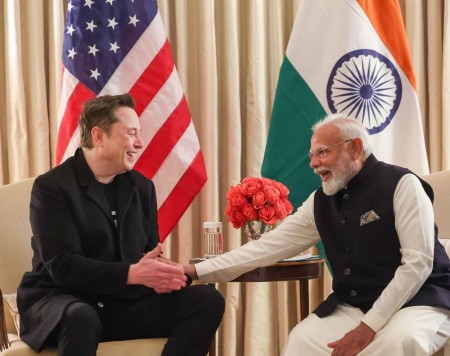
PM Narendra Modi with Billionaire Elon Musk Image credit X.com
By RAVI SHANKER KAPOOR
The reported delay in granting Starlink final approval has reignited debate over whether India’s commitment to strategic autonomy serves its national interests.
New Delhi, June 10, 2026 — Policymaking in New Delhi seems increasingly divorced from reason, common sense, and national interest. The denial of final clearances to Starlink underscores this reality yet again.
The government’s reported reluctance stems from Starlink’s alleged use during the Iran war. This reasoning is difficult to understand. If Elon Musk’s company allowed its services to be used by the United States before or during the conflict, it was merely serving the interests of its home country. Wouldn’t Airtel, Jio, the Tatas, the Adanis, or the Birlas do the same if India were at war?
At any rate, India’s stance evokes the Urdu saying, “Begaani shaadi mein Abdullah deewana”—getting overly excited in an affair where one has no stake. India is not a participant in this conflict, so why should it shape policy in a manner that appears designed to appease the clerical regime in Tehran?
Even though India is not among the belligerents, its neutrality should be informed by reason, common sense, and national interest. Yet what is often described as “strategic autonomy” continues to dominate policymaking. As a result, New Delhi appears more inclined to accommodate Tehran despite longstanding concerns, including tensions involving the Strait of Hormuz and attacks on commercial shipping routes that affect Indian interests.
Strategic autonomy, in many ways, is non-alignment on steroids.
Muskism Review: The Book That Reframes Elon Musk as a System
Supporters of strategic autonomy argue that Iran has supported India diplomatically in the past. That is true to an extent. However, it is equally true that Iran’s leadership has repeatedly made critical remarks about India, often prompting diplomatic protests from New Delhi.
In 2017, Iran’s Supreme Leader appealed to the Muslim world to support what he described as the “oppressed Muslims of Kashmir.” Following the abrogation of Article 370 in August 2019, Tehran urged India to adopt what it called a “just policy” on Kashmir. During the protests over the Citizenship Amendment Act (CAA) in January 2020, senior Iranian leaders also criticised India’s domestic policies.
By contrast, it is difficult to identify a comparable instance of Israel publicly berating India on a major bilateral issue. Israel has consistently supported India’s security concerns, including during the 1971 war, despite the absence of full diplomatic relations at the time.
In fact, Israel has long treated India as a strategic partner, even during decades when New Delhi declined to establish full diplomatic ties. Israel supplied critical military assistance during the 1962 war and the 1971 Indo-Pak conflict. Following the establishment of full diplomatic relations in 1992, defence cooperation expanded significantly, including support during the 1999 Kargil conflict.
Over the past decade, India-Israel defence ties have deepened considerably, with India emerging as one of Israel’s largest defence customers. India has acquired missiles, radars, drones, and electronic warfare systems from Israel. Harop and Harpy drones were reportedly deployed effectively during Operation Sindoor in May 2025.
During Prime Minister Narendra Modi’s February 2026 visit to Israel, both countries agreed to elevate defence cooperation from a traditional buyer-seller framework to one focused on joint development and production. Such a shift could become even more significant if the relationship evolves into a formal strategic alliance.
Yet instead of upgrading relations with Israel, the government appears more concerned with avoiding actions that might upset Tehran. New Delhi’s position on Starlink sends a message that India continues to prioritise an outdated foreign policy doctrine over what many would regard as common sense and national interest.
(This is an opinion piece. Views expressed are the author’s own. Article brought in collaboration with The Hindu Chronicle.)
Starlink vs. Globalstar: Battle between Tim Cook and Elon Musk
Follow The Raisina Hills on WhatsApp, Instagram, YouTube, Facebook, and LinkedIn




About The Author