Muskism Review: The Book That Reframes Elon Musk as a System
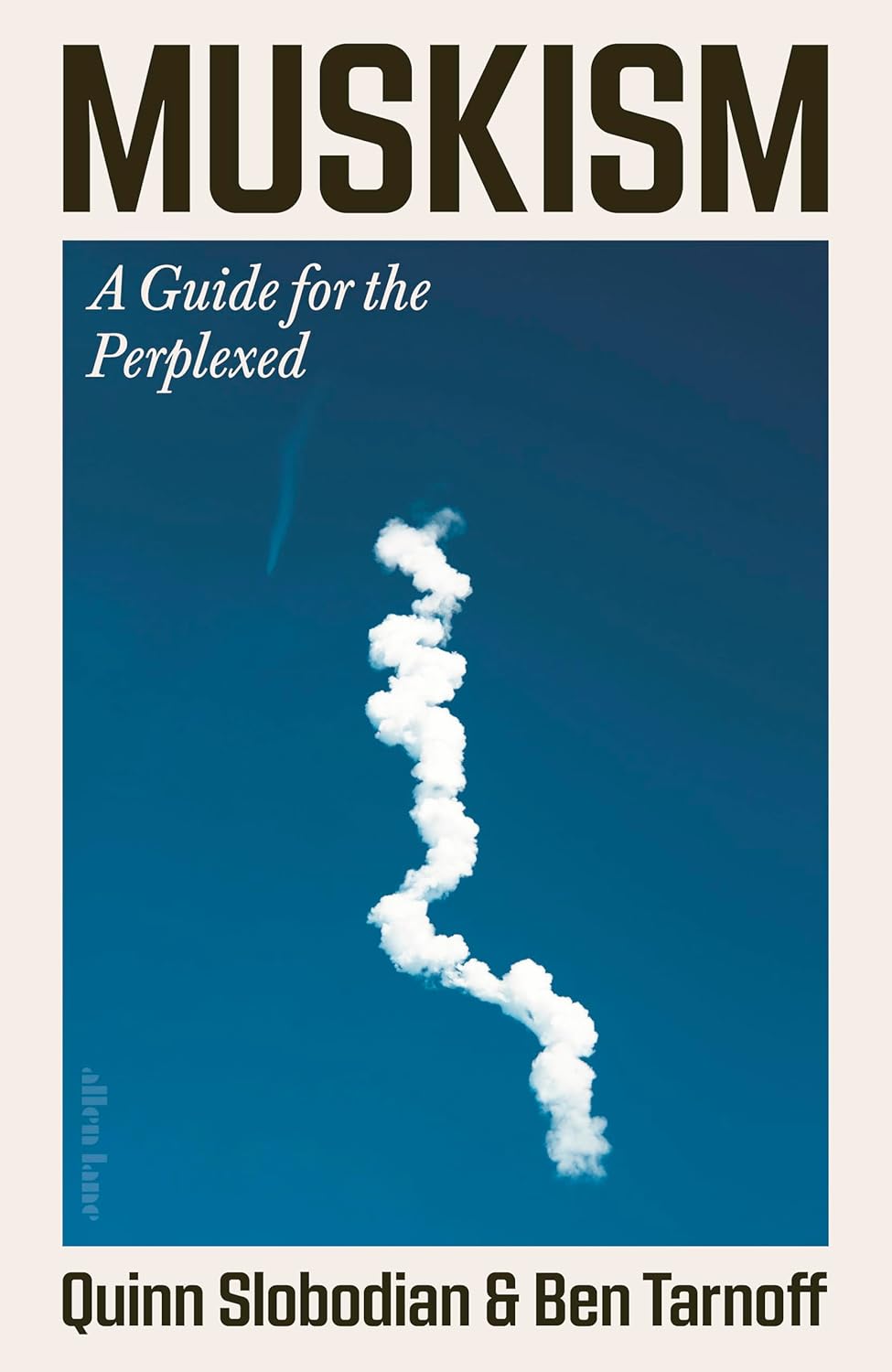
Cover of Muskism A Guide for the Perplexed by Quinn Slobodian and Ben Tarnoff (Image Amazon)
Quinn Slobodian and Ben Tarnoff’s sharp, slim new polemic argues that the world’s most powerful individual is best understood as the world’s most dangerous ideology — and that we had better learn to read it.
By Books Desk | April 22, 2026 | 7 min read
Title: Muskism: A Guide for the Perplexed
Authors: Quinn Slobodian and Ben Tarnoff I Publisher: Harper/HarperCollins (US), Allen Lane (UK) I Published: April 21, 2026 I Pages: 288
Everyone, by now, has an Elon take. He is a visionary. A troll. A genius with the emotional regulation of a toddler. A billionaire patriot. A global menace. The arguments are everywhere and they exhaust more than they illuminate — because almost all of them share the same fundamental error: they treat Musk as a person, a personality, a problem of individual psychology.
Muskism: A Guide for the Perplexed opens by refusing that premise entirely. Elon Musk, Quinn Slobodian and Ben Tarnoff argue, is not a glitch in the system. He is the system. And the ideology he embodies — which the authors name Muskism — deserves to be studied with the same rigour we once brought to Fordism, Thatcherism, or any other worldview that reshaped the political economy of its era.
That reframing is not merely rhetorical. It is the book’s great intellectual contribution, and it lands with considerable force.
Who Are the Authors?
Quinn Slobodian is Professor of International History at the Frederick S. Pardee School of Global Studies at Boston University. His books include Crack-Up Capitalism: Market Radicals and the Dream of a World Without Democracy and Hayek’s Bastards: The Neoliberal Roots of the Populist Right. Ben Tarnoff is a writer and technologist based in Massachusetts and is the author of Internet for the People and co-author of Voices from the Valley. He is a frequent contributor to the New York Review of Books, and has also written for the New York Times, The New Yorker, and The New Republic.
The pairing is deliberate and effective. Slobodian brings the historian’s capacity to situate a contemporary figure within longer currents of political thought. Tarnoff brings a technologist’s fluency with the specific machinery — the satellites, the social networks, the AI systems — through which Muskism is being built in real time. Together they produce something neither could have written alone: a book that is simultaneously an intellectual history, a systems analysis, and an urgent political warning.
The Central Argument
The book’s core thesis can be stated plainly: Musk’s worldview promises sovereignty through technology — plug in, power up, and become self-reliant. But the more you connect, the more he owns you. Muskism sells itself as the future but entrenches age-old hierarchies. It offers autonomy for some and exclusion for others. It’s pro-natalist but anti-immigrant, futurist but reactionary. It speaks of humanity but warns against empathy.
The authors invoke Fordism as their central analogy — deliberately. As Slobodian and Tarnoff write, Musk “is not just a man but the avatar of a worldview: Muskism.” Whereas Fordism was an all-boats-rising form of modernizing, Muskism is a doctrine of wealth for the few and political and economic domination: SpaceX in space, X and Grok online, Starlink on every phone.
The analogy is not casual. If Fordism defined the capitalism of the twentieth century and gave us the welfare state, the forty-hour working week, and mass consumption as a political settlement, then Muskism — the authors argue — is its twenty-first century inversion: a system that thrives on dependence while preaching freedom, that dismantles the public institutions it relies upon to survive.
Apartheid, Family, and the Roots of a Worldview
Much of the book’s early power comes from its treatment of Musk’s formation. The authors resist pop psychology — they are not particularly interested in whether Musk was bullied at school or loves his mother — but they are sharply attentive to the structural conditions that shaped his thinking.
There’s apartheid, with its “rational” system of technocratic authoritarianism, which blended together a life of luxury and plenty for white settlers, brutal surveillance and state violence for the Black majority, and fascist control over speech for everyone, combined with a conscript draft that saw young men of Musk’s age called up to suppress liberation uprisings. Peak apartheid coincided with peak personal computing, offering a young Musk access to a broad world outside of the fascist bubble of South Africa, inspiring global ambitions. Closer to home, there’s Musk’s family: his grandfather, a grandiose and vicious white supremacist who moved to South Africa from Canada because of his love for apartheid and racial hierarchy.
The New York Times Book Review noted that the authors “skillfully guide us through the subsequent decades, as Musk made his fortune and learned some lessons that would become foundational to Muskism.” That is a fair summary of the biographical architecture: this is not a cradle-to-present chronicle but a careful excavation of the intellectual sediment — the lessons Musk absorbed and the conclusions he drew.
The Libertarian Paradox
One of the book’s most insightful passages concerns the central contradiction of Musk’s self-image. He presents himself, consistently and loudly, as a libertarian — a man who hates the state, loves freedom, and trusts markets over governments. And yet his entire empire is built on the state.
As Slobodian and Tarnoff note, Musk may present himself as a libertarian, but his power comes from his interlinkages with the state: without government contracts, there wouldn’t be his space launches or satellites, and Musk wouldn’t be on the path to becoming the world’s first trillionaire.
His electric cars were built on federal subsidies. His satellites run military operations. His social network trains the artificial intelligence that now shapes public discourse. Muskism, they show, speaks the language of crisis and emergency to invoke a less human future: where humans are purged from the productive process and, through social media and video games, merged with the machine. This is a worldview in which the technocrat is king, which piggybacks on the state to achieve supremacy, and in which only a select few deserve salvation.
What the Critics Say
The book has arrived to wide critical attention and largely strong notices — though with some substantive pushback on what it leaves out.
Publishers Weekly gave the book a starred review, calling it “impressive and unrelenting” and noting that it “grapples with a destructive ideology that seems poised to consume everything.”
Booklist found it “pithy and informative from beginning to end,” commending Slobodian and Tarnoff’s ability to recognise the world that produced Elon Musk as well as how he became first an icon and later a political firebrand.
Slate observed that the authors’ “firmer grasp of just what flavor of capitalism Musk and his cohort represent sheds a brighter light on the topic” than many competitors in the rapidly expanding genre of Musk-sceptical literature.
One more measured notice, collected by Book Marks, concluded that while Muskism “makes for bracing reading, and its brevity and subject matter ought to earn it a wide audience,” it would benefit from situating Musk more fully in the broader institutional nest that has allowed him to flourish — and that the book felt “more suggestive than revelatory,” leaving the impression that “the definitive left-wing critique has yet to be written.”
That last point is fair. The book is ambitious but short — 288 pages for a subject of almost limitless complexity. There are moments when the reader wants the argument to slow down, to linger, to follow a thread rather than move briskly to the next. The authors’ efficiency is also a limitation.
A Slim Volume With Outsized Stakes
What Muskism does better than almost anything else currently in print is insist on the systemic over the personal. Into a de-globalizing world comes a promise of sovereignty through technology — but importantly, not for everyone. The institutional breakdown of our era offers an opening for Muskism, Slobodian and Tarnoff warn. At some point, society will stabilize on a new basis, and Muskism could provide the foundation.
That is a chilling proposition, and the authors earn it. By the final pages, the book has shifted the terms of debate. Asking whether Musk is a genius or a fraud, a hero or a villain, feels suddenly beside the point — like arguing about Henry Ford’s personality in 1926 rather than asking what Fordism was doing to the social contract.
The question Muskism presses us toward is more unsettling: not what to make of this particular man, but what kind of world a system built around him would actually produce — and whether we have the political vocabulary, let alone the will, to stop it.
On the evidence of this book, the vocabulary is beginning to form. Whether the will follows is a question only politics, not publishing, can answer.
Muskism: A Guide for the Perplexed by Quinn Slobodian and Ben Tarnoff is published by Harper/HarperCollins. 288 pages.
Books That Travel: Explorers, Talibs & a Dog on the Brahmaputra
Follow The Raisina Hills on WhatsApp, Instagram, YouTube, Facebook, and LinkedIn




About The Author