The Fire That Won’t Go Out: Making Sense of the US-Iran War
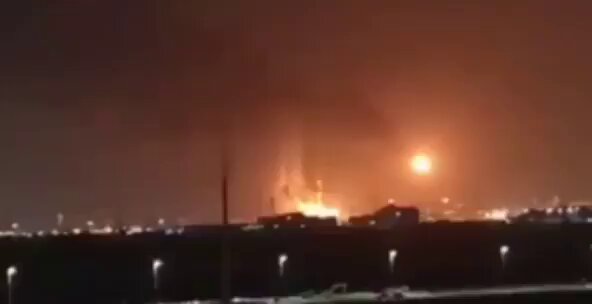
SABIC missile strike by Iran in Saudi Arabia (image X.com)
By TRH World Desk
From the killing of Iran’s Supreme Leader to a collapsing ceasefire, the US-Iran war of 2026 is reshaping the Middle East in ways no bomb can fully control. A news commentary.
New Delhi, June 10, 2026 — Wars are often described as the failure of diplomacy. The US-Iran conflict of 2026 is more accurately the failure of imagination — a collision that most of the world saw coming and few had the will to prevent.
On 28 February 2026, the United States and Israel launched what Washington codenamed Operation Epic Fury: a sweeping air campaign targeting Iran’s nuclear installations, ballistic missile infrastructure, and the command architecture of the Islamic Revolutionary Guard Corps.
The opening salvo was devastating. Iran’s Supreme Leader Ali Khamenei was killed in the early hours of the offensive, decapitating the clerical state and triggering an immediate crisis of succession as his son Mojtaba moved to assert control.
Tehran’s response was swift and wide. Iranian missiles and drones rained down on US military bases and allied facilities from Kuwait to Bahrain to Saudi Arabia, while the Islamic Republic moved to close the Strait of Hormuz — the narrow throat through which twenty percent of the world’s oil supply passes.
Al Jazeera, reporting from Doha, captured the scale of what had been unleashed: this was not a surgical strike but a war with a regional pulse. Iran’s counter-strikes targeted embassies, energy infrastructure, and commercial hubs across the Gulf, dragging the conflict far beyond bilateral confrontation into a theatre-wide emergency.
The Strait’s closure triggered global fuel shortages and cascading economic disruption that extended from Asian markets to European ports.
Iran War ‘Greatest Disaster in American History’: Brig. Anderson
A conditional ceasefire was announced on 8 April 2026, brokered by Pakistan with diplomatic support from Turkey and Egypt. But “ceasefire” has since proven to be a generous word. The April truce has been strained by skirmish after skirmish: US strikes on Iran’s Qeshm Island in early June, Iranian drone attacks that killed civilians in Kuwait, and the IRGC launching retaliatory hits on US bases in the region.
As Al Jazeera reported, Kuwait’s air defences intercepted Iranian missiles and drones, prompting Kuwaiti condemnation of attacks on its sovereign territory. Tehran has made its ceasefire terms plain.
Speaking to the Lebanese broadcaster Al Mayadeen, Iran’s Foreign Minister Abbas Araghchi stated that any end to the conflict must simultaneously include Lebanon — a demand Washington has resisted, leaving the two sides deeply misaligned on the war’s basic terms.
Then came 9 June. Reporting live from the region, Al Jazeera confirmed that a US Army AH-64 Apache helicopter went down near the Strait of Hormuz. American President Donald Trump immediately blamed Tehran, declaring on social media that the US “must, of necessity, respond.”
Within hours, US Central Command announced renewed self-defence strikes on Iran — targeting Qeshm Island, the port of Sirik, Jask, and Bandar Abbas.
Al Jazeera’s correspondent in Tehran reported that Iran was “adamant” about retaliation, and Iranian Foreign Minister Araghchi warned that foreign military forces near Iranian territory were “at constant risk.” Al Arabiya, reporting from Riyadh, noted that Iran had informed international mediators about its position — even as fresh explosions lit up Iran’s southern coastline.
Iran’s state television confirmed that Israeli attacks over the preceding days had killed at least two members of its air defence units, layering the Lebanon theatre on top of an already volatile bilateral exchange.
Arab News reported that the cascading regional toll has been severe, with Gulf Cooperation Council members suffering repeated civilian casualties — a reminder that Washington’s closest partners are absorbing costs from a war they did not initiate.
Writing in Al Jazeera, commentator Mohamed Elmenshawy offered the most sobering assessment: the war may have dealt a heavy blow to the Iranian-aligned Axis of Resistance, but it will not restore Arab public confidence in the United States. Military dominance, Elmenshawy argued, is no longer sufficient to build political legitimacy — a lesson Washington learned imperfectly in Afghanistan and Iraq, and is learning again in real time along the Strait of Hormuz.
What the Apache incident lays bare is that this conflict has no stable floor. Each skirmish produces a response, each response a counter-response, in a cycle that peace talks have so far failed to interrupt.
Iran’s nuclear infrastructure has been degraded and its supreme leader killed — yet the Islamic Republic continues to fight, threaten, and bleed. The fire lit on 28 February will not go out by negotiation alone. But as the rubble accumulates from Qeshm to Kuwait, it is becoming harder for anyone in the region — or in Washington — to pretend it can be extinguished by force either.
Rubio Faces Congress After Iran War Outbreak — And the Answers Are Still Incomplete
Follow The Raisina Hills on WhatsApp, Instagram, YouTube, Facebook, and LinkedIn




About The Author