UPI MDR: India’s Free Digital Payments Model Faces Its First Major Test
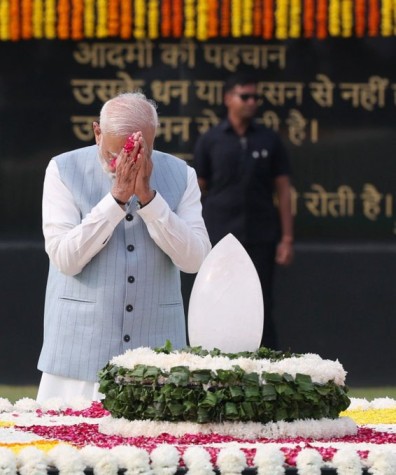
Prime Minister Narendra Modi pays floral tributes to late Atal Bihari Vajpayee (Image Modi on X)
By S. JHA
The new 0.4% Merchant Discount Rate on select UPI transactions above ₹2,000 marks a significant shift in the economics of India’s digital payments ecosystem, even though consumers will continue to make UPI payments free of charge.
Mumbai, September 15, 2026 — India’s Unified Payments Interface (UPI) has been built on a remarkably simple proposition: digital payments should be easy, ubiquitous and effectively free for users. The introduction of a Merchant Discount Rate (MDR) on selected high-value merchant transactions changes an important part of that equation.
From October 15, 2026, a 0.4% MDR will apply to Person-to-Merchant (P2M) UPI transactions above ₹2,000, with the charge capped at ₹300 for transactions of ₹75,000 and above. The policy does not impose a direct charge on consumers. Person-to-person transactions remain free, while UPI applications cannot levy a platform fee on customers.
That distinction is central to understanding the controversy.
Congress president Mallikarjun Kharge has described the move as a departure from the government’s earlier “no fees on UPI” position and questioned whether the cost will eventually reach consumers through higher prices. His criticism reflects a broader concern: once a payment-processing cost is introduced on merchants, the economic incidence does not necessarily end with the merchant.
The government’s argument is different. It sees MDR as a mechanism for making UPI financially sustainable rather than as a consumer tax. The official FAQ says the revenue will support infrastructure resilience, cybersecurity, innovation and customer service. It estimates the annual cost of maintaining UPI’s servers, bandwidth, fraud-prevention systems and banking technology at around ₹20,000 crore.
This creates the first major economic question around UPI: who should pay for the infrastructure behind a public digital payment network?
For years, zero MDR helped accelerate UPI adoption. But the scale of the system has now become enormous. UPI processed 2,451 crore transactions worth ₹29.9 lakh crore in August 2026 alone, according to the NPCI FAQ.
UPI Transactions Soar while Fraud Incidents Call for Caution
At that scale, the argument that the system requires a sustainable revenue model becomes difficult to dismiss outright. Servers, cybersecurity, fraud monitoring, telecommunications infrastructure and bank technology all have recurring costs.
At the same time, introducing MDR creates a different risk. UPI’s competitive advantage has partly rested on its low cost to merchants and consumers. Even a relatively small charge can become significant for businesses operating on thin margins if transaction volumes are large.
The framework attempts to limit that impact. Transactions up to ₹2,000 remain outside the standard MDR, while small merchants under the P2PM category receiving up to ₹1 lakh a month through UPI QR payments are protected by zero-MDR provisions. Certain sectors, including insurance, fuel, telecom and railways, receive a flat ₹5 MDR for transactions above ₹2,000.
The structure therefore appears designed less as a broad UPI fee and more as a tiered commercial model, with the largest burden falling on higher-value commercial transactions.
Former BharatPe CEO Ashneer Grover has challenged the rationale from another direction. He has pointed to RBI surplus transfers to the government, bank profitability and NPCI’s own surplus while questioning why UPI should require another revenue stream. He has also contrasted the cost of UPI with the much higher estimated cost of maintaining India’s cash, ATM and cash-logistics infrastructure.
That argument raises an important policy choice. If UPI is cheaper than cash and traditional card networks, charging merchants could potentially weaken one of the strongest economic incentives behind India’s digital-payment transition.
Yet keeping UPI entirely free also carries a cost. If government subsidies remain the principal mechanism for supporting the ecosystem, taxpayers ultimately finance the infrastructure indirectly. The official framework explicitly argues that government incentives were designed as transitional support rather than a permanent substitute for commercial revenue.
The real test, therefore, will not be whether consumers see a fee on their UPI screens. They will not under the announced framework.
The bigger test will be whether the MDR improves the financial sustainability of UPI without reducing merchant acceptance, increasing operating costs for businesses or weakening the price advantage that helped make UPI India’s dominant digital-payment platform.
India is effectively moving from a “free-to-use” digital public infrastructure model towards a selective commercialisation model.
How that balance works in practice will determine whether the new MDR becomes a sustainable funding mechanism for UPI or the beginning of a broader debate over the economics of India’s digital public infrastructure.
UPI Free-for-All Under Threat? Bankers and Opposition Push Back on Sitharaman’s MDR Defence
Follow The Raisina Hills on WhatsApp, Instagram, YouTube, Facebook, and LinkedIn




About The Author