UPI Was Never Really Free: The Missing Ledger Behind India’s Digital Payments
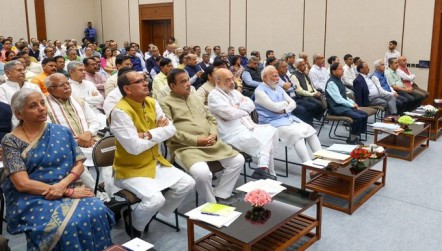
Prime Minister Narendra Modi at the meeting of the Council of Ministers on Thursday. (Image Modi on X.)
By P. SESH KUMAR
India’s UPI ecosystem processes billions of transactions while NPCI generates substantial surpluses. The real question is whether the full cost, revenue and cross-subsidy ledger has been made transparent.
New Delhi, September 17, 2026 — India’s Unified Payments Interface (UPI) has become far more than a payment mechanism. It is national digital infrastructure, a financial-inclusion instrument, a strategic alternative to international card networks and increasingly an element of India’s economic diplomacy. That success has also produced an unusual paradox.
For years, hundreds of millions of Indians experienced UPI as “free”; yet the National Payments Corporation of India (NPCI), which operates the platform, was never working for free. NPCI is a Section 8 not-for-profit company, but Section 8 does not prohibit surpluses: it requires profits to be applied towards the company’s objects and prohibits their distribution as dividends. NPCI has in fact generated substantial recurring surpluses, while earning revenue from payment services, institutional charges and switching fees paid within the banking ecosystem. Its standalone net surplus rose from roughly Rs 423 crore in FY2020-21 to Rs 1,552 crore in FY2024-25; according to financial statements reported in September 2026, it remained strongly surplus-generating at about Rs 1,362 crore in FY2025-26.
These are NPCI-wide figures, not UPI-specific profits, but they materially change the question that ought to precede any debate about Merchant Discount Rate (MDR).
The Government’s September 2026 framework does not impose a charge on ordinary UPI users. Person-to-person payments remain free, small merchants are protected, and the new 0.4 per cent MDR applies only to specified merchant payments above Rs 2,000, with caps and special treatment for essential sectors.
The Government says approximately 96 per cent of merchant transactions remain unaffected and explicitly prohibits UPI apps from imposing platform fees on customers.
Yet the central policy question is now sharper: before adding a new merchant-side revenue stream to an ecosystem whose central utility already earns substantial surpluses, has India published a sufficiently granular account of who currently pays for UPI, who earns from it, what the true net incremental cost is, and precisely where the financing deficit lies?
That question assumes greater significance because Washington has already criticised aspects of India’s payments architecture as favouring domestic suppliers; Europe increasingly embeds transparency, competition and digital-trade disciplines in its economic relations with India; and China’s UnionPay experience demonstrates how payments sovereignty can eventually become an international trade-law issue.
The argument is therefore no longer simply “free UPI versus paid UPI.” It is about the missing ledger beneath free UPI: cost, cross-subsidy, surplus, sovereignty, competition and public trust.
The Miracle Was Never Really Free
UPI’s greatest achievement is not merely that it moves money rapidly. It is that it has made the machinery of moving money almost disappear from the customer’s consciousness.
A vegetable vendor and a department store can display essentially the same QR code. A Rs 30 cup of tea and a Rs 30,000 purchase can travel over the same basic payment rail. The customer does not ordinarily ask which bank is the acquirer, which bank holds the payer’s account, what NPCI charges, what the Payment Services Provider (PSP) earns, or how settlement takes place. By August 2026, UPI was processing about 24.5 billion transactions in a single month, worth nearly Rs 29.82 lakh crore, through 752 live banks.
That extraordinary network effect was built partly on a simple proposition: the customer did not see a transaction fee.
But “free to the customer” was never synonymous with “costless to the system.”
NPCI itself has long charged institutions participating in payment systems. A September 2023 NPCI circular explicitly refers to the “existing NPCI switching fees for UPI merchant payments” while dealing with inter-operability between the digital rupee and UPI QR codes. PwC similarly explained that banks pay NPCI switching fees for UPI transactions even though there was no MDR imposed on the merchant or payment originator under the zero-MDR regime.
That distinction ought now to become the starting point of the MDR debate.
UPI may have been free at the point of use. It was never free throughout the payment chain.
UPI Transactions Soar while Fraud Incidents Call for Caution
NPCI: Not-for-Profit Does Not Mean No Profit
NPCI’s institutional character is central to understanding the economics.
NPCI describes itself as an initiative of the Reserve Bank of India (RBI) and the Indian Banks’ Association (IBA), incorporated because of the utility nature of its functions as a not-for-profit company under Section 25 of the Companies Act, 1956, now Section 8 of the Companies Act, 2013. Its purpose is to provide payment and settlement infrastructure to the banking system. Its ownership has over time been broadened beyond the original promoter banks.
There is sometimes a misconception that a Section 8 company cannot make a profit. That is not the law.
Section 8 expressly contemplates “profits, if any” or other income. What it requires is that those profits be applied towards the company’s objects and that payment of dividends to members be prohibited.
NPCI can therefore earn a large surplus without violating its not-for-profit character. Indeed, a systemically important payments utility arguably requires substantial reserves for servers, redundancy, data centres, cybersecurity, technological renewal, disaster recovery and expansion.
The more interesting question is not whether NPCI may earn a surplus.
It plainly may.
The question is how large a recurring surplus is required for its statutory and institutional purposes, what generates that surplus, and how much additional revenue is needed elsewhere in the ecosystem before merchant charges become necessary.
That is an accounting question before it is an ideological one.
The Numbers Make That Question Impossible to Ignore
NPCI’s finances have strengthened markedly.
Publicly available standalone figures show net surplus of roughly Rs 423 crore in FY2020-21, Rs 769 crore in FY2021-22, Rs 809 crore in FY2022-23, Rs 1,095 crore in FY2023-24 and Rs 1,552 crore in FY2024-25. NPCI’s FY2024-25 standalone revenue from operations was about Rs 3,270 crore, with another Rs 566 crore in other income. Its net worth was reported at approximately Rs 6,412 crore at March 2025.
The latest reported FY2025-26 figures make the issue still more interesting. Moneycontrol, citing NPCI’s annual financial statement, reported that standalone revenue rose another 21 per cent to around Rs 3,969 crore, while net surplus declined by about 12 per cent but remained a substantial Rs 1,362 crore. Higher marketing, depreciation, administration and server costs were cited among the reasons for the decline.
Across those six years, the cumulative standalone surplus is around Rs 6,000 crore. That number should be handled carefully: it is NPCI-wide, embracing the range of payment systems NPCI operates, and cannot legitimately be labelled “UPI profit.” NPCI operates UPI, RuPay, IMPS, NACH, AePS, NFS and other systems, and its revenue streams cannot simply be attributed wholesale to UPI.
Nevertheless, the trend destroys one simplistic proposition: NPCI has not been maintaining UPI solely through charity or annual government support.
It has an established revenue model.
Where Did the Money Come From If UPI Was Free?
This is the apparent contradiction at the heart of the debate.
If users paid nothing and merchants faced zero MDR, how could NPCI generate billions of rupees in annual income?
Because the customer was only one participant in a much larger transaction chain.
NPCI earns revenue from operating payment services and also earns membership, compliance and other operating income. Its rules and circulars demonstrate that switching fees can be collected from participating institutions. Its 2023 UPI circular expressly acknowledges existing NPCI switching fees for merchant transactions.
Government incentives supplied another source of ecosystem support. For FY2024-25, the Union Cabinet approved a Rs 1,500 crore incentive programme for low-value BHIM-UPI merchant transactions. The same official release records earlier Government payouts of Rs 1,389 crore in FY2021-22, Rs 2,210 crore in FY2022-23 and Rs 3,631 crore in FY2023-24 for the combined RuPay debit-card and BHIM-UPI incentive programme. The Government explained that incentive money paid initially to the acquiring bank was then shared among other ecosystem participants, including the issuing bank, PSP bank and app provider.
Thus the economic structure was never:
customer pays zero → nobody earns anything.
It was closer to:
customer pays zero → costs and revenues are redistributed elsewhere through institutional fees, Government incentives, cross-subsidisation, scale economies and revenues from other services.
That distinction is fundamental.
UPI Free-for-All Under Threat? Bankers and Opposition Push Back on Sitharaman’s MDR Defence
The Missing Ledger
Once that distinction is recognised, the most important question raised by the new MDR is not whether 0.4 per cent is “too much.”
It is whether the public has been shown the full economic ledger demonstrating why an additional revenue stream is necessary.
The Parliamentary Standing Committee on Finance argued that the zero-MDR ecosystem faced a structural sustainability problem and that Government incentives covered only a fraction of claimed industry costs. Its 32nd Report called for a viable revenue model rather than perpetual reliance on the exchequer.
That is a serious argument.
But it concerns the whole ecosystem, not simply NPCI.
An issuing bank incurs technology and fraud-control costs. An acquiring bank has merchant-onboarding and settlement costs. PSP banks provide connectivity. Third-party apps maintain interfaces, customer support and risk infrastructure. Payment aggregators serve merchants. NPCI operates the central switching and settlement architecture.
Consequently, NPCI making a surplus does not prove that PhonePe, Google Pay, an acquiring bank or another ecosystem participant is adequately compensated.
But the converse is equally important: an industry assertion that the ecosystem costs Rs 20,000 crore or more annually does not by itself establish the efficient cost that society should recover through MDR.
The unanswered analytical question is therefore: What does one incremental UPI transaction actually cost, who incurs that cost, and how much of it is already recovered through existing revenue?
Until that is published with sufficient granularity, the debate risks comparing two aggregates that describe different things: NPCI’s corporate surplus on one side and an industry-wide estimate of ecosystem expenditure on the other.
Gross Cost Is Not the Same as Net Cost
The India Today column, provocatively titled “UPI fee is peanuts. Losing face over peanuts is nuts,” adds a useful dimension here.
The article accepts that payment infrastructure costs money but points out that banks discussing UPI expenditure may not simultaneously count the costs that UPI has displaced: fewer cash transactions, fewer teller interactions, lower cash-management burdens, potentially less ATM servicing and cheaper digital customer acquisition. The article presents this as an opinion rather than a quantified cost study, but the underlying accounting proposition deserves attention.
The economically relevant measure is not simply: servers + apps + banks + cybersecurity = cost of UPI.
A fuller calculation would examine: incremental UPI infrastructure cost minus avoidable costs displaced elsewhere in the banking and cash ecosystem, while also accounting for fraud losses, resilience investment, financial-inclusion gains and the value of formal digital transaction trails.
UPI has not merely added another payments channel on top of an unchanged banking system. It has altered customer behaviour.
If an ATM withdrawal is avoided because a customer makes ten QR-code payments instead of withdrawing Rs 5,000 in cash, the bank incurs UPI costs but may also avoid part of the cost of ATM replenishment, cash logistics and handling.
The magnitude of those savings is an empirical question. The India Today column does not establish the answer. Nor do currently published aggregate industry cost estimates appear sufficient on their own to settle it.
That is precisely why the net-cost question matters.
(This is first of the two-part series. This is an opinion piece. Views expressed are the author’s own.)
UPI MDR: India’s Free Digital Payments Model Faces Its First Major Test
Follow The Raisina Hills on WhatsApp, Instagram, YouTube, Facebook, and LinkedIn




About The Author