Modi at 76: The Challenges May Matter More Than the Achievements
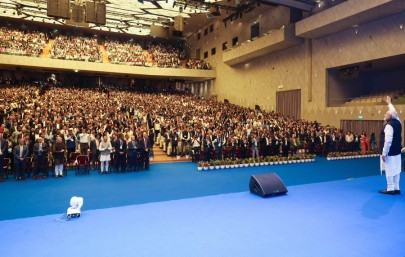
Prime Minister Narendra Modi receives a standing ovation during the inauguration of SEMICON India 2026 at Yashobhoomi in New Delhi on September 17, 2026. (Image BJP on X)
By NIRENDRA DEV
As Narendra Modi turns 76, India’s changing aspirations, economic expectations, unresolved regional issues and a more complex global environment present a different test from the one he faced in 2014.
New Delhi, September 17, 2026 — As Narendra Modi turns 76, the political landscape he inherited in 2014 has changed considerably. The India of 2026 is not the India of 2014, when Modi first became Prime Minister, nor is it the same political environment in which he began his third term in 2024.
For Modi and the BJP, unpredictability has often been an important feature of their political strategy. The party has repeatedly experimented with new faces and political equations. In Nagaland, S. Phangnon Konyak’s election to the Rajya Sabha in 2022 was historic: she became the first woman from the state ever elected to the Upper House.
The BJP also chose Bhupendra Patel, then a first-time legislator, as Gujarat Chief Minister in 2021. Such decisions demonstrated the willingness of the party leadership to take political risks and experiment beyond established expectations.
But the larger question on Modi’s birthday is not simply why his political phenomenon has endured. It is whether the expectations created since 2014 can continue to be met in a substantially changed India.
In 2014, the answer to the Modi phenomenon was relatively straightforward: a powerful public hunger for change. The BJP and Modi presented themselves as agents of transformation at a time when a large section of the electorate was dissatisfied with the political establishment. Different social groups attached different aspirations to Modi. That ability to embody multiple aspirations became a defining feature of his appeal.
More than a decade later, the aspirations themselves have changed.
Young Indians entering adulthood today have grown up with smartphones, WhatsApp, expanding digital services and an India far removed from the era of routine power cuts and limited connectivity. Their expectations are increasingly shaped by opportunity, mobility, employment, technology and quality of life.
This makes employment and economic opportunity central to the next phase of governance. The question is not merely whether India is growing, but whether growth is creating sufficient opportunities for individuals to develop according to their abilities and aspirations.
The political debate around the protests and public mobilisation of 2026 also deserves careful attention. Whatever one’s interpretation of these developments, they demonstrate that questions of education, employment, economic opportunity and accountability remain politically significant.
India’s external environment has also become more complicated. The BRICS summit hosted by India in 2026 underlined the importance of strategic autonomy, but BRICS cannot by itself resolve India’s bilateral or economic challenges. Maintaining working relationships with Russia, Iran, China, the United States and other major powers requires careful balancing. BRICS also brings together countries with different political systems, economic models and strategic interests.
On his birthday, therefore, the more useful question may be: why does Modi’s political phenomenon continue to thrive, and what does that success demand from him now?
Expectations remain high, and they are closely associated with Modi himself. His supporters continue to associate him with decisive leadership, national security and India’s projection abroad. His emphasis on cultural nationalism and Hindutva remains central to his political identity, while critics argue that these politics have contributed to greater social polarisation.
Yet unresolved challenges remain. The Naga peace process continues to demand attention, while Manipur’s prolonged crisis has posed a serious governance challenge. Urban India faces persistent problems ranging from pollution and sanitation to congestion and inadequate infrastructure.
Modi’s greatest political strength may therefore also create a responsibility: the ability to take decisive decisions must be accompanied by institutional consultation, expert engagement and effective implementation.
Achievements will continue to define the Modi era. But at 76, the harder test may be whether the government can acknowledge shortcomings, correct course where necessary and build delivery mechanisms capable of matching the expectations created over the past twelve years.
The future historical assessment of Narendra Modi will ultimately depend not only on what he achieved, but also on how he responded to the challenges that emerged after those achievements.
(This is an opinion piece. Views expressed are the author’s own.)
Modi at 76: Why Governance Is Emerging as His Next Big Challenge
Follow The Raisina Hills on WhatsApp, Instagram, YouTube, Facebook, and LinkedIn




About The Author