West Bengal Budget Under Pressure: Welfare Promises Meet a ₹40,000-Crore Funding Gap
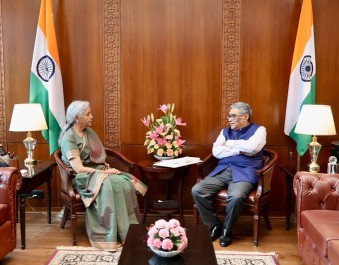
West Bengal Finance Minister Swapan Dasgupta with Union Finance Minister Nirmala Sitharaman in New Delhi. (Image Dasgupta on X)
By P. SESH KUMAR
Annapurna, higher DA, jobs and welfare payouts are adding pressure as central grants lag and capital spending falls sharply, raising questions over how the numbers will hold.
New Delhi, September 2026 — West Bengal’s 2026-27 Budget is built around a striking combination of higher welfare payouts, increased dearness allowance, new employment commitments and a projected surge in capital expenditure. But the State’s own early-year accounts raise a more difficult question: where will the money come from?
Lakshmir Bhandar paid Rs 1,500 to Rs 1,700 a month to roughly 2.21 crore women and cost Rs 26,700 crore in 2025-26. Annapurna Yojana, notified on 19 May 2026, replaces it with a flat Rs 3,000 a mmonth-Rs 36,000 a year, regardless of category–and is allocated Rs 36,000 crore.
Following re-verification against the Special Intensive Revision (SIR) of electoral rolls, about thirty lakh entries were dropped as deceased, shifted, duplicate, absentee or otherwise ineligible, and the State’s own working expectation is that the roll will settle at around two crore beneficiaries once the registration window closed on 25 August 2026.
The first instalment on 3 June reached 28,25,769 women; by 1 July, on the government’s own announcement, some 1.3 crore had been paid.
Two crore women at Rs 3,000 a month is Rs 72,000 crore a year. The allocation is exactly half of that. Allow generously that payments run only from June, ten months of the financial year, and two crore beneficiaries would still cost Rs 60,000 crore.
Let us take the coverage actually achieved by 1 July and freeze it there–1.3 crore women, Rs 3,900 crore a month–and ten months costs–39,000 crore, which already exceeds the provision. On the budget’s own numbers and the government’s own coverage target, Rs 36,000 crore buys roughly nine months for 1.3 crore women, or six months for two crore.
I may be wrong in either direction. The roll may settle well below two crore; the deletions may go deeper than thirty lakh; supplementary demands may be brought in the winter session, as they routinely are. But one of three things must be true:
- the beneficiary roll will end up dramatically smaller than the State has said it expects, or
- the transfer will not be paid for twelve months in 2026-27, or
- the House will be asked later in the year for money the budget did not disclose when the deficit numbers were being celebrated.
The re-verification exercise is therefore not an administrative housekeeping detail appended to a generous scheme. On this arithmetic it is load-bearing.
- The honorarium tier, and Rs 900 crore of headroom
The DA hike is the budget’s most audible promise: 20 percentage points, taking the rate from 18 to 38 per cent, with matching dearness relief for pensioners. It takes effect on 1 October 2026–half the financial year–and the Chief Minister has conceded that a twenty-two point gap against the central rate survives even after it.
The salaries head rises Rs 9,257 crore, from Rs 73,047 crore to Rs 82,304 crore, or 12.7 per cent. On a wage bill of that size, twenty points of DA on basic pay for six months plausibly absorbs most of that increase on its own, which leaves very little for one lakh new recruits –arithmetic that closes only if recruitment is heavily back-loaded within the year, which the phrase “in phases” permits.
Pensions tell a starker story: the head rises Rs 788 crore, three per cent, in a year when dearness relief for pensioners is to rise by twenty points from October in a State that never adopted the National Pension System. I cannot reconcile those two facts, and I do not think the budget tries.
Underneath the salaried establishment sits a second tier that the committed-expenditure table does not capture at all, because honoraria are not salaries. On budget day the government also
- raised monthly allowances for senior citizens, widows and persons with disabilities by Rs 500;
- gave civic volunteers, village police, green police personnel and home guards Rs 2,000 more a month;
- gave ASHA workers Rs 5,000 more;
- fixed contractual State Transport Corporation conductors at Rs 16,000 a month;
- earmarked Rs 550 crore for free bus travel for women under a Pink Card; and
- announced the Bharosa Karmosuchi from October, paying graduate job-seekers up to Rs 3,000 a month and other unemployed youth Rs 2,000.[21]
In a State where the previous government’s unemployment allowance drew something like 27.8 lakh applicants, that last commitment alone is capable of running into several thousand crore a year once it matures.
Where is it all provided?
The Social Welfare and Nutrition head rises Rs 10,198 crore, from Rs 53,696 crore to Rs 63,894 crore. Annapurna’s own increase over the Rs 26,700 crore spent on Lakshmir Bhandar is about Rsx9,300 crore of that, and old-age pension under Jai Bangla takes Rs 8,151 crore.
By my subtraction that leaves on the order of Rs 900 crore of headroom in the head for everything else announced. Some of these items will sit elsewhere–the bus subsidy in Transport, the job-seekers’ allowance conceivably in Labour–and I have not traced each to its demand for grants. But the pattern is unmistakable and it is the same pattern as Annapurna: the promises were made in June and the money for them will have to be found in December.
What is unambiguous is what is missing.
Nowhere in the committed-expenditure heads is there a provision that can be attributed to the Supreme Court’s arrears judgment. The quantum was left to the Malhotra committee to determine; the budget tabled three months after the first instalment fell due provides for the prospective hike and is silent on the adjudicated past. A government may reasonably say it cannot budget a figure not yet determined. An auditor’s answer is that the correct treatment of a liability certain in existence and uncertain in amount is disclosure, not omission–and that presenting a halved revenue deficit while the largest judicially enforceable claim against the exchequer sits outside the document is a presentation problem, not a timing one.
This is the deferral that matters most. The DA begins in October, the jobs come “in phases,” the Bharosa allowance starts in October, and the arrears are not there at all. Nineteen months from now, a full year of thirty-eight per cent DA, a full complement of a lakh of employees, a matured job-seekers’ allowance and a court-supervised instalment schedule will all land in the same financial year.
The third forty-thousand crore
Capital outlay is budgeted at Rs 40,930 crore, up 55 per cent. The same head was budgeted at Rs 35,866 crore in 2024-25 and delivered Rs 21,621 crore; budgeted at Rs 39,338 crore in 2025-26 and revised to Rs 26,439 crore, with water supply and sanitation cut 82 per cent and welfare of Scheduled Castes, Scheduled Tribes and minorities cut 64 per cent.
This is the third consecutive promise of about Rs 40,000 crore. Much of the increase is a restoration of the very heads that collapsed last year–water supply and sanitation returns to Rs 15,402 crore, with Rs 8,703 crore of capital outlay–which is to say it is the same centrally sponsored money reappearing on the assumption that it will now arrive.
The pattern extends to the parts of the budget that read most ambitiously. The Sundarbans embankment work, the Ghatal flood master plan, the Upper Delta project and the riverfront scheme are financed by the World Bank, the Asian Development Bank or centrally sponsored schemes rather than the State’s capital budget, while the dedicated Science, Technology and Environment head is Rs 197 crore for the whole year–less than a quarter of what a single elevated corridor in Kolkata gets.
Sixty-nine per cent of the budget has been mapped to the Sustainable Development Goals (SDG) in Budget Publication No. 31, about Rs 3.01 lakh crore, and it is a genuine first for the State; mapping existing expenditure to goals is nonetheless a labelling exercise, and the environment department’s own allocation is the test of whether it is more than that.
Where Bengal’s Money Goes: The Anatomy of a Stretched Welfare State
The first four months
All of the foregoing is a reading of intentions. Intentions can now be tested, because the accounts have begun to come in.
The Principal Accountant General (A&E), West Bengal publishes a Monthly Key Indicator (MKI), a short unaudited statement of actuals against budget estimates, and the issue for July 2026 covers the first four months of the year the budget describes.[26] It makes short work of the central assumption.
Grants-in-aid received between April and July 2026 total Rs 1,315.48 crore. In April the State received nothing at all–the column reads zero. Over the same four months of 2025-26 it received Rs 2,205.85 crore.
Four months into the year of the double engine, transfers from Delhi are running 40 per cent below the last year of the feud.
The arithmetic of catching up is punishing. To reach Rs 71,393.19 crore, the remaining eight months must yield Rs 70,078 crore, or Rs 8,760 crore every month. The largest single month anywhere in the recent series is Rs 4,934.38 crore, recorded in March 2026 when the year-end rush inflates everything.
Bengal must now average, for eight consecutive months, something close to twice its best month ever. Let us allow for the genuine back-loading of scheme money–only thirteen per cent of last year’s eventual total had arrived by July–and apply the same seasonal shape to what has actually come in, and the year projects to about Rs10,000 crore. That is not a shortfall. It is a different budget.
The same statement disposes of the wage-bill question. Salaries between April and July cost Rs 17,506.36 crore against Rs 12,504.14 crore in the same months last year, a rise of 40 per cent. Pensions cost Rs 11,409.60 crore against Rs 8,642.92 crore, a rise of 32 per cent–62 per cent of the whole year’s provision on the accounting authority’s own budget figure, consumed in a third of the year. Neither number includes a paisa of the dearness allowance that begins in October, or of the dearness relief for pensioners, or of the Supreme Court’s arrears. The pensions head that I could not reconcile in Section VI is not merely tight. It is already spent.
Capital expenditure, meanwhile, is Rs 1,670.06 crore against Rs 3,543.81 crore last year, down 53 per cent, and standing at 4 per cent of the annual provision. Social sector capital expenditure is at 2 per cent. The third consecutive promise of Rs 40,000 crore is failing faster than the first two did. And total revenue receipts for the four months are Rs 64,864.34 crore against Rs 67,931.61 crore last year–the State is not merely short of the increase it budgeted, it is behind where it stood a year ago. The revenue deficit already stands at Rs 11,274.67 crore, which is 52 per cent of the entire year’s target, reached in a third of the year.
One discrepancy in the same document deserves an auditor’s attention rather than a commentator’s. The Monthly Key Indicator (MKI) carries the year’s budget estimate for grants-in-aid as Rs 47,615.46 crore, where the Budget at a Glance laid before the House shows Rs 71,393.19 crore–a gap of ₹23,778 crore.
It is not a case of the accounting office working from the February interim budget, because the interest-payment estimate in the same statement, Rs 53,033.80 crore, matches the June budget to the lakh. Something has been classified differently between the document the Assembly voted and the ledger the accounts are kept in, and the State’s own Finance Department and its own Accountant General are not, on this line, describing the same budget. Until that is reconciled, every percentage of achievement published this year rests on a denominator two authorities disagree about. I cannot resolve it from outside, and I do not pretend to.
The One Number That Could Make or Break West Bengal’s First BJP Budget
Two caveats, plainly. These are unaudited provisional figures, and one treasury was excluded from the July compilation. Four months is a third of a year, scheme releases cluster in the closing quarter, and a political relationship in its first summer may yet open taps that a decade of litigation had rusted shut. None of that touches the direction of travel. The question is whether a budget could be built on a forecast of somebody else’s generosity. By July the forecast was not merely unmet; it was moving the wrong way.
Three pipes, not one
Before the question can be answered, an apparent contradiction has to be cleared away, because a careful reader will already have spotted it. How can this note say in one breath that central grants to Bengal have risen 224 per cent, and in the next that the Finance Commission has cut the State’s share and abolished a grant it used to draw? Both statements are true, and they are true because money does not come from Delhi to Kolkata through one pipe. It comes through three, and they were turned in different directions.
The first pipe is tax devolution under Article 270–the State’s formula share of the divisible pool of Union taxes, worked out by the Finance Commission and payable as of right. That is the line in the budget reading Rs 1,10,119.27 crore, and it grew by a limp 3 per cent, because the Sixteenth Finance Commission reduced Bengal’s share from 7.52 per cent to 7.22 per cent.
The second pipe is Finance Commission grants under Article 275–what the Commission awards over and above the tax share. Here Bengal has genuinely lost. Revenue deficit grants, sector-specific grants and state-specific grants have all been discontinued for 2026-31. What survives for the State is Rs 57,095 crore across five years for rural and urban local bodies and disaster management, most of which is a pass-through to panchayats and municipalities rather than money the State may spend as it wishes.[28]
The third pipe is assistance for centrally sponsored schemes (CSS) under Article 282– ministry-by-ministry money for VB-G RAM G, PMAY, the Jal Jeevan Mission, Samagra Shiksha and the rest, released against sanctions and conditions. This is the pipe that has been opened wide: Rs 13,821 crore last year, Rs 62,793 crore this.[4]
The confusion arises because the budget’s Grants-in-aid line is a composite of the second and third pipes. The shrinking part is buried inside the surging part, and the surge is entirely centrally sponsored scheme money. Once the line is unbundled, there is no contradiction at all–only a substitution, and the substitution is the interesting thing.
What the Finance Commission took away was entitlement: formula-driven, awarded for five years by a constitutional body, largely untied in use, and impossible for any minister to withhold.
What has arrived in its place is discretion: money released scheme by scheme, conditional on utilisation certificates, beneficiary verification and a State matching share, and demonstrably capable of being switched off, since it was switched off between 2022 and 2025.
Bengal has swapped a smaller guaranteed stream for a larger revocable one. In this year’s arithmetic that is a gain of some Rs 49,000 crore. In the constitutional structure of the State’s finances it is a step down–Kolkata is now more dependent on the goodwill of the Union executive at precisely the moment the formula gave it less. And tied money dictates its own uses: Rs 62,793 crore of scheme assistance obliges the State to find matching crores of its own and to spend them where the scheme says, not where the State might otherwise choose.
Two Engines, One Tank: How West Bengal’s First BJP Budget Bets on Delhi
(This is the second of the three-part series. This is an opinion piece. Views are the author’s own.)
Follow The Raisina Hills on WhatsApp, Instagram, YouTube, Facebook, and LinkedIn




About The Author