Where Bengal’s Money Goes: The Anatomy of a Stretched Welfare State

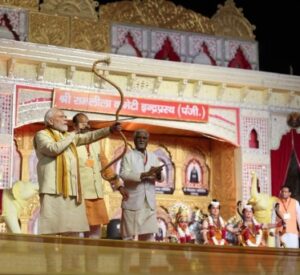
West Bengal CM Suvendu Adhikari with state Governor RN Ravi in Kolkata. (Image Adhikari on X)
By P. SESH KUMAR
West Bengal’s budget tells a deeper story than politics. Every rupee entering the treasury is increasingly consumed by salaries, pensions, welfare schemes and debt servicing — leaving shrinking room for infrastructure and long-term development. An analysis of Bengal’s evolving fiscal vortex.
New Delhi, May 2026 — West Bengal’s budget over the last two years reveals the anatomy of a politically muscular but fiscally stretched welfare state. Every rupee entering the Bengal treasury now carries the weight of debt, subsidies, welfare commitments and interest obligations accumulated over decades. The State’s finances therefore resemble a gigantic revolving wheel- one side stoked by taxation and borrowing, the other consumed by salaries, welfare schemes and debt servicing before fresh developmental momentum can even gather pace.
In simple terms, for every Rs1 that came into the West Bengal government’s coffers during FY 2024–25 and FY 2025–26, roughly 38–42 paise came from the State’s own taxes, around 28–32 paise from the Union Government through tax devolution and grants, about 4–6 paise from non-tax revenues, and an alarming 22–26 paise from borrowings and debt creation. That final component is the key fiscal signal. Bengal increasingly runs not merely on taxation, but on continuous market borrowing.
The biggest contributor to Bengal’s own revenue remains State GST. Consumption taxes, VAT on petroleum products, excise duties on liquor, stamp duties and motor vehicle taxes together form the fiscal backbone of the State. Bengal’s revenue structure therefore depends heavily on urban and semi-urban consumption, real estate transactions and indirect taxation rather than on a deep industrial tax ecosystem. Unlike Maharashtra or Gujarat, Bengal does not possess a giant manufacturing-driven revenue engine. Its fiscal architecture is consequently more vulnerable to economic slowdowns and consumption shocks.
The second major source is the Union Government. Tax devolution under the Finance Commission formula contributes a very substantial share of Bengal’s receipts. Grants under centrally sponsored schemes, Finance Commission transfers and other Union-linked flows also remain critical. This is precisely why the Centre-versus-State dispute over GST compensation, MGNREGA dues and centrally sponsored scheme releases became politically explosive. Bengal’s treasury remains structurally dependent on predictable federal transfers despite its rhetoric of fiscal autonomy.
Borrowings now constitute the fourth major pillar of Bengal’s budget. State Development Loans, negotiated borrowings and other debt instruments increasingly finance not merely infrastructure creation but also fiscal balancing itself. Bengal’s outstanding liabilities have crossed extraordinarily high levels relative to GSDP. Debt has therefore ceased to be a temporary adjustment mechanism; it has become embedded into the State’s operating model.
But where does Bengal’s rupee go?
This is where the fiscal strain becomes brutally visible.
For every Rs 1 spent by the State during the last two years, nearly 22–26 paise went toward salaries, wages and administrative expenditure. Another massive chunk — roughly 16–20 paise — disappeared into pensions and retirement liabilities. Bengal’s government machinery itself has become an enormous recurring fiscal commitment.
Then comes the most worrying component: interest payments. Roughly 18–20 paise of every rupee spent by Bengal now goes merely toward servicing past debt. In other words, a significant part of today’s tax collections is being consumed not for creating new assets or welfare expansion, but simply for paying the cost of yesterday’s borrowings. This is the classic signature of a debt-heavy fiscal regime.
Welfare schemes and subsidies absorb another enormous slice of expenditure. Lakshmir Bhandar, social pensions, subsidised food support, rural transfers, healthcare commitments and other welfare interventions together consume nearly 20–24 paise of every rupee spent. Politically, these schemes are now deeply entrenched and electorally non-negotiable. Economically, however, they make expenditure compression extraordinarily difficult during periods of fiscal stress.
The most uncomfortable reality emerges when one examines capital expenditure. Despite ambitious budget speeches promising roads, infrastructure, logistics, industrial corridors and irrigation projects, actual capital spending often remains far below projected levels. In several years, Bengal sharply compressed capital expenditure in revised estimates while protecting welfare and committed expenditure. As a result, the State increasingly borrows heavily but spends a relatively smaller share on productive long-term asset creation.
This is the central contradiction in Bengal’s fiscal story. The State is not starving for expenditure. It is starving for fiscal flexibility.
The treasury first pays salaries, then pensions, then interest, then welfare obligations- and only whatever remains becomes available for future-oriented development spending. Roads, flood management systems, industrial infrastructure, urban renewal and logistics modernization therefore compete for increasingly narrow fiscal space.
The situation becomes even more delicate because Bengal faces major climate and infrastructure vulnerabilities. Flood control, river management, coastal resilience and urban drainage require sustained capital investment. Yet these are precisely the sectors vulnerable to expenditure cuts whenever deficits widen.
There is another deeper structural problem. Bengal’s non-tax revenues remain disproportionately weak for a State of its size. Public enterprises contribute modestly. User charges remain politically sensitive. Asset monetisation has been limited. Consequently, the State relies excessively on taxation and borrowing while possessing relatively narrow fiscal cushions outside those streams.
And yet, Bengal is not a bankrupt state.
Its economy remains large. Consumption remains robust. GST collections continue growing. Welfare expenditure has sustained social stability and rural demand. Tax devolution from the Centre still provides substantial inflows. The State retains market access for borrowings. The crisis therefore is not one of immediate collapse.
It is one of gradual fiscal tightening.
West Bengal’s “Where the Rupee Comes From and Where It Goes” story over the last two years reveals a government increasingly trapped in what may be called a “committed expenditure vortex.” Every incoming rupee is substantially pre-allocated before developmental priorities are even considered. Debt servicing, pensions and welfare obligations increasingly dominate the budgetary landscape, leaving shrinking space for transformative capital creation.
That is why Bengal’s fiscal challenge today is not simply about reducing deficits. It is about redesigning the State’s growth model itself. Unless Bengal expands productive industry, strengthens non-tax revenues, protects capital expenditure and slows the relentless growth of committed liabilities, the State risks becoming fiscally functional but developmentally constrained- a welfare-heavy political economy permanently balancing itself on the edge of debt-driven survival.
(This is an opinion piece. Views expressed are the author’s own.)
Bengal’s Budget Tightrope: Welfare, Debt and the Fiscal Trap
Follow The Raisina Hills on WhatsApp, Instagram, YouTube, Facebook, and LinkedIn




About The Author