Fed Holds Rates Steady, Wall Street Sinks as Warsh Speaks
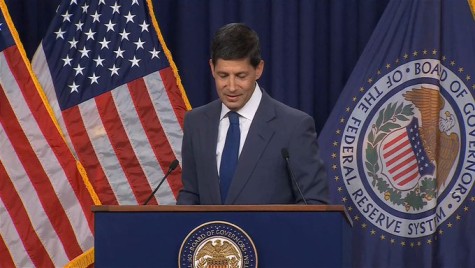
US Fed Chair Kevin Warsh after the July policy meeting holds a press conference. (Image X.com)
By S. JHA
Fed Holds Rates Steady, Warsh Faces Down Dissent as Wall Street Sells Off — Asia Reacts
Mumbai, July 30, 2026 — The Federal Reserve wrapped up its July policy meeting on Wednesday by holding the benchmark rate at 3.50%–3.75% for a fifth straight meeting, extending a pause that has now stretched deep into 2026. It wasn’t a clean vote. Three FOMC members broke with the majority to push for a rate hike instead, one of the more contested splits the committee has produced in years.
Fed Chair Kevin Warsh, in only his second full meeting cycle at the podium, leaned into the disagreement rather than downplay it. Speaking to reporters, he described the split decision as the result of wanting “a good family fight,” and said he got one. At the same briefing, Warsh cautioned that markets are useful for gauging sentiment but shouldn’t be treated as a definitive guide for policy.
The committee’s post-meeting language pointed to a familiar tension: solid growth data running up against inflation that refuses to settle back toward the Fed’s 2% target, aggravated by rising energy costs tied to the conflict between the U.S. and Iran.
Wall Street’s Reaction
Investors didn’t wait for the ink to dry. Equities were already sliding into the 2 p.m. ET decision and extended their losses once Warsh’s press conference ended. By the close, the Dow Jones Industrial Average had shed 1,153.18 points, or 2.19%, to finish at 51,594.14 — its steepest one-day drop since April 2025. The S&P 500 slid 1.52% to 7,316.15, while the Nasdaq Composite fell 1.74% to 24,442.94, putting the tech-heavy index more than 10% below its record high.
Bond markets moved just as sharply. The 10-year Treasury yield jumped 7 basis points to above 4.67%, and the 30-year yield climbed 10 basis points to top 5.2% — its highest level in years. The signal from the bond market was less about the hold itself and more about what it implies: traders increasingly worry the Fed may be a step behind on inflation.
Layered on top of the rate decision was a fresh jolt from the Middle East. Oil prices jumped more than 4% after U.S. and Jordanian forces intercepted another barrage of Iranian missiles aimed at American troops, reigniting fears that a brief lull in the conflict was already over.
What Warsh Hinted Going Forward
Warsh, who took over the Fed chair earlier this year, has drawn a mix of praise and scrutiny from the White House. National Economic Council Director Kevin Hassett recently told CNBC that Warsh’s stewardship of the central bank has “already” proven itself, expressing strong confidence in his judgment. Whether markets share that confidence is another matter — Wednesday’s selloff suggests investors are still parsing whether “steady” from the Fed means “patient” or “behind the curve.”
Asia’s Response
Here’s where the picture gets more nuanced than a single headline can capture. Heading into Thursday’s Asian session, futures for Australia, Japan, and South Korea pointed lower, tracking Wall Street’s overnight losses amid renewed anxiety over AI-related spending and the higher-for-longer signal from Treasury yields.
But the region didn’t move as one bloc. Some markets opened in the red in sympathy with Wall Street’s Fed-driven selloff, while others — buoyed by strong earnings out of the chip sector earlier in the week and a rebound in beaten-down tech names — held gains or opened higher. That divergence is worth flagging for readers: “Asia up today” is true for parts of the region (notably Greater China and Australia in recent sessions) but not a clean, region-wide story, especially with South Korea’s Kospi and Taiwan’s Taiex whipsawing on chip-sector jitters.
Japan was trading higher by over two percent on Thursday. Singapore also traded higher.
Three Threads Tangled
Three threads are now tangled together for markets: a Fed that’s clearly divided on how much longer to hold, a bond market pricing in more inflation risk than officials seem willing to admit, and an oil-price shock from an escalating Middle East conflict that complicates the inflation outlook further. None of that resolves cleanly before the Fed’s next meeting in September — the one meeting where a fresh Summary of Economic Projections and dot plot will actually be on the table.
Zomato Parent Eternal Stock Analysis: Why It’s Climbing and What Charts Say Next
Follow The Raisina Hills on WhatsApp, Instagram, YouTube, Facebook, and LinkedIn




About The Author