Gujarat Congress Eyes Revival as Shankersinh Vaghela Talks of Return Ahead of 2027 Polls
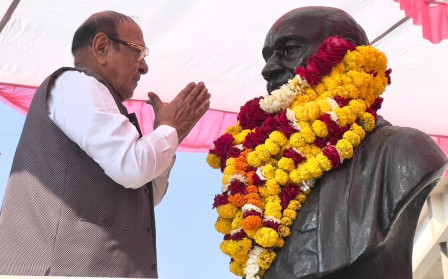
Gujarat leader Shankerinh Vaghela during campaign ! (Image credit The Raisina Hills)
By NIRENDRA DEV
The former Gujarat chief minister, once a close associate of Narendra Modi, is in discussions with Congress leaders as the party weighs its strategy for the 2027 Assembly elections.
Ahmedabad, October 9, 2026 — Former Gujarat chief minister Shankersinh Vaghela, once a close associate of Narendra Modi and later a Congress leader, is in discussions with the party as it explores its political options ahead of the 2027 Assembly elections.
The Congress is looking at the possibility of a political revival in Gujarat through Shankersinh Vaghela, a former Rashtriya Swayamsevak Sangh (RSS) leader who was once a close friend and political associate of Narendra Modi.
Gujarat Congress president Amit Chavda has said discussions are underway with Vaghela and that the party will decide on the next steps after consultations with its leadership. A meeting involving Vaghela and Congress leaders, including Rahul Gandhi, is also on the cards.
Vaghela, a former chief minister of Gujarat, served as a Union minister under Prime Minister Manmohan Singh in 2004 and was also the Leader of the Opposition in the Gujarat Assembly. He began his political career with the Jana Sangh, which merged into the Janata Party in 1977.
His political journey has been closely intertwined with that of Modi and former Gujarat chief minister Keshubhai Patel. The three were once considered close associates within the BJP’s Gujarat political establishment, but their paths eventually diverged.
Keshubhai Patel became chief minister, while Modi moved to Delhi. Vaghela subsequently worked to dislodge Keshubhai from power. In November 2001, Modi replaced Keshubhai as Gujarat chief minister, beginning a political chapter that would eventually take him to the prime minister’s office.
Vaghela’s Congress exit and the Ahmed Patel contest
Vaghela’s relationship with the Congress also witnessed a dramatic turn. He left the party in July 2017 following differences with its leadership, just ahead of the high-stakes Rajya Sabha election in Gujarat, in which Sonia Gandhi’s trusted lieutenant Ahmed Patel was seeking re-election.
Fourteen Congress MLAs, including Vaghela, left the party in 2017. Three of them, including Balvantsinh Rajput, crossed over to the BJP before the Rajya Sabha contest. Rajput was subsequently fielded against Ahmed Patel.
The election turned into a high-voltage political battle that continued late into the night. Patel eventually scraped through by a single vote, with Bharatiya Tribal Party leader Chhotubhai Vasava coming to his rescue.
The Congress later expelled eight MLAs, including Vaghela, for cross-voting.
Vaghela’s possible return would therefore involve a party with which he has had a complicated relationship, marked by both leadership differences and his departure during one of Gujarat Congress’s most consequential electoral contests.
Modi’s 2002 jibe at Sonia Gandhi
Vaghela’s political position also became a talking point during the 2002 Gujarat Assembly elections, held in the aftermath of the Godhra incident and the subsequent communal riots. The Congress projected him as its face and potential chief ministerial candidate against Modi-led BJP.
Modi, then under intense criticism over the anti-Muslim violence, took a swipe at Sonia Gandhi for relying on a former RSS man to challenge the BJP in Gujarat.
“I thank Jesus Christ for giving the right sense to Soniaben for depending on an ex RSS man,” Modi had said.
Vaghela, for his part, was openly critical of Modi. He used to describe the Gujarat chief minister’s remarks as “anab shanab”.
Yet their political relationship was not defined by hostility alone. In 2014, when Modi was elected the BJP parliamentary party leader ahead of becoming prime minister, he and Vaghela embraced during Modi’s last visit to the Gujarat Assembly as a state legislator.
The gesture reportedly angered several Congress leaders in Delhi.
Vaghela also publicly acknowledged Modi’s role in the BJP’s national rise. Referring to the party’s increase from two Lok Sabha seats in 1984 to 282 in 2014, he said: “In 1984 it was 2, now it is 282 and the credit goes to Narendra Bhai.”
He also expressed hope that a Ram temple could be built within the framework of the Constitution and described a Gujarat chief minister becoming prime minister as a matter of happiness for everyone.
Gujarat’s changing political landscape
Vaghela’s political positions have reflected the shifting equations within Gujarat politics over several decades. After the BJP’s sweeping victory in the December 2022 Assembly elections, he argued that even voters drawn to Hindutva would require a responsible government focused on public welfare and development.
Meanwhile, the BJP’s Gujarat leadership has produced several figures who went on to occupy prominent national positions. At the time of Modi’s elevation as prime minister in 2014, Gujarat leaders, including Amit Shah and Anandiben Patel, were among those associated with the state’s political establishment. Shah subsequently became Union home minister, while Anandiben Patel later served as Uttar Pradesh governor.
For the Congress, discussions with Vaghela come as the party considers its approach to the 2027 Gujarat Assembly elections. Whether the talks translate into a formal return remains to be seen.
Vaghela’s political history, spanning the Jana Sangh, BJP, Congress and government service, makes any potential comeback a significant development in the state’s political narrative. The larger question is whether his experience and past political connections can help the Congress strengthen its position in a state where the BJP has remained dominant.
Modi Model: How Hindutva, Governance and Diaspora Perceptions Shape BJP’s Political Appeal
Follow The Raisina Hills on WhatsApp, Instagram, YouTube, Facebook, and LinkedIn




About The Author