Satya Niketan Collapse: Delhi’s Student Housing Crisis Was a Tragedy Waiting to Happen
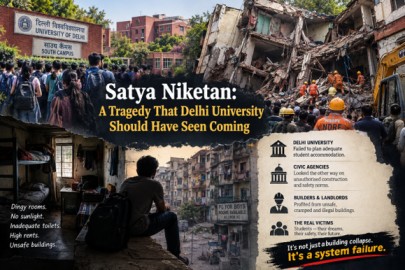
Satya Niketan Tragedy: The Warning Signs Were Visible for Decades (A representative image.)
By SIDHARTH MISHRA
The Satya Niketan collapse exposes a deeper crisis: inadequate Delhi University hostel capacity, unchecked construction and years of regulatory failure have left students dependent on overcrowded and potentially unsafe private accommodation.
New Delhi, September 7, 2026 — The collapse of a house in Satya Niketan, barely a stone’s throw from Delhi University’s South Campus, should not be dismissed as an unfortunate accident. It was a tragedy waiting to happen. For anyone who has known the area closely over the decades, the question is not simply how a building collapsed. The more uncomfortable question is why was a situation in which students were routinely compelled to live in such buildings allowed to develop in the first place?
The responsibility for this tragedy cannot rest solely with the owner of one unsafe building. It must also raise serious questions about Delhi University’s decades-long failure to provide adequate student accommodation, about the civic authorities responsible for regulating construction and enforcing building norms, and about the larger nexus of unplanned urbanisation and commercially driven construction, that has turned neighbourhoods around university campuses into hazardous student ghettos.
This author entered university as student in mid-1980s and has travelled through Satya Niketan and its surrounding areas on a regular basis. One has watched the area change. What was once a relatively modest neighbourhood gradually became a dense concentration of paying-guest accommodation and multi-storey structures, many of them in an unauthorised colony. Buildings of four and even five storeys came up cheek by jowl with established and often affluent colonies and massive government accommodation.
The contrast could hardly be starker. On one side are spacious government residences and planned neighbourhoods. On the other are cramped buildings packed with students who have come to Delhi in pursuit of education and opportunity.
This did not happen overnight. When South Campus was established in 1983 and colleges subsequently came up in and around the area, there was an obvious and predictable requirement of student housing. Yet Satya Niketan became, by default, the principal accommodation hub for students because the university did not create sufficient hostel capacity alongside the expansion of its academic institutions.
Hostels were eventually built within South Campus for boys and girls. However, the total capacity remains a tiny fraction of the demand. For a university attracting students from across India, this is woefully inadequate.
The question therefore needs to be asked plainly; did nobody in the university administration foresee that students would need somewhere safe to live? One supposes some must have seen. The demand was not unpredictable. Every academic year thousands of young people arrive in Delhi from different parts of the country. The pressure has only increased with the introduction of centralised entrance examinations, which have widened the geographical spread of students entering Delhi University.
How WhatsApp, YouTube and X Are Changing Indian Politics Beyond Election Day
Families with considerable financial means can send their children abroad or arrange expensive private accommodation. However, for thousands of middle-class and lower-middle-class families, Delhi University remains one of the most attractive avenues for higher education. Their children come to Delhi because they have earned the opportunity to study here, not because their families can afford luxury housing.
Yet once they arrive, many discover that the university can provide them a seat in a classroom much more readily than a safe place to sleep. That gap has been filled by the private market.
In addition, the private market, operating in an environment of weak planning and inadequate enforcement, has produced precisely the kind of accommodation that Satya Niketan represents. Rooms are carved out in buildings and rented at high rates. Floor after floor is packed with students. Many rooms are dingy, poorly ventilated and deprived of adequate sunlight. Toilets and kitchens are often inadequate. Basic standards of hygiene, fire safety, structural safety and occupancy can become secondary to the simple economics of extracting the maximum rent from the smallest possible space.
This is where the role of civic agencies becomes unavoidable. If unauthorised colonies can witness the construction of four- and five-storey structures, if buildings can be repeatedly modified to accommodate more paying tenants, and if such activity can continue for years, then the issue is not merely that of an individual builder or landlord. It points towards a serious failure of regulation and enforcement.
The disturbing reality in Delhi is that unauthorised construction often does not mean invisible construction. Buildings rise in full public view. Floors are added. Rooms multiply. Students move in. Rents are collected. Businesses flourish. Yet meaningful intervention frequently appears only after something goes terribly wrong.
That is not regulation. It is regulatory failure. The tragedy is therefore also a failure of imagination and governance on the part of Delhi University. The university has expanded academically without adequately expanding the social infrastructure required to support its students. A university cannot simply count classrooms, laboratories and faculty positions. Accommodation is part of the educational ecosystem.
If a student spends hours commuting because affordable accommodation is unavailable, that affects academic life. If another lives in a cramped and unsafe room because there is nowhere else to go, that affects health and dignity. If hundreds of students are housed in buildings never designed for such occupancy, their lives are placed at unnecessary risk.
The Satya Niketan incident should force a fundamental rethink. Delhi University must stop treating student accommodation as an afterthought. The university and the government need a long-term hostel expansion programme for both North and South Campus and for colleges where accommodation is severely inadequate. Land and institutional resources must be identified and used for this purpose.
At the same time, civic agencies cannot continue with a system in which enforcement is reactive rather than preventive. Buildings housing large numbers of students should be subject to periodic structural, electrical and fire-safety inspections. Where violations are found, action must be swift and transparent. There are evidence of collusion between officials, property owners and builders in permitting or ignoring illegal construction. These evidences must be investigated rather than buried beneath the familiar language of an “unfortunate incident.”
Young people come to Delhi University carrying dreams, not just luggage. Many are the first in their families to reach a premier university. They should not have to choose between an expensive room they cannot afford and an unsafe room they cannot risk living in!
The Satya Niketan collapse should therefore not become another news cycle followed by silence. It should become a reckoning. For decades, the university knew that students needed accommodation. The city knew that buildings were proliferating around campuses. Civic agencies knew, or should have known, the risks of unauthorised construction. Yet the system continued to function until a building collapsed and lives were lost or shattered.
The real tragedy is not that this happened without warning. The tragedy is that the warning was visible for decades, and nobody with the authority to act did enough.
Follow The Raisina Hills on WhatsApp, Instagram, YouTube, Facebook, and LinkedIn




About The Author