Meters Away from Power, Miles Away from Accountability
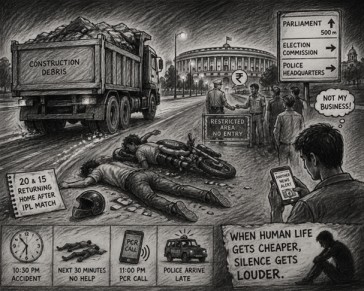
Ashoka Road Tragedy 500m from Parliament, A Deadly System Failure (A representative image.)
Two lives lost just 500 meters from Parliament—and no one stopped to help.
By SIDHARTH MISHRA
New Delhi, April 30, 2026 — A tragedy unfolding barely 500 meters from Parliament of India should have shaken the national conscience. Instead, it has passed with a disturbing quiet—another statistic in a city that is steadily becoming numb to the value of human life. The death of two young cousins, returning home after watching an IPL match, is not merely a road accident. It is a reflection of systemic apathy, administrative failure, and a society increasingly disengaged from real-world responsibility.
The facts themselves are chilling. A truck, reportedly entering a restricted high-security zone on Ashoka Road during prohibited hours, allegedly did so after bribing a law enforcement official. That detail alone should have triggered immediate outrage. This is not an obscure street on the city’s fringes—it is one of the most tightly monitored zones in the capital, flanked by institutions such as the Election Commission of India and key offices of the Delhi Police. If such a breach can occur here, it raises uncomfortable questions about the integrity of the entire security apparatus.
Equally troubling is what followed the crash. Two young men lay on the road for nearly 30 minutes without assistance. In a city teeming with vehicles, pedestrians, and surveillance, this delay is not just administrative—it is moral. It suggests a breakdown of the most basic civic instinct: to help. The bystander effect, often discussed in abstract psychological terms, played out in its most brutal form. People passed by, perhaps glanced, perhaps hesitated, but ultimately chose not to act.
This indifference is not emerging in isolation. It is growing alongside a culture increasingly dominated by screens. Outrage today is curated, delayed, and often confined to social media timelines. We react strongly to distant tragedies, trending hashtags, and viral clips, but when confronted with immediate reality, many retreat into silence. The question is uncomfortable but necessary: have we outsourced our humanity to the digital world?
The absence of political accountability is another dimension of this silence. Incidents like these should provoke sharp responses from political parties across the spectrum. Questions should be raised in public forums: How did a truck enter a restricted zone? Who allowed it? Why was enforcement compromised? Why did emergency response take so long in one of the most secured districts of the country? Yet, the silence from political leadership has been deafening. Perhaps because outrage today is selective, calibrated to political convenience rather than moral urgency.
The role of the police demands particular scrutiny. The Delhi Police is tasked not only with maintaining law and order but also with ensuring rapid response in emergencies. A delay of 30 minutes in such a critical zone cannot be brushed aside as procedural lag. It indicates either a lack of preparedness or a deeper institutional complacency. Both are dangerous.
Then there is the issue of corruption. If indeed a truck driver could “grease palms” to gain entry into a restricted zone, it reflects a vulnerability that goes far beyond this incident. It suggests that enforcement can be negotiated, that rules are flexible for those willing to pay. This undermines not only road safety but also national security. The same loopholes that allow a truck to pass unchecked could be exploited for far more sinister purposes.
At a societal level, this tragedy forces us to confront an uncomfortable truth: human life is becoming cheaper. Not in rhetoric—we still express grief, we still post condolences—but in action. We hesitate to intervene, to question, to demand accountability. We move on quickly, absorbed back into our routines and screens.
But this normalization is precisely what makes such incidents more frequent. When systems fail and society does not react, failure becomes acceptable. When corruption is exposed and goes unpunished, it becomes embedded. When lives are lost and no one demands answers, those lives are reduced to fleeting headlines.
What is needed is not just outrage, but sustained engagement. Citizens must reclaim a sense of responsibility—not only to help in emergencies but also to question institutions. Political parties must recognize that governance is not just about policy announcements but also about accountability in moments of crisis. Law enforcement agencies must introspect and reform, ensuring that such lapses are neither repeated nor tolerated.
The deaths on Ashoka Road should not fade into obscurity. They should serve as a wake-up call—a reminder that proximity to power does not guarantee safety, that systems are only as strong as the integrity of those who run them, and that a society that stops caring in real time risks losing its moral compass altogether.
If we continue to remain passive observers, the cost will not just be measured in statistics, but in the steady erosion of what makes us human.
Q: What does the Ashoka Road accident reveal?
The Ashoka Road accident highlights serious lapses in security enforcement, delayed emergency response, and growing civic apathy in Delhi.
(This is an opinion piece. Views expressed are the author’s own.)
Follow The Raisina Hills on WhatsApp, Instagram, YouTube, Facebook, and LinkedIn




About The Author