Manipuri Musician Beaten to Death in Delhi: When Did a Noise Complaint Become a Death Sentence?
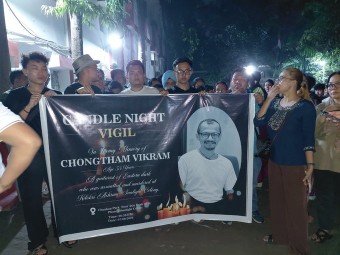
Delhi Violence: Manipuri Musician Beaten to Death After Objecting to Noise — How Did We Get Here? (Image Huidrom Athouba on X)
By TRH Op-Ed Desk
The death of Manipuri musician Chongtham Vikram Singh after an alleged assault in Kilokari exposes a disturbing culture of public aggression and raises urgent questions about deterrence, policing and the safety of Northeastern residents in Delhi.
New Delhi, September 8, 2026 — There is something profoundly disturbing about the death of Manipuri musician and music teacher Chongtham Vikram Singh in Delhi’s Kilokari village. A man reportedly objected to shouting, drinking and nuisance outside his home. What followed was not an argument that got out of hand. It was an alleged assault by a group of men that left a 54-year-old man fatally injured.
Singh was taken to Holy Family Hospital by his son, Yaiphaba, but succumbed to his injuries. Delhi Police have arrested seven men and apprehended a juvenile in connection with the case.
And that should leave every citizen of Delhi asking a brutally simple question: When did it become acceptable to answer an objection to public nuisance with collective violence?
This is not merely another crime story to be consumed, debated for a day and then forgotten.
It is a warning about what happens when the fear of law disappears from public life.
A resident should be able to tell a group of people outside his home to lower the noise without having to calculate whether that perfectly legitimate request could provoke a violent attack. A family should be able to sleep without a drunken or unruly gathering turning the street outside their house into a zone of intimidation.
Most importantly, nobody should have to die because he objected to disorder outside his own home.
According to police, Singh had objected to alleged shouting and nuisance by delivery workers and dhaba staff operating opposite his residence. He was allegedly assaulted with fists and blows after coming downstairs to raise the issue.
The horror lies partly in the apparent triviality of the trigger.
A disagreement over noise should never become a death sentence.
Yet Delhi has increasingly acquired a reputation for aggressive public behaviour in which arguments can rapidly escalate into threats, physical assault and, in the worst cases, murder. Road rage, neighbourhood disputes, parking fights, drunken brawls and arguments over everyday matters routinely demonstrate how quickly civic disagreement can become physical violence.
The problem is not that Delhi has disagreements.
The problem is that too many people appear increasingly willing to settle those disagreements with their fists.
And when people believe that a group can overpower an individual with little immediate consequence, the rule of law itself is weakened.
A city cannot outsource law and order to fear
The Singh case also raises uncomfortable questions about policing and deterrence.
Citizens do not expect the police to stand outside every house and prevent every argument. That is impossible. But they do expect something more fundamental: that people who assault others will face swift and certain consequences.
The purpose of criminal law is not merely to punish after a life has been destroyed. It is also to create deterrence before violence occurs.
If a person knows that a complaint about noise can be answered with threats or violence, while the consequences for the aggressor are uncertain, then the balance of power shifts away from the law-abiding citizen.
That is a dangerous transformation.
Delhi cannot become a city where the loudest, most aggressive or most violent person effectively controls the street.
And what about the Northeast?
Singh’s identity as a Manipuri has understandably intensified concern within the Northeast community.
Members of the community have demanded a thorough investigation, and some have raised the possibility of a racial dimension. But that allegation must be investigated rather than casually declared as fact. Delhi Police have said that no racial motive has been established so far and that the circumstances and motive remain under investigation.
But it does not make the broader concern any less serious.
For decades, people from India’s Northeast have spoken about discrimination, stereotyping and a sense of vulnerability in mainland Indian cities. Every violent incident involving a Northeastern citizen inevitably raises that history.
The answer cannot be to dismiss those fears.
Nor can it be to prematurely attribute a motive before investigators establish the facts.
The answer must be a transparent investigation that examines every possible motive, including whether Singh’s identity played any role.
Justice requires nothing less.
Former Manipur Chief Minister N. Biren Singh has expressed grief over Singh’s death and called for swift action and a thorough investigation.
Satya Niketan Collapse: Delhi’s Student Housing Crisis Was a Tragedy Waiting to Happen
Follow The Raisina Hills on WhatsApp, Instagram, YouTube, Facebook, and LinkedIn




About The Author