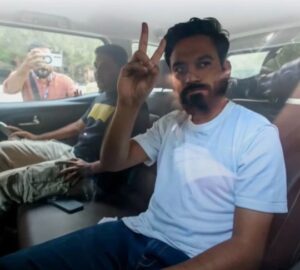
From Movements to Events: Politics of Ram Mandir and Cost of Symbolic Protest
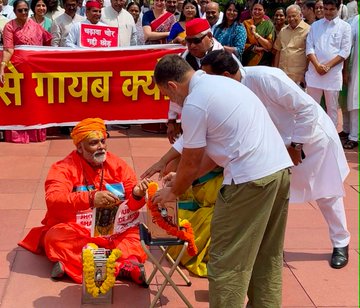
Lok Sabha MP Pappu Yadav with Congress leader Rahul Gandhi staging Ram Temple donation row issue. (Image INC India)
By SIDHARTH MISHRA
Can political spectacles replace decades-long public movements? This opinion piece explores why the Ram Janmabhoomi movement reshaped India while today’s event-driven politics struggles to build lasting public trust.
New Delhi, August 5, 2026 — Politics is shaped by two very different forces — movements and events. While both occupy public attention, they are fundamentally different in purpose, impact and longevity. Movements alter the direction of society. Events merely interrupt it. A movement changes public consciousness over years, sometimes decades. An event captures headlines for a news cycle before disappearing into the endless churn of social media.
The distinction is particularly relevant to contemporary Indian politics, where the line between sustained political mobilisation and performative activism has become increasingly blurred. The trajectory of the Ram Janmabhoomi issue offers perhaps the clearest illustration of this difference.
The Ram Janmabhoomi movement was not simply a political campaign. It was a civilisational mobilisation that unfolded over several decades. It drew strength from religious sentiment, cultural memory, legal arguments, social participation and political organisation. Whether one supported or opposed it, there could be little disagreement about its scale and transformative impact. It fundamentally altered India’s political vocabulary, redefined electoral alignments and brought cultural nationalism to the centre of public discourse.
The movement was larger than elections. It survived changes of government, judicial battles, criticism from opponents and fluctuations in public opinion. Above all, it created a sense among its supporters that they were participants in a historic national cause rather than spectators at a political spectacle. That explains why the eventual consecration of the Ram Mandir in Ayodhya was viewed by millions not merely as the completion of a construction project but as the culmination of a decades-long cultural aspiration.
Ironically, after such a profound movement reached its destination, public engagement with the issue appears increasingly reduced to isolated political events. Instead of shaping public opinion through sustained campaigns, both supporters and opponents often resort to carefully choreographed moments designed primarily for television cameras and social media feeds.
Recent incidents illustrate this tendency. The episode involving a person dressed as Hanuman dancing before the cavalcade of BJP president Nitin Nabin may have generated visual attention, but it also demonstrated the dangers of converting symbols of deep civilisational significance into political props. Such acts may momentarily energise partisan supporters or produce viral content, yet they simultaneously risk trivialising the very cultural symbols that movements had sought to elevate. When sacred imagery becomes part of political theatre, reverence often gives way to spectacle.
The same caution applies to the Opposition. Allegations regarding financial irregularities or corruption in connection with the administration of the Ram Mandir, if supported by evidence, deserve serious scrutiny. Institutions that receive public trust and public donations cannot be insulated from questions of accountability merely because they are associated with faith. Transparency strengthens institutions; it does not weaken them.
However, if those allegations are to become matters of public protest, they require something far more substantial than symbolic demonstrations or dramatic media appearances. The intervention by Member of Parliament Rajesh Ranjan, better known as Pappu Yadav, may have attracted attention but attention alone is not political persuasion. A protest built around a single dramatic gesture rarely develops into sustained public engagement.
Movements are constructed patiently. They require documentation, public education, organisational networks, moral consistency and persistence. They demand that those leading them convince citizens not only that a problem exists but also that it deserves sustained collective action.
Events demand none of these qualities. An event is designed for instant visibility. A movement is designed for lasting legitimacy. This distinction explains why many contemporary political campaigns disappear as quickly as they emerge. Social media rewards immediacy. Television rewards confrontation. Political consultants often reward optics over organisation. Consequently, political actors increasingly mistake visibility for influence.
But democratic politics has always been more demanding than digital popularity. The anti-corruption movement led by Jayaprakash Narayan, the struggle for Independence under Mahatma Gandhi, the Ram Janmabhoomi movement and several regional social reform campaigns succeeded because they created durable public participation. They built institutions, volunteers, narratives and emotional investment. Their leaders understood that history is shaped by sustained mobilisation, not by isolated performances.
For the Bharatiya Janata Party, the lesson is equally important. A movement that helped bring the party to the centre of national politics should not gradually degenerate into a series of symbolic public spectacles that diminish the dignity of its own cultural foundations. Reverence cannot coexist comfortably with excessive theatricality. If political workers reduce sacred symbols to instruments of partisan display, they risk weakening the moral authority that originally gave the movement its strength.
For the Opposition, the lesson is perhaps even more significant. If it genuinely believes there are credible questions regarding the management of the Ram Mandir or any institution connected with it, then it must resist the temptation to pursue headline-grabbing events. Instead, it should undertake meticulous investigation, place documentary evidence before the public, demand institutional accountability and build a sustained campaign rooted in facts rather than symbolism. Only such an approach can command credibility beyond its existing political constituency.
Ultimately, Indian democracy must decide whether it wishes to be governed by movements or distracted by events. Movements demand conviction, discipline and patience. Events demand choreography, cameras and hashtags. History remembers movements because they transform societies. Events survive only as archived video clips.
The Ram Janmabhoomi movement reshaped India’s political and cultural landscape because it spoke to a deeply held collective conviction. Any attempt either to celebrate that legacy or to question its institutional outcomes must rise to the same level of seriousness. Otherwise, politics risks becoming an endless sequence of spectacles where symbolism overwhelms substance, performance replaces persuasion and momentary excitement substitutes for meaningful democratic engagement.
(This is an opinion piece. Views expressed are the author’s own.)
Yogi Adityanath Says SIT Found No Saint Involved in Ayodhya Ram Temple Offerings Case
Follow The Raisina Hills on WhatsApp, Instagram, YouTube, Facebook, and LinkedIn




About The Author