Brotherhood or Breakpoint? Iran Challenges the Gulf’s US Reliance
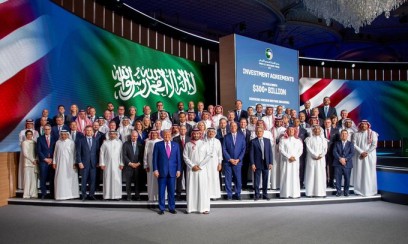
Crown Prince Mohammed bin Salman and President Donald J. Trump with Saudi and US investors (Image credit MFA Saudi Arabia)
Tehran’s diplomatic offensive is forcing Gulf monarchies to reconsider decades of dependence on Washington for security
By TRH World Desk
New Delhi, April 1, 2026 — Iran is recalibrating the security architecture of the Middle East — not through military confrontation alone, but through a carefully crafted diplomatic offensive that is forcing Gulf monarchies to ask an uncomfortable question: is Washington still a reliable guarantor of their security?
That is the assessment of Djoomart Otorbaev, former Prime Minister of the Kyrgyz Republic, who in a post in Linkedin argues that Iran’s recent moves represent not rhetoric but a coherent regional strategy with potentially far-reaching consequences.
The Aragchi Gambit
When Iranian Foreign Minister Abbas Aragchi publicly called on Saudi Arabia to remove American troops from the region, he did more than issue a demand. He shifted the regional narrative.
By describing the Saudis as a “brotherly people,” Tehran signalled that the central fault line in the Middle East is no longer the ancient Persian-Arab divide — it is now framed as a contest between regional sovereignty and external influence
“This is not rhetoric. It is a strategy,” Otorbaev argues.
The Architecture of Dependence
For decades, Gulf security has rested on a single foundational assumption: rely on Washington for defence. The U.S. Fifth Fleet based in Bahrain, airbases in Qatar and the UAE, and America’s broader military presence across the region have functioned as what Otorbaev calls an “external balancer” against Iran.
The Gulf monarchies accepted this arrangement not out of preference, but because they saw no credible alternative.
That calculus is now under severe strain.
Iran’s Asymmetric Advantage
Iran has demonstrated, with growing confidence, that it can disrupt the region’s economic lifelines — from the Strait of Hormuz to the Red Sea — using asymmetric tools that are inherently difficult to deter through conventional military means.
Simultaneously, confidence in American security guarantees is eroding. Washington is no longer perceived as a predictable security provider. Instead, as Otorbaev notes, it is “increasingly viewed as a risk amplifier” — capable of drawing its Gulf partners into conflicts they neither initiated nor control.
This is the classic security dilemma playing out in real time: U.S. forces, deployed to prevent conflict, simultaneously increase the Gulf states’ exposure as potential targets in any Iran escalation.
Aragchi’s Real Message
Otorbaev argues that Aragchi’s public statement about troop withdrawal is not primarily about expelling American forces. It is about forcing a strategic reconsideration in Riyadh.
The implicit question Tehran is posing to Saudi Arabia is pointed: why maintain dependence on a distant power whose very presence invites danger, when a working accommodation with your most powerful neighbour might actually reduce it?
The Trust Deficit
The trust gap, however, remains formidable. For Saudi Arabia, Iran’s language of “brotherhood” sits uneasily alongside years of proxy conflict — from Yemen to Lebanon and beyond. Security relationships are built on measurable restraint, not diplomatic vocabulary.
Yet a strategic shift is no longer inconceivable. Recent multilateral diplomatic engagement — notably the Islamabad talks involving Saudi Arabia, Turkey, Pakistan and Egypt — signals that major regional players are actively exploring options beyond permanent reliance on external guarantors.
The question has evolved. It is no longer whether the current security arrangement is stable. It is whether it is sustainable over the long term.
The Slow Drift Toward Internal Balancing
If Gulf states begin hedging — gradually reducing the footprint of U.S. bases while cautiously expanding engagement with Tehran — the regional consequences could be profound.
A Middle East historically structured around external security guarantees could, unevenly and incrementally, begin shifting toward internal balancing — regional powers managing their own security equations without Washington as the default backstop.
That, Otorbaev concludes, is the true significance of Aragchi’s statement. “This is not a demand but an invitation to reconsider who delivers security in the Middle East — and what they sacrifice in the process.”
China and Pakistan Issue Joint Five-Point Plan for Middle East Peace
Follow The Raisina Hills on WhatsApp, Instagram, YouTube, Facebook, and LinkedIn




About The Author