China and Pakistan Issue Joint Five-Point Plan for Middle East Peace
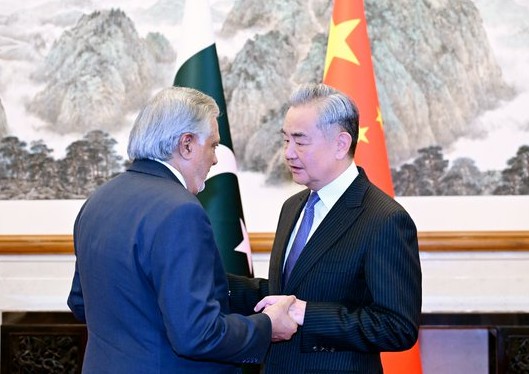
China FM Wang Yi met with Pakistani Deputy Prime Minister and Foreign Minister Mohammad Ishaq Dar in Beijing on Tuesday (Image China MFA on X)
Wang Yi and Pakistan’s Ishaq Dar met in Beijing on March 31 and called for immediate ceasefire, peace talks, civilian protection, and UN Charter primacy — a coordinated diplomatic signal directed squarely at Washington.
By TRH World Desk
New Delhi, March 31, 2026 — China and Pakistan have jointly issued a five-point initiative for restoring peace and stability in the Gulf and Middle East region, following a meeting in Beijing between Chinese Foreign Minister Wang Yi and Pakistan’s Deputy Prime Minister and Foreign Minister Mohammad Ishaq Dar.
The statement — issued as Pakistan’s Ministry of Foreign Affairs — represents the most explicit coordinated diplomatic intervention by Beijing and Islamabad in the ongoing Middle East conflict. Its five points, taken together, constitute a direct challenge to the US military posture in the region.
The Five Points
Immediate Cessation of Hostilities
China and Pakistan called for an immediate halt to hostilities and maximum efforts to prevent the conflict from spreading. The statement specified that “humanitarian assistance must be allowed to all war-affected areas” — language that implicitly criticises the blockade conditions created by the current conflict.
Start of Peace Talks
The joint statement demanded that peace talks begin “as soon as possible,” with a framework that explicitly protects the sovereignty, territorial integrity, national independence, and security of Iran and the Gulf states. The two sides backed diplomatic engagement, calling on all parties to commit to peaceful resolution and to refrain “from the use or the threat of use of force during peace talks.”
Protection of Civilians and Non-Military Targets
China and Pakistan called on all parties to immediately stop attacks on civilians and non-military infrastructure — explicitly naming energy facilities, desalination plants, power stations, and “peaceful nuclear infrastructure, such as nuclear power plants.” The inclusion of nuclear power plants is a pointed reference to the vulnerability of Iranian nuclear infrastructure under current military conditions.
Security of Shipping Lanes
The statement singled out the Strait of Hormuz by name, describing it as “an important global shipping route for goods and energy.” China and Pakistan called for the protection of ships and crew members stranded in the Strait, the safe passage of civilian and commercial vessels, and the restoration of normal passage “as soon as possible.”
Primacy of the United Nations Charter
The final point called for “true multilateralism,” support for UN primacy, and the conclusion of a comprehensive peace framework “based on the purposes and principles of the UN Charter and international law” — a formulation that directly contests the legitimacy of unilateral US military action without Security Council authorisation.
What the Statement Signals
The Beijing meeting and the five-point communiqué carry significance beyond their diplomatic language.
China is Iran’s largest trading partner and has deep strategic interests in Gulf stability. Pakistan — which shares a border with Iran and hosts a large Shia Muslim population — has its own strong incentives to see the conflict de-escalated. Together, their joint statement represents a coordinated signal to Washington: that the military campaign against Iran lacks the political legitimacy of a multilateral framework, that Hormuz must remain open (a demand as much directed at Iran as at the US), and that Tehran’s sovereignty and territorial integrity must be the non-negotiable baseline of any settlement.
The explicit protection of “peaceful nuclear infrastructure” is also notable. It suggests that a Chinese and Pakistani red line exists around any expansion of the conflict to Iran’s nuclear facilities — a line that Beijing, as a permanent UN Security Council member, has the institutional capacity to enforce diplomatically.
The Strait the World Is Ignoring Is More Dangerous Than Hormuz
At a Glance
| Element | Detail |
| Document | Five-Point Initiative on Peace and Stability in Gulf and Middle East |
| Reference | Pakistan MoFA Communiqué 85/2026 |
| Point I | Immediate cessation of hostilities; humanitarian access |
| Point II | Peace talks; protect Iran’s sovereignty and territorial integrity |
| Point III | Stop attacks on civilians, energy infra, nuclear power plants |
| Point IV | Hormuz security; safe passage for civilian and commercial ships |
| Point V | UN Charter primacy; true multilateralism; comprehensive peace framework |
| Implicit target | US unilateral military action without Security Council mandate |
| Nuclear infrastructure| Explicitly listed as protected category — red line signal |
The Middle East War Blows up Modi’s ‘Atmanirbhar Bharat’ Slogan
Follow The Raisina Hills on WhatsApp, Instagram, YouTube, Facebook, and LinkedIn




About The Author