The Middle East War Blows up Modi’s ‘Atmanirbhar Bharat’ Slogan
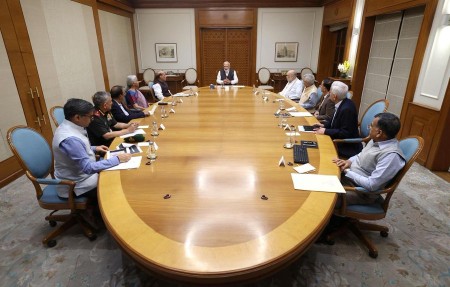
PM Narendra Modi chairs Cabinet Committee on Security amid US-Iran war (Image PIB)
Fertiliser imports under threat. Forex reserves draining. FII sell-off hitting ₹20 billion in March alone. A geopolitics analyst argues India’s self-reliance slogan was never stress-tested — and the bill is now arriving.
By TRH Op-Ed Desk
New Delhi, March 31, 2026 — The rupee has touched ₹95 to the dollar. Crude oil is trading at $115 a barrel. Foreign Institutional Investors pulled out approximately $20 million from Indian markets in March alone. And the Middle East conflict shows no sign of resolution.
For Manish Anand, geopolitics analyst at The Raisina Hills, this convergence of pressures is not merely an economic cycle. It is a stress test — and India’s flagship policy doctrine of Atmanirbhar Bharat (Self-Reliant India) is not passing it.
“The Atmanirbhar Bharat slogan appears to have a very serious deficiency. We did not seriously and at speed try to actually achieve self-reliance — and we never imagined that a crisis like this could come, where fuel supply itself would face disruption,” Anand added.
The Rupee’s Decline: A Forty Percent Fall Since 2014
The numbers provide the context. When Narendra Modi became Prime Minister, the rupee stood at approximately ₹73 per dollar. It has now reached ₹95 — a depreciation of roughly 40 to 50 per cent over a decade. Anand argues this is not an abstraction: a weakening rupee raises the cost of every import India depends on, from crude oil to fertilisers to pharmaceutical ingredients, and feeds directly into retail inflation and household expenditure.
Finance Minister Nirmala Sitharaman has publicly said the rupee’s slide to ₹95 is not a cause for concern. Anand’s view is blunt: “This is shutting one’s eyes to the problem. The rupee weakening affects every sector of the country’s economy and people’s daily lives. The problem is becoming increasingly serious.”
Fertiliser: The Vulnerability Nobody Fixed
The most structurally significant warning Anand raises is about fertilisers and urea — the chemical foundations of India’s agricultural economy and, by extension, its employment base.
India’s farming sector is heavily dependent on imported fertilisers. This is not a new vulnerability: during the COVID-19 period, when China effectively shut down, fertiliser shipments collapsed. The consequences were felt across the automobile sector and agriculture alike. During the four years of India-China border tensions following the Galwan clash, China’s restrictions on rare earth exports and fertiliser supplies to India added another layer of pressure.
“The biggest challenge for the Indian government right now is ensuring that petrol and diesel are available at pumps, that LPG continues to reach kitchens, that PNG supply is maintained. But the larger problem is that our agriculture-based economy — for urea, for fertilisers — dark clouds are gathering, because we were dependent on foreign ports for these basic necessities,” added Anand.
If the Middle East conflict disrupts shipping lanes through the Strait of Hormuz or the Bab el-Mandeb, fertiliser supply chains face a second shock. Anand warns that even after the conflict ends, normalisation of supply could take months — making the next year potentially very painful for Indian agriculture and GDP growth.
Oil: Paying More Than the Market Price
India currently imports crude at between $85 and $90 per barrel under pre-negotiated contracts, even as global prices have reached $115. While this provides a partial buffer, the direction of travel is clear: as contracts are renegotiated and market rates feed through, India’s forex outgo on oil will accelerate. Dollar demand rises. Reserves fall further. The rupee weakens more.
When state elections conclude, Anand expects diesel prices to be raised — triggering a retail inflation wave that will eat into household discretionary spending and compress domestic consumption, one of India’s key economic growth engines.
The Renewable Energy Gap India Chose Not to Close
One of Anand’s most pointed arguments is about energy policy choices. India had the opportunity to rapidly scale solar and wind power — which would have reduced fossil fuel import dependence and provided a structural buffer against exactly the kind of Middle East supply shock that is now unfolding. Pakistan, despite being a Chinese ally under significant economic pressure, managed to bring solar to 25 per cent of its domestic power mix. India’s renewable push slowed.
“The speed at which we should have pushed solar power, wind power, renewable power — we see that in the last three to four years, that momentum reduced. Had our railway network, for example, been running on solar power, we would have achieved a great deal more fuel self-reliance. That is something we were not able to achieve,” argued Anand.
The consequences, he notes, now extend to medicine. Paracetamol — the most basic fever medication — requires ingredients derived from petrochemical supply chains. A disruption in fuel supply is, eventually, a disruption in pharmaceutical supply. This is what systemic import dependence looks like at its most intimate level.
The Diplomatic Trap: All Directions, No Anchor
Anand also questions Modi’s foreign policy posture — a strategic ambiguity that has positioned India simultaneously with the United States, Russia, and in oscillating tension with China. In a world of clear-cut conflict, this multi-directional balancing carries its own costs.
India’s approximately one crore (ten million) diaspora workers in the Gulf region contribute enormous remittance flows to the domestic economy. If the Middle East conflict threatens their employment or safety, remittances fall, forex reserves contract further, and FDI confidence — already weakened by the FII sell-off — declines further.
“The Middle East war’s most negative global impact is being felt by India. The stock market is falling. Foreign investors are selling at record levels — approximately $20 million in March alone. Forex reserves are declining rapidly. Dollar demand is rising. Investor confidence in the Indian economy is visibly weakening,” added Anand.
The Verdict: A Slogan That Was Never Made Real
Anand’s conclusion is structurally measured but politically pointed. Atmanirbhar Bharat achieved genuine progress in one area: defence exports. India’s defence manufacturing has grown and export figures are real. But the rest of the economy — agriculture, fuel, pharmaceuticals, fertilisers — remained dependent on global supply chains that are now under simultaneous stress.
“Atmanirbhar Bharat, if we try to see it in its true form, was in the defence sector where our exports are large — that is not wrong, defence production has increased. But because India is an agricultural country, and employment comes from the agricultural sector, and agriculture is dependent on imported fertilisers and urea and chemicals — that sector faces the full possibility of coming into trouble,” Anand added.
India globalised rapidly, Anand argues, and globalisation always extracts a price when the global system is disrupted. The lesson of this moment is not that globalisation was wrong — it is that self-reliance, if it is to mean anything, must be built before the crisis arrives, not announced during one.
At a Glance
| Indicator | Current Status |
| Rupee vs Dollar | ₹95 (was ₹73 when Modi took office — ~40–50% depreciation) |
| Crude oil price | $115 per barrel (global); India paying $85–90 under contracts |
| FII sell-off (March) | $20 million — record outflows |
| Forex reserves trend | Declining rapidly |
| Key import vulnerability | Fertilisers, urea — agriculture sector at risk |
The Strait the World Is Ignoring Is More Dangerous Than Hormuz
Follow The Raisina Hills on WhatsApp, Instagram, YouTube, Facebook, and LinkedIn




About The Author