11,000 Cases Pending: Armed Forces Tribunal Faces Staff Crisis
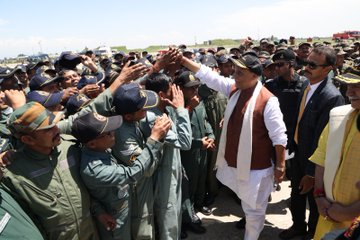
Union Defence Minister Rajnath Singh with Indian Air Force personnel in Bhuj (Image credit X.com)
One in four cases filed before the AFT over the past five years remains unresolved. At Srinagar, Jabalpur and Guwahati, two posts each sit vacant. For veterans fighting for pension after retirement, the wait is not an inconvenience — it is a financial crisis.
By TRH News Desk
New Delhi, March 30, 2026 — The Armed Forces Tribunal — India’s dedicated judicial body for serving and retired military personnel — was created in 2007 with a specific promise: that soldiers would no longer have to navigate the slow machinery of High Courts and civil courts to resolve disputes about their service, pension, and dignity. Nearly two decades later, that promise is in difficulty.
The Ministry of Defence told the Rajya Sabha on March 30 that between 2021 and January 2026, a total of 44,622 cases were filed before the AFT. Of these, 33,525 have been disposed of. That leaves 11,097 cases pending — approximately one in every four cases unresolved, and the number rising again after a brief dip.
“The Tribunal, designed to be faster and more expert than civilian courts, is now carrying the same disease it was created to cure: backlog,” reported Raksha Samachar.
The Numbers Tell a Troubling Story
The year-by-year data disclosed in parliament shows a pattern that should alarm the defence establishment. Pending cases stood at 3,431 in 2021. They fell sharply to 534 in 2023 — a brief moment of apparent efficiency. Then the numbers climbed again: 2,795 cases pending in 2025, with a further 406 cases already pending in the early months of 2026.
This is not a one-time accumulation. “It is a structural problem — cases are being filed faster than they are being resolved, and the Tribunal’s capacity has not kept pace,” added the report. The Ministry offered no timeline in its Rajya Sabha response for when the situation would be brought under control.
Vacant Posts: The Root of the Problem
The AFT’s most immediate crisis is one of staffing. Multiple regional benches are operating well below their sanctioned strength, and the Ministry acknowledged as much to parliament without providing a remedy.
The worst-affected benches:
Srinagar — 2 posts vacant
Jabalpur — 2 posts vacant
Guwahati — 2 posts vacant
“Benches in Chandigarh, Lucknow, Kochi, Chennai and Kolkata are also operating with reduced staff,” said Raksha Samachar in its report.
The irony is pointed. The Principal Bench in New Delhi — which serves the capital — is fully staffed, with all posts including the Chairperson filled. The benches that are understaffed are precisely those serving soldiers and veterans in the regions where military presence is heaviest: the northeast, Jammu and Kashmir, and central India.
The AFT operates through two categories of members: judicial members, typically retired High Court judges, and administrative members, who are senior serving or retired military officers. When either post is vacant, hearings slow. When both are vacant, benches can effectively stall.
There is something deeply uncomfortable about a system designed for military men and women — people trained to act with speed and precision — that cannot fill its own vacancies.
‘We Are Indians Only If India Exists’: Capt. Saurabh Kalia’s Father
What Is at Stake: Pension, Promotion, and Dignity
This is not abstract institutional underperformance. The cases pending before AFT benches across the country are overwhelmingly about the most concrete aspects of a soldier’s life: pension entitlements, promotion disputes, medical board decisions, service conditions, and court martial appeals.
“For a retired soldier, pension is not one source of income among many. It is the primary source. When a pension case drags through the AFT for years — as many do — the consequences are financial hardship, not procedural inconvenience,” added the report.
For a serving soldier fighting a court martial appeal or a promotion dispute, the delay carries a different but equally serious cost: years of uncertainty about career and standing, compounded by the knowledge that the system built specifically to serve them is not functioning as designed.
The AFT’s regional structure was deliberately designed to bring justice to where soldiers actually are — in remote postings, border areas, northeastern states, Jammu and Kashmir. “A bench in Srinagar exists precisely so that a soldier from that region does not have to travel to Delhi to access the military justice system,” added the report. When that bench has two vacant posts and a growing backlog, the geographic promise of the system collapses along with the procedural one.
A System That Admitted the Problem Without Offering a Solution
What is perhaps most remarkable about the Ministry of Defence’s Rajya Sabha statement is its combination of candour and inaction. The Ministry confirmed the staffing shortfall. It confirmed the caseload. It confirmed that benches are affected. It did not announce when vacancies would be filled, what target clearance rates have been set, or what interim measures — additional sittings, expedited appointments, temporary postings — are being considered.
The AFT was established under a specific law in 2007. It has handled more than 33,000 cases in five years — a genuine institutional achievement that should be acknowledged. But the same five years have left 11,097 cases unresolved, and the trend line for 2025 and 2026 is heading in the wrong direction.
The soldiers who filed those cases have, in many instances, already waited years. The least a functioning system owes them is a timeline.
Indian Army’s Pipping Ceremony: A Timeless Tradition of Memory
At a Glance
| Metric | Figure |
| Total cases filed (2021–Jan 2026) | 44,622 |
| Cases disposed of | 33,525 |
| Cases pending| 11,097 (~25% of total) |
| Pending cases, 2021 | 3,431 |
| Pending cases, 2023 (low point) | 534 |
| Pending cases, 2025 | 2,795 |
| Pending cases, early 2026 | 406 (partial year) |
| Benches with 2 vacancies each | Srinagar, Jabalpur, Guwahati |
| Other understaffed benches | Chandigarh, Lucknow, Kochi, Chennai, Kolkata |
| Fully staffed bench | New Delhi (Principal Bench) |
| Member types | Judicial (retired HC judges) + Administrative (senior military officers) |
| Common case types | Pension, promotion, medical board, service conditions, court martial appeals |
Follow The Raisina Hills on WhatsApp, Instagram, YouTube, Facebook, and LinkedIn




About The Author