From Antelope Reef to PLA Purges: How Xi Is Expanding China’s Strategic Power
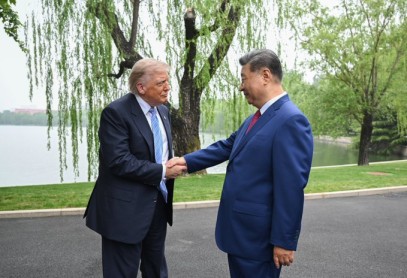
China President Xi Jinping held a private meeting with U.S. President Donald J. Trump at Zhongnanhai. (Kmage China MFA)
By TRH Foreign Affairs Desk
China’s expanding footprint in the South China Sea, the purge of senior PLA commanders and Washington’s multiple geopolitical crises are creating a new strategic asymmetry, according to retired Major General Shashi Asthana.
New Delhi, August 30, 2026 — China is playing a long strategic game while the United States is increasingly consumed by competing geopolitical crises, retired Major General Shashi Asthana argues in his latest assessment of the evolving US-China rivalry.
Asthana says Beijing is combining political consolidation under President Xi Jinping with military restructuring and gradual expansion of China’s strategic footprint, while Washington’s attention is divided among conflicts, trade disputes and domestic political pressures.
“China’s advantage is not simply the growth of Chinese power. It is the combination of strategic patience, political concentration and America’s increasingly fragmented attention,” Asthana writes in his website.
“The danger for Washington is therefore not that China suddenly becomes stronger than America—but that Beijing continues advancing while America is repeatedly forced to look elsewhere,” he adds.
Xi Jinping’s Long Strategic Game
Asthana has described Xi’s governing model as “Smart Dictatorship with Chinese Characteristics”, arguing that China’s leadership combines concentrated political control at home with calibrated strategic expansion abroad.
The concept, which Asthana first developed in his writings in 2022, has now acquired a wider geopolitical context as Xi continues to consolidate authority over the Communist Party and the PLA.
“China does not need to defeat America to outlast it. It only needs America to remain distracted,” Asthana says.
The argument comes as Washington and Beijing prepare for another Trump-Xi engagement, with expectations of diplomatic warmth and possible transactional agreements but little indication that the core strategic competition will disappear.
Trump-Xi Summit: Deals Without a Strategic Reset?
The coming Trump-Xi encounter could produce headlines, trade announcements and diplomatic gestures without changing the underlying US-China rivalry, according to Asthana.
He expects both sides to seek limited, transactional gains while avoiding concessions on their most sensitive strategic interests.
“Limited, transactional deliverables dressed up as strategic stabilisation” are likely to emerge from the engagement, Asthana argues.
Issues including Taiwan, technology restrictions and the South China Sea are unlikely to be fundamentally resolved through summit diplomacy, he says.
Asthana describes the broader relationship as one of “adversarial coexistence”, in which Washington and Beijing remain economically and technologically intertwined even as their military and strategic competition intensifies.
China’s Rise in the Trump Era: How Beijing Outplayed New Delhi
Antelope Reef: China’s Incremental Expansion
China’s activities around Antelope Reef in the Paracel Islands are another element of the strategic picture highlighted by Asthana.
He argues that the development reflects a broader Chinese strategy of gradually altering the regional status quo while avoiding a direct confrontation with the United States.
“Build faster than rivals can react, dispute the narrative rather than the underlying facts, and let sheer scale outpace any meaningful international legal response,” Asthana writes.
The approach resembles China’s earlier island-building campaign in the South China Sea, where infrastructure development generated new strategic realities while diplomatic and legal challenges struggled to keep pace.
For Asthana, the significance of Antelope Reef extends beyond the physical reclamation itself. It represents the way Beijing can use incremental moves to expand strategic space without triggering a major military confrontation.
PLA Purges: Power Consolidation or Strategic Risk?
The reported purge of senior PLA commanders represents another important dimension of Xi’s consolidation of power.
Asthana points to the removal and investigation of senior military figures, including General Zhang Youxia and General Liu Zhenli, as evidence of the extraordinary degree of political control Xi is seeking over the military establishment.
“This is not routine anti-corruption housekeeping,” Asthana argues.
He suggests that the campaign may reflect concerns about political reliability within the PLA as well as Xi’s determination to ensure absolute control over the military hierarchy.
But the strategy carries risks.
A highly centralised command structure can strengthen political control while simultaneously disrupting institutional continuity and removing experienced leadership.
“A hollowed-out Central Military Commission is a fragile instrument of command, not necessarily a stronger one; however it can be soon restructured,” Asthana writes.
Why Xi’s Thucydides Reference Matters
Asthana also attaches significance to Xi’s invocation of the Thucydides Trap, the controversial theory that competition between a rising power and an established power can increase the risk of conflict.
He argues that Xi’s reference should be viewed as strategic signalling rather than merely historical commentary.
The message, according to Asthana, is that conflict between the world’s two largest powers would be mutually costly and that Washington should therefore exercise restraint.
At the same time, Asthana notes that serious scholars have criticised the Thucydides Trap as a deterministic interpretation of history.
The importance, he argues, lies less in whether the theory is historically inevitable and more in whether it influences political calculations in Washington.
America’s Strategic Attention Is Divided
The biggest advantage China may possess is therefore not simply its growing economic or military power but the ability to exploit gaps created by American distraction.
Washington is simultaneously dealing with multiple international crises, trade tensions and domestic political pressures.
“An over-engaged US with depleted reserves works towards Chinese strategic advantage,” Asthana says.
His assessment is that competition with China requires sustained strategic attention, particularly in the Indo-Pacific.
Every major crisis that absorbs American diplomatic, military and political resources elsewhere potentially creates additional room for Beijing to consolidate its position.
China Is Not Without Vulnerabilities
Asthana, however, cautions against portraying the strategic equation as a simple story of China’s rise and America’s decline.
China faces economic, demographic and institutional challenges. Xi’s concentration of power could also become a source of vulnerability if decision-making becomes excessively dependent on one leader.
The purge of military commanders could create short-term disruption even if Xi subsequently succeeds in rebuilding the command structure around trusted loyalists.
The United States, meanwhile, retains major economic, technological, military and alliance advantages.
The question is therefore not whether American power has disappeared, but whether Washington can consistently deploy that power against a competitor operating on a much longer strategic timeline.
The Battle Is Increasingly About Time and Attention
That difference in strategic time horizons may ultimately prove more important than any individual summit or military development.
China can pursue incremental objectives over decades, while US foreign policy is more exposed to elections, domestic political pressures and immediate international crises.
“Smart dictatorship does not need to defeat American power outright to succeed. It only needs to outlast American attention,” Asthana concludes.
The coming Trump-Xi engagement may consequently produce diplomatic warmth, trade announcements and carefully choreographed summit imagery.
But beneath that theatre, the structural US-China competition is likely to continue.
The central strategic question, as Asthana’s assessment suggests, is no longer simply whether China is rising.
It is whether the United States can maintain the sustained attention required to manage that rise.
Xi’s Military Purge Sends a Warning to India—and an Opportunity
Follow The Raisina Hills on WhatsApp, Instagram, YouTube, Facebook, and LinkedIn




About The Author