Trump’s ‘Economic D-Day’ Against Iran: What His Truth Social Post Really Means
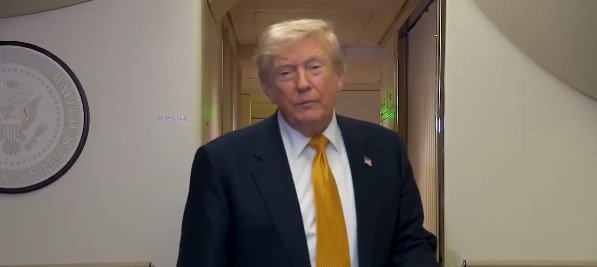
US President Donald Trump aboard Air Force One while on way to Ankara for NATO Summit. (Image White House)
By S. JHA
Trump has threatened an unprecedented economic campaign against Iran and warned countries, banks, businesses and other entities helping Tehran that they could face severe consequences.
Mumbai, August 20, 2026 — US President Donald Trump’s latest Truth Social post on Iran is more than another threat of sanctions. It signals a possible shift from a policy of punishing Iran to one aimed at isolating the entire economic ecosystem that keeps Tehran connected to the outside world.
Calling it an “ECONOMIC D-DAY,” Trump said the United States would launch what he described as the “most crushing economic operation ever taken against any country.” He also warned that countries allowing their financial institutions, businesses, airports or government entities to provide Iran with any economic “lifeline” would face “tremendous economic consequences.”
For years, US policy toward Iran has relied heavily on sanctions. Trump’s latest language suggests that Washington may now seek to make third-country involvement in Iran’s economy itself a target.
The real target may be Iran’s economic lifelines
Trump specifically named oil smuggling, financial swap lines, cash transfers, exchange houses, ship registries and front companies.
These are not random examples. Together, they represent some of the mechanisms through which a heavily sanctioned country can continue trading with the world.
If Washington moves aggressively against these channels, the objective would be to make transactions involving Iran increasingly expensive and risky even for companies and countries that are not themselves under US sanctions.
That is the potentially transformative element of Trump’s announcement.
The United States already has extensive sanctions against Iran. The new threat appears designed to strengthen enforcement by putting pressure on the intermediaries that help Tehran circumvent those restrictions.
In other words, Washington may be preparing to sanction not just Iran, but the networks around Iran.
Why the warning to other countries is important
Trump’s message to other governments is unusually direct.
He said any country providing Iran with a financial or commercial lifeline could face economic consequences. The Times of Israel reported that Trump did not specify what those consequences would be.
That leaves considerable room for interpretation.
The measures could potentially involve restrictions on financial institutions, secondary sanctions, shipping-related penalties, restrictions on access to the US financial system or action against companies facilitating Iranian trade.
Until the administration announces the actual measures, however, it would be premature to assume precisely what form the new campaign will take.
This is why the phrase “Economic D-Day” should currently be understood as a political and strategic declaration rather than the formal name of a specific sanctions programme.
The Strait of Hormuz connection
The announcement comes amid a broader confrontation involving Iran and the unresolved reopening of the Strait of Hormuz. The Wall Street Journal reported that frustration has grown over both the Strait and the lack of progress toward a deal with Tehran.
That gives Trump’s economic threat a wider strategic meaning.
The Strait of Hormuz is one of the world’s most important energy corridors. Any prolonged disruption has consequences far beyond Iran and the United States, particularly for Asian energy-importing economies.
A US campaign aimed at further restricting Iranian oil exports and financial channels could therefore have implications for global energy markets.
The economic pressure on Tehran may increase, but so could the risk of a wider confrontation over trade, shipping and energy security.
Trump is also sending a message to Iran
The post contains another important element.
Trump says Iran was given an opportunity to make a deal but “failed to take it.”
This suggests that the economic campaign is being presented not simply as punishment but as leverage for a political settlement.
The message from Washington appears to be: accept the terms being demanded by the Trump administration or face progressively greater economic isolation.
That is consistent with Trump’s broader negotiating style, in which maximum pressure is used to create conditions for a deal.
But there is a contradiction at the heart of the strategy.
The greater the pressure, the greater the possibility that Iran sees the campaign not as an invitation to negotiate but as an attempt at economic strangulation.
That could make diplomacy harder rather than easier.
What it means for India
For India, the most important issue is likely to be energy, shipping and strategic autonomy.
India has historically maintained important economic and strategic interests involving Iran, even while navigating US sanctions.
Any American attempt to penalise third-country entities dealing with Iran could therefore create difficult choices for countries that want to maintain relations with Tehran while avoiding confrontation with Washington.
The biggest concern is not necessarily direct Indian involvement in Iranian trade. It is the possibility that the US campaign could affect shipping networks, insurance, financial transactions and energy markets well beyond Iran.
If the pressure campaign contributes to prolonged uncertainty around the Strait of Hormuz, the consequences could be felt through higher energy costs and greater volatility in global markets.
For New Delhi, therefore, Trump’s announcement is not simply another Iran-US dispute.
It could become a test of India’s ability to balance relations with Washington, maintain strategic space in West Asia and protect its energy interests.
Jennifer Gavito Says US-Iran Conflict Will Ultimately Return to Diplomacy
Follow The Raisina Hills on WhatsApp, Instagram, YouTube, Facebook, and LinkedIn




About The Author