US Iran oil sanctions waiver explained: what it authorizes
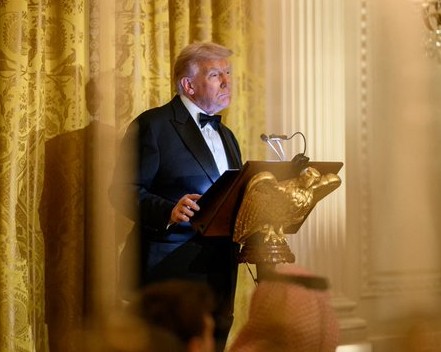
US Presdent Donald trump at a welcome ceremony for Saudi Arabia Crown Prince Mohammed bin Salman. (Image The White House on X)
140 million barrels, a 30-day window, a $14 billion revenue question, and a Strait of Hormuz that is still closed — the full breakdown of America’s most contradictory energy policy decision of the war
By TRH World Desk
New Delhi, March 21, 2026 — The United States Treasury Department issued General License U on March 20, 2026, authorising the delivery and sale of crude oil and petroleum products of Iranian origin loaded on vessels before 12:01 a.m. Eastern Daylight Time on March 20 — permitting transactions through April 19, 2026.
The document, signed by Bradley T. Smith, Director of the Office of Foreign Assets Control, is simultaneously the most pragmatic and most contradictory energy policy decision of the war: Washington is bombing Iran while unlocking Iranian oil for global markets, including — for the first time since 1996 — potential importation into the United States itself.
Treasury Secretary Scott Bessent framed the move as economic warfare rather than concession. “Today, the Department of the Treasury is issuing a narrowly tailored, short-term authorization permitting the sale of Iranian oil currently stranded at sea. At present, sanctioned Iranian oil is being hoarded by China on the cheap,” Bessent stated.
By temporarily unlocking this existing supply for the world, the United States will quickly bring approximately 140 million barrels of oil to global markets, he said, adding: “In essence, we will be using the Iranian barrels against Tehran to keep the price down as we continue Operation Epic Fury.”
Bessent emphasised the limits of the authorisation: it applies strictly to oil already in transit, does not permit new purchases or production, and Iran will face significant obstacles accessing any revenue generated. He said the Trump administration has worked to bring approximately 440 million additional barrels to global markets in total, directly undercutting Iran’s ability to leverage its disruptions in the Strait of Hormuz.
The analytical community was less contained in its assessment.
Journalist Barak Ravid identified the financial scale immediately: the move amounts to approximately $14 billion in oil revenue that Iran could potentially access — making it, in his words, “a huge financial concession to Iran by the U.S.” and “the first time the U.S. is buying Iranian oil since 1996.” His summary captured the central tension: “It’s all happening in the middle of a war against… Iran.”
Gregory Brew, an oil markets historian, was precise about the mechanics: “The US is providing a 30-day sanctions waiver for Iranian oil on the water loaded before 20 March. While the US is trying to bomb Iran into submission, it is permitting nations to buy Iranian oil for the first time since 2019.”
Strategic analyst Edward Luttwak pointed to the geographic conditionality that makes the entire arrangement contingent on the war’s trajectory: “Therefore Iran can again earn dollars by sending out oil from Kharg Island — IF all others can also ship their oil and LNG through the Gulf and Strait.” The Strait of Hormuz remains closed. The “if” in Luttwak’s formulation is load-bearing.
The internal contradiction is structural, not incidental. Washington is conducting sustained military strikes on Iranian energy infrastructure under Operation Epic Fury while simultaneously issuing a Treasury license that authorises the global sale of Iranian crude — including importation into the United States — and which could deliver Tehran up to $14 billion in revenue the administration insists Iran will struggle to access.
Bessent’s framing — “using the Iranian barrels against Tehran” — is the administration’s attempt to resolve the contradiction rhetorically. Whether the oil markets, the Gulf states watching Hormuz, or Iran’s own leadership accept that framing is a different question entirely.
The license expires April 19, 2026. The war has no expiry date on the document.
Follow The Raisina Hills on WhatsApp, Instagram, YouTube, Facebook, and LinkedIn




About The Author