Inside Sonam Wangchuk’s Protest: A Cause That Resonates but Fails to Mobilise India
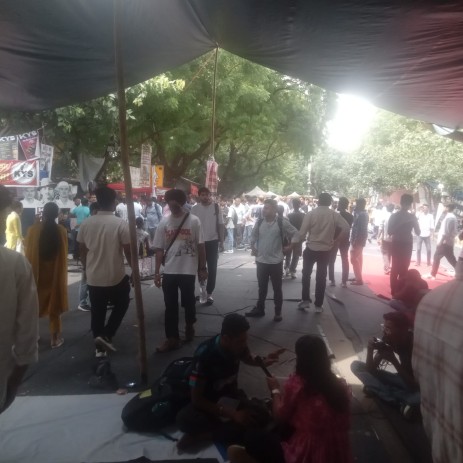
The CJP protest venue at Jantar Mantar in New Delhi. (Image TRH)
By MANISH ANAND
The CJP protest at the Jantar Mantar is riding Sonam Wangchuk alone, and this aspect is a big verdict on Abhijeet Dipke and his skills on mass mobilisation.
New Delhi, July 16, 2026 — The police frisks visitors at Jantar Manter venue of the indefinite fast of activist Sonam Wangchuk after they walk through metal detectors. From a makeshift corner, activists offer Tata Copper mineral water in 200 ml bottles. The street isn’t enough noisy.
Political visitors make their appearances on the stage. They’re mostly from the neighbouring Uttar Pradesh. They deliver quickfire speeches, aiming at Prime Minister Narendra Modi-led government at the Centre for “utter disarray in the education field.”
On the stage, Sonam Wangchuk rests as he remains on an extended indefinite fast. Doctors show up. Supporters rush to enquire of the latest health readings.
Rappers take stage, in between. They in a sonic boom belt out “we’re cockroach.” The audience gets a feel of a DJ. Hip-hop moves sync with the rapper’s elaboration of “we’re cockroach.”
In one corner, student activists affiliated to the Student Federation of India (SFI) exhibit gravity of the “crisis in the education sector.” On the other side of the pavement, large posters reveal “decay in India’s education sector.”
The entre stage of the protest venue belongs to an army of content creators. With cameras turned to face the stage, the content creators look out for the next trending “reels.”
A drone also keeps mapping the area. The green colour drone makes aerial videos to feed the social media channels of the Cockroach Janata Party (CJP).
The nearby Metro stations are open, and the people can freely come and go. One can also walk to the protest venue with ease and exit without rubbing shoulders with others.
Those who covered the Anna Hazare movement in the initial days give their verdict: this isn’t that big. “That was something extraordinary.”
The few people who visit the protest venue hold sympathy of Wangchuk. “He has taken the right cause. Education sector is in a mess.”
But that sympathy doesn’t translate into the ordinary people transforming into agitationists. The supporters come and go. They don’t stay. Those who stay longer are mostly from the students’ unions.
CJP founder Abhijeet Dipke sounds unimpressive when he speaks. He shot to prominence with internet satire movement. But he lacks skills necessary to stir a ground-based movement. Wangchuk remains the sole face of the agitation.
Paper leaks have marred examinations in Rajasthan, Uttarakhand, Bihar, and Uttar Pradesh. The CJP protest could have acquired the force of a popular protest if students had been coming to Jantar Mantar from the paper leaks affected states. They seem to have given a miss, leaving the CJP to bank on activists from Delhi and its satellite towns.
Wangchuk isn’t a greenhorn protestor. He has held several indefinite fast protests in Ladakh. He had even been jailed, quite recently.
The Ladakh-based activist would have already sensed that Modi is excessively cold to street protests. This should allow Wangchuk to make a tactical judgment. By unveiling an action agenda to galvanise the youth across the country, Wangchuk can make a honourable retreat to fight a bigger battle.
Follow The Raisina Hills on WhatsApp, Instagram, YouTube, Facebook, and LinkedIn




About The Author