Ram Madhav’s BJP Return: RSS Concession or a Bigger Political Script?
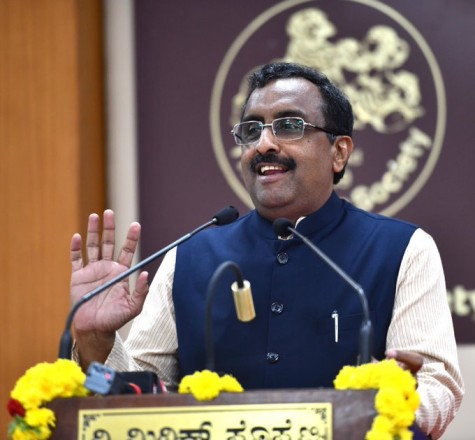
BJP vice president Ram Madhav speaks at an event in New Delhi. (Image Madhav on X)
By MANISH ANAND
After a gap of six years, Ram Madhav returned to the BJP as a vice president at a time when the RSS has begun asserting control over its political shoot after years of drift in relations.
New Delhi, August 2026 — BJP president Nitin Nabin has named Ram Madhav as the vice president of the party, marking his formal return to the party-fold after a gap of six years. He is among 13 vice presidents of the BJP. Nabin on Monday unveiled a new team of 64 national office bearers of the BJP.
Madhav’s earlier stint in the BJP was as the national general secretary. His position in the first few years of the Modi government almost rivalled that of then party president Amit Shah. Madhav regularly attended meetings at 7, Racecourse Road, now named Lok Kalyan Marg, residence of the Prime Minister.
From strategic matters to the affairs of Jammu and Kashmir and the Northeast, Madhav raised stakes for the BJP. As Shah consolidated power in the BJP and brought together his core team, Madhav’s clout began waning, leading to his eventual exit as J.P. Nadda unveiled the BJP’s national executive in 2020. The RSS accommodated Madhav in its national executive.
Madhav on Margins and Deepening BJP-RSS Divide
Madhav’s exit from the BJP also set off a phase in the saffron outfit when the party sought to assert a functional autonomy from the RSS. Nadda’s tenure as the BJP president, from 2020 to 2026, is reckoned as a time span when the RSS control on the party weakened. This became public when Nadda said in an interview in 2024 that “the BJP is now self-reliant to run own affairs without needing hand-holding from the RSS.”
That statement rang alarms in the RSS. The BJP’s loss of own majority in the Lok Sabha in the 2024 general elections, in part, is attributed to its strained relations with the RSS. The BJP top brass got the message that the RSS is still critical for the party’s electoral fortunes.
Later, fissures were ironed out. The BJP conveyed discreetly to the RSS that the mentorship is respected. The RSS came back strongly and led the charge in the Maharashtra Assembly elections in 2024 by unleashing an unprecedented outreach to help the BJP-led alliance win the elections. The RSS doubled the efforts for the Delhi Assembly elections. The same was in play in Haryana and the Jammu region too.
The BJP’s efforts to repair bond with the RSS coincided with the return of Madhav for election works. The BJP had tasked Madhav to look after party’s poll preparations for Jammu and Kashmir Assembly elections. In August 2024, the BJP named Madhav as election in-charge for J&K polls.
While Madhav’s exit from the BJP in 2020 set in motion the drift of the party from the RSS, his roping in for the J&K polls also marked a tactical readjustment by Modi-Shah dispensation. Since then, the BJP and the RSS worked in improving ties. Eventually, the thaw culminated in Modi visiting the RSS headquarters in Nagpur in March 2025.
The next few months saw intense speculation on Modi’s future as the Prime Minister as he approached his 75th birthday in September 2025. Insiders in the BJP claimed that much of the fodder to the rumour mills came from the RSS only on the fate of Modi as the PM once he turned 75.
At last, RSS chief Mohan Bhagwat cleared the air, saying “one can stay in the office as long as there’s physical fitness.” His statement was preceded by Modi showing immense praise on the RSS when he spoke from the Red Fort on August 15, 2025, as well as personal accolades through a newspaper article, published by many, to Bhagwat when he himself turned 75.
Madhav remained a key instrument in the evolving relations between the BJP and the RSS. Madhav’s proximity to RSS joint general secretary Dattatreya Hosbole is widely known. Bhagwat is also known to consider Madhav as a valuable asset.
Madhav as Link to RSS Bid for Global Attention
Last year, on Vijyadashmi, the RSS revealed its eagerness to seek global recognition as the outfit invited dozens of opinion writers of foreign media publications to Nagpur. Many of them attended the event and later wrote articles in foreign publications on the RSS.
As the one-year centenary celebrations of the RSS come to conclusion this year on Vijyadashmi in the next few months, Bhagwat himself is embarking on a foreign tour. This month Bhagwat will be visiting the US, Canada, and the UK.
Bhagwat’s foreign outreach was preceded by Hosbole on similar outings. The objective is for the foreign commentators to know the RSS by listening to its top functionaries firsthand.
After he was dropped from the BJP’ national executive, Madhav busied himself on the diplomatic turf through his India Foundation. His connect with foreign think tanks is seen as a crucial link for the RSS to seek a favourable depiction in commentaries in place of being simply called a right-wing Hindu outfit. The RSS is seeking a portrayal of a cultural organisation, per some of its functionaries.
Madhav, per RSS insiders, has significant influence on top brass of the organisation in shaping their geopolitical views. Lately, the RSS is growing wary of Modi’s America foreign policy. This became evident after Swadeshi Jagran Manch (SJM), an affiliate of the RSS, on August 12, gave a call to boycott the US goods due to the tariff threats on India for buying Russian oils. The SJM urged upon the Modi government to “stay firm on buying the Russian oils.”
Madhav in the BJP: A Token concession
“The BJP vice presidents now mostly have ornamental roles, to light lamps at the stages,” said a former vice president of the party. Madhav will be among the 13 vice presidents of the BJP. The key meetings of the BJP are attended by the general secretaries. They strategize and make decisions.
In his earlier stint, Madhav as the national general secretary was instrumental in drafting key resolutions of the party. He is believed to have drafted the resolutions adopted by the BJP at the Kozikode national executive meeting, which had taken place in the backdrop of the Uri terror attack in 2016.
Till Shah was president of the BJP, some of the party’s vice president such as Om Mathur, Prabhat Jha, Vinay Sahasrabuddhe played active roles in state elections. After Nadda took over as the BJP president in 2020, the party’s vice presidents mostly became posts of respects granted to senior leaders. Under Nitin Nabin, the practice is not likely to see a dramatic change.
Thus, Madhav may not be returning to political thick of actions. At best, his rehabilitation in the BJP is a token concession from Modi-Shah to the RSS. That the BJP top brass accepts the importance of the RSS in party’s affairs.
Many waters have flown in the Ganges since Madhav was dropped from the BJP national executive in 2020. Nadda almost spent his entire six years long tenure as the chief of the party in the shadow of Shah. In the case of Nabin, this is already talk of the town.
In the run up to elections, strategy meetings take place at the residence of Shah. In fact, Shah is considered to be the last BJP president who exercised a fair amount of autonomy in his functioning. Madhav’s last stint in the BJP was with Shah.
Madhav returns to a changed BJP where the party president, per insiders, wait for approval for taking decisions. Madhav also returns to the BJP at a time when some of the past formalities such as holding meetings of the parliamentary board or election committee have become rare.
Madhav also returns to the BJP at a time when the party has conveniently ignored holding a national executive meeting every six months. In Shah’s BJP presidency, Union Ministers were regularly seen at the party office. After Shah joined the Modi Cabinet, the power centre shifted away from the BJP headquarters.
Why RSS will Need Madhav in BJP?
The RSS’ presence in the BJP never depleted in the numerical sense. B.L. Santhosh, per the custom in the BJP, is an RSS import as the general secretary (organisation). His two deputies, Saudan Singh and Shivprakash (both joint general secretaries organisation), are from the RSS. The BJP’s arguably most powerful general secretary Sunil Bansal is also an RSS pracharak. They represent the core of the RSS presence in the BJP, holding key positions.
Yet, Nadda asserted autonomy in functioning from the RSS. Despite the presence of these RSS men in the BJP, the party drifted away from its saffron mentor during Nadda’s stint at the helm of the BJP.
Additionally, the RSS has taken a note of the post of the BJP president seen working in the shadow of another power centre. The RSS, per insiders, views a weak BJP president as a sign of a weaker organization.
Madhav is the RSS’s trusted man in New Delhi. In the BJP, even with a ceremonial post, he will be the eyes and ears for the RSS. With him in the BJP, the RSS will hope that the party begins functioning independent of outside power centre. Madhav’s presence in the BJP in an official position will remind the party’s top-brass that the RSS is watching the functioning closely.
The BJP top-brass may believe that Madhav’s rehabilitation as the party’s vice president is a small give away to the RSS. But insiders in the party state, the Nitin Nabin presidency is marked for extraordinary affairs. Nabin presidency has the likelihood of confronting the question: “who after Modi.”
Modi will be 79 years old in 2029. If Nabin takes two terms as the BJP chief, he may stay at the helm of the party till 203. Modi will be 82 years old then, well beyond the comfort of the RSS to hold an office.
The third term of Modi is already writing the subtext of “who after him.” Until the Cockroach Janata Party (CJP) arrived at the Jantar Mantar, the BJP was looking far into future with prospects of holding power at the Centre. The events of July have brought moderation in the long power vision of the BJP leaders, who now are worrying about immediate challenges.
The CJP protests also made the BJP leaders discussing the prospects of confronting “who after Modi” sooner than far latter. That was in the aftermath of the Gen Z assault on Brand Modi.
But whenever “who after Modi” question erupts, Madhav’s presence in the BJP may give the RSS a ringside view of the happenings in the party. The RSS had convinced L.K. Advani to not oppose Modi as the PM face of the BJP for the 2014 Lok Sabha elections. The RSS by all accounts may assert its authority to choose the successor of Modi whenever time comes, and for that Madhav may have suitably been placed in the BJP.
Modi Meets BJP’s New Team: Seva Setu and Vande Mataram Take Centre Stage
Follow The Raisina Hills on WhatsApp, Instagram, YouTube, Facebook, and LinkedIn




About The Author