A Fortress Falls: What Prashant Kishor’s Bankipur Victory Says About Bihar Politics
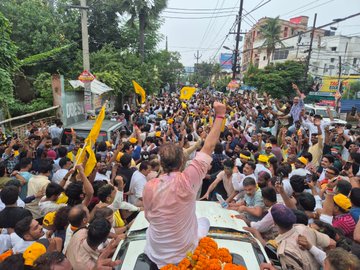
Jan Suraj founder Prashant Kishor holds a roadshow after his victory in Bankipur Assembly byelection (Image Jan Suraj on X)
By RAJESHWAR JAISWAL
The bypoll result is more than an upset—it reflects voter frustration with governance, campaign arrogance and the search for an alternative in Bihar.
Patna, August 3, 2026 — Prashant Kishor’s victory in the Bankipur Assembly bypoll is not merely the success of an individual candidate or the Jan Suraaj Party. It is a political event that deserves to be read as a broader commentary on the mood of Bihar’s urban electorate.
For nearly three decades, Bankipur had been regarded as one of the Bharatiya Janata Party’s safest constituencies. The constituency’s demographic profile, political history and organisational strength made it a seat where the BJP was expected to win almost by default. Opposition parties often entered the contest only symbolically, with little expectation of victory.
That assumption has now been shattered.
The result suggests that political strongholds are not impregnable when voters believe that their concerns are not being adequately addressed.
Several factors appear to have converged in Prashant Kishor’s favour.
The first was public resentment over the controversial police handling of the Bharat Tiwari episode. Whether justified or not, the perception among many residents was that the administration had acted unfairly. In politics, perception often matters more than official explanations. The anger was directed not only at the police but gradually extended to the state government itself.
The second factor was the student-led agitation that gathered momentum in Bihar after protests linked to education and employment acquired national attention. What initially appeared to be a limited protest in New Delhi expanded after opposition parties joined the movement and it reached Parliament. In Patna, however, the issue acquired an entirely different dimension. Young voters increasingly viewed the protests as a symbol of dissatisfaction with governance rather than merely an isolated agitation.
The political atmosphere created by these developments benefited Prashant Kishor, who had consistently projected himself as someone willing to confront the administration on behalf of ordinary citizens. During the campaign he was seen publicly questioning officials and standing with his supporters in disputes involving the local administration. Whether one agrees with his style or not, such actions helped cultivate the image of a leader prepared to challenge the establishment rather than accommodate it.
Yet perhaps the BJP’s biggest setback was self-inflicted.
During the campaign, a BJP leader reportedly remarked that “anybody fielded by the BJP could win from Bankipur.” The statement spread rapidly across Patna through political circles and social media. Many voters appear to have interpreted the remark as dismissive of the constituency’s electorate—as though the choice of candidate did not matter because victory was guaranteed.
Bankipur is among Bihar’s most politically aware and educated urban constituencies. Such voters often take pride in independent political judgment. The perception that the constituency could be taken for granted may have generated a silent backlash.
Bharat Tiwari’s Death Has Become Bihar’s Political Rorschach Test
In politics, arrogance is frequently punished more severely than organisational weakness.
The BJP also overlooked several local faces who arguably possessed stronger personal appeal and could have made the contest more competitive. By not fielding a candidate with deeper local credibility, the party appeared to underestimate both Prashant Kishor and the changing political mood.
Prashant Kishor, meanwhile, displayed a version of himself that differed from his public image of recent years. Often criticised for appearing overly confident, he adopted a noticeably more restrained and accessible campaign style. Humility, whether genuine or politically calculated, can become a powerful electoral asset when contrasted with an opponent perceived as complacent.
His campaign also succeeded in shifting the conversation beyond the routine issues of roads and drains. He repeatedly framed the election as a referendum on Bihar’s future leadership, arguing that the state needed better governance, quality education, employment opportunities and an end to large-scale migration. By elevating the narrative above local civic issues, he transformed a bypoll into a larger political statement.
This does not automatically mean that Bihar’s political equations have fundamentally changed or that Jan Suraaj has emerged as the state’s dominant alternative. One election cannot erase decades of organisational strength enjoyed by established parties. Nor should sweeping conclusions be drawn from a single constituency.
However, Bankipur has delivered an unmistakable warning.
Safe seats are no longer entirely safe.
Urban voters are increasingly willing to cross traditional political boundaries if they believe that governance has become complacent or leadership disconnected. They are also signalling that political messaging matters as much as caste arithmetic, particularly in educated constituencies.
For the BJP, the verdict should serve as a reminder that electoral dominance cannot substitute for careful candidate selection, humility and responsiveness.
For Prashant Kishor, it is an important political breakthrough—but also the beginning of a much tougher test. Winning one symbolic battle is easier than building a durable political movement across Bihar.
The coming Assembly election will reveal whether Bankipur was an exception—or the first sign of a deeper political realignment.
(This is an opinion piece. Views expressed are the author’s own.)
Follow The Raisina Hills on WhatsApp, Instagram, YouTube, Facebook, and LinkedIn




About The Author