Eves Behind Manipur PWG Surrenders: Families Key to Militants Returning
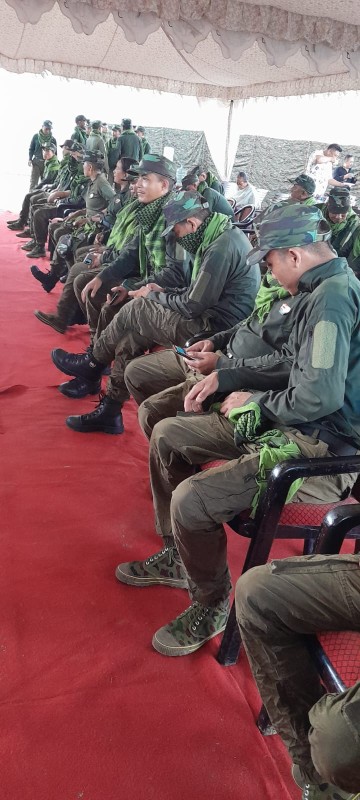
Surrendered KCP-PWG militants in Imphal. (Image Nirendra Dev)
By NIRENDRA DEV
Behind the surrender of KCP-PWG militants lies a story of wives, daughters and parents persuading loved ones to abandon insurgency, even as rehabilitation challenges persist.
Imphal, July 23, 2026 — It is true that a series of relentless efforts by the security forces, including the Assam Rifles, played a crucial role in persuading armed KCP-PWG cadres led by their chairman, Tamnganba, to lay down arms and pledge to rejoin the social and national mainstream.
Joblessness remains one of the biggest issues in Manipur. Authorities and the political leadership under Chief Minister Y. Khemchand Singh have welcomed the surrendered cadres back into the mainstream and urged other armed groups operating within and outside the state to abandon violence and contribute to Manipur’s development.
However, interactions with a few former cadres and their family members reveal that significant challenges remain. There is always the risk that some problems in the rehabilitation policy could become a revolving door for militants.
Former militants remain vulnerable to social stigma and security threats. In a violence-hit state like Manipur, which continues to grapple with multiple insurgent groups, sections of the local population still view militants as “freedom fighters.”
Broadly, Manipur is home to three major ethnic communities — Meiteis, Kukis and Nagas. Within each community, multiple insurgent organisations and ethnic fault lines continue to shape both divisions and alliances.
Among Meitei insurgent groups are the Kangleipak Communist Party–People’s War Group (KCP-PWG), PLA, UNLF, PREPAK and others. At least some of the former PWG cadres who surrendered on July 22 before Chief Minister Khemchand Singh, in the presence of senior military officers including GOC Spear Corps Lt Gen Girish Kalia, admitted they had worked with more than one militant organisation.
“You are right… we also have defection seasons, just like the BJP and Congress,” one of them joked in pidgin Hindi after learning that this writer was a “Delhi-wallah.”
A woman standing nearby smiled and remarked, “In Manipur, there is ‘Imphal-wallah’,” making a subtle political point.
A 66-year-old father of one of the surrendered militants said, “Youngsters of our generation joined underground organisations mainly because there were no adequate employment opportunities.”
“I know boys who wanted to join the Assam Rifles or the CRPF, but they eventually drifted elsewhere,” he added. Perhaps the most compelling stories came from the women.

Asked why her husband decided to surrender, Alva, in her twenties, said: “I made him do so. We got married in January 2026. It was a love marriage. My parents and brothers were against it.”
“I could hardly spend time with him. A few months ago, when we met in a hideout, I told him — either return to the mainstream and give up arms, or forget me and our future child,” she said.
Teenager Elina spoke emotionally about her father.
“My father loved me very much. He bought me gifts and sent money on my birthdays, but he was not willing to give up his ideology. Yes, he is a communist,” she said.
“My prayer to God has finally come true. My father has returned to the mainstream.” She quickly added, “But the real credit goes to my mother. She cried for hours. Ultimately, she convinced him.”
While relishing a samosa, the ambitious young girl asked, “Uncle, do you think I should become a journalist or join the Indian Army?” I replied honestly, advising her to stay away from “my media world by miles.”
Another young man, pursuing a PhD in Manipuri at Assam University, Silchar, had travelled to attend the surrender ceremony because his brother was among those laying down arms.
“We are happy. I came specially from Silchar. I also met Army officials and requested them to ensure adequate protection for our family,” he said. Such apprehensions are not without reason.
Apart from rival insurgent groups — whether Naga, Meitei or Kuki — even within the larger PWG fraternity, it cannot be stated with certainty that the July 22 surrender marks the complete end of the KCP-PWG faction.
What is certain, however, is that the regional network and territorial influence of the Tamnganba-led faction have been significantly dismantled.
Yet the surrender may also create resentment among remaining factions. Retired military officers who served in the Northeast say rehabilitation is only the beginning. “These poor chaps face enormous problems trying to live a normal middle-class life,” one former officer said.
“Even before anyone knows their militant past, they are already disadvantaged in the job market because they lack employment experience,” he added.
Their identity as former militants often becomes a burden not only for them but also for their families. There have been instances across the Northeast where such families have faced social ostracism.
Another expert argued that while former militants should remain accountable under the law for crimes such as extortion, public disclosure should be handled carefully.
“They broke the law and should face the criminal justice system. But there is also a question of how much disclosure is necessary. The media has a responsibility here,” he said.
Former militants between the ages of 22 and 50 often struggle with long gaps in employment, limited professional networks and social acceptance.
Military scholars and experts on insurgency have long argued that successful rehabilitation requires sustained counselling, community engagement and ideological reorientation. In the Northeast, this may include faith-based counselling for Christian former militants, alongside broader value-based discussions drawing from figures such as the Buddha and Swami Vivekananda.
Yoga and psychological counselling have also shown encouraging results in helping former militants question extremist beliefs and adopt more inclusive, democratic perspectives.
Ultimately, rehabilitation cannot end with a surrender ceremony. It must open minds, rebuild trust and create genuine opportunities so that former militants do not find themselves drawn back into the underground.
46 Meitei PWG Militants, Including Four Women, Lay Down Arms in Imphal
Follow The Raisina Hills on WhatsApp, Instagram, YouTube, Facebook, and LinkedIn




About The Author