Why the Modi Government Won’t Remove Dharmendra Pradhan
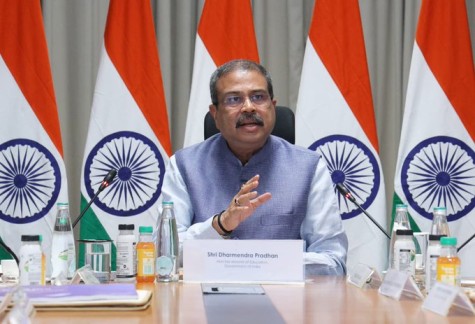
Union Minister Dharmendra Pradhan (Image Ministry of Education on X)
By RAVI SHANKER KAPOOR
The refusal to seek the Education Minister’s resignation despite mounting criticism reflects a deeper political mindset, argues the author.
New Delhi, July 23, 2026 — Is Education Minister Dharmendra Pradhan so important—or so powerful—that the Bharatiya Janata Party (BJP)-led government at the Centre is unable to seek his resignation? Or is it a fact that the two leaders who matter most in the current dispensation are Prime Minister Narendra Modi and Home Minister Amit Shah?
These are questions increasingly being asked in political circles. The answer, the author argues, lies in a single word: self-righteousness.
I have referred to this trait before, writing that “the shamelessness of the BJP-led government at the Centre is matched only by its self-righteousness.” In my view, self-righteousness has become a defining characteristic of the ruling party and the larger political establishment.
Merriam-Webster defines self-righteous as “convinced of one’s own righteousness, especially in contrast with the actions and beliefs of others; narrow-mindedly moralistic.”
Almost all of us exhibit some degree of self-righteousness. We often justify or overlook our own shortcomings or those of our family and friends. But self-righteousness becomes more problematic when logic is twisted to shield serious wrongdoing, when dubious arguments are deployed to defend the indefensible, or when fallacies such as argumentum ad hominem and whataboutery are used to avoid accountability.
Pradhan’s public gaffes are exemplary. Although he claims to hold a master’s degree in anthropology from Utkal University, he once stated that the Equator and the Tropic of Cancer meet at Ujjain. In reality, the Equator does not pass through India, and the Equator and the Tropic of Cancer are parallel imaginary lines that never intersect.
The criticism extends beyond alleged irregularities in the National Eligibility-cum-Entrance Test (NEET) and other competitive examinations.
The University Grants Commission (Promotion of Equity in Higher Education Institutions) Regulations, 2026, implemented by the Ministry of Education, introduced divisive provisions that contradicted the BJP’s own political messaging centred on unity.
These regulations were consistent with the broader direction of the National Education Policy (NEP) 2020, which is criticised for promoting the concept of “equity” over “equality.” The equality should mean equal opportunity and common standards, whereas equity places greater emphasis on equal outcomes.
The NEP incorporates aspects of contemporary gender ideology that can be seen with Left-wing academic thought. It questions why a government identified with the political Right would adopt policies that, in the author’s view, reflect progressive ideological frameworks.
The broader argument is that both the Indian Right and the Left display a similar tendency towards ideological certainty and self-righteousness.
Socialism and communism for their historical record have been at odds with progress of the society. Hindutva, although different in its consequences, similarly displays a disregard for facts, reason and evidence. Political slogans and ideological narratives often take precedence over objective policymaking.
Within this framework, the continued retention of Dharmendra Pradhan is a political decision rather than an administrative one.
Removing the Education Minister would amount to acknowledging that the government had erred—an admission the ruling establishment is unwilling to make because it sees itself as fundamentally correct.
Cabinet ministers generally leave office only when Prime Minister Narendra Modi decides. Union minister M.J. Akbar’s resignation during the #MeToo controversy was a rare exception and then Railway Minister Suresh Prabhu had also offered to resign following railway accidents in 2017 while that was not accepted.
This political culture explains why demands for Dharmendra Pradhan’s resignation have not resulted in any change, despite sustained criticism and repeated controversies.
(This is an opinion piece. Views expressed are the author’s own.)
Paper Leaks Won’t Stop by Changing Ministers, Says Former Education Secretary
Follow The Raisina Hills on WhatsApp, Instagram, YouTube, Facebook, and LinkedIn




About The Author