Selfies Under Bombs: Iran’s Leadership on Tehran Streets
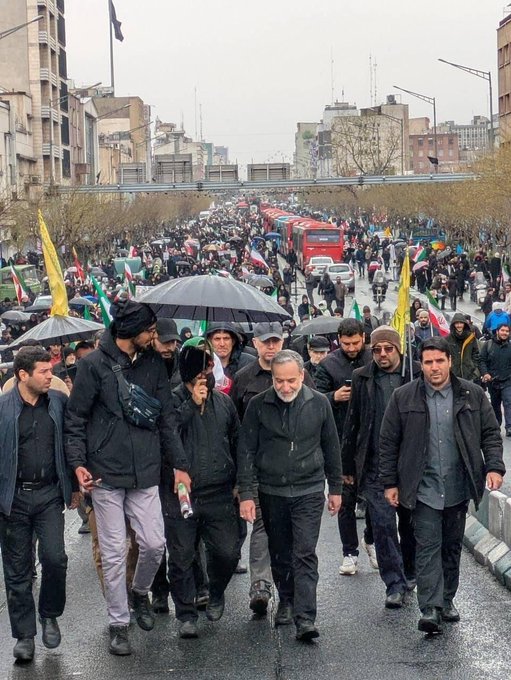
Iran's Foreign Minister Seyed Abbas Araghchi during International Quds Day walk (Image X.com)
Iran’s president, foreign minister and top security official march publicly through a city being bombed, as analysts across the political spectrum agree the war is unfolding nothing like the US and Israel predicted
By TRH World Desk
New Delhi, March 13, 2026 — On Day 14 of the US-Israel war on Iran, the imagery coming out of Tehran delivered perhaps the most powerful single rebuttal yet to the strategic assumptions that launched the conflict.
Iranian President Masoud Pezeshkian walked through a massive Quds Day rally in Tehran — no security cordon, no bunker, taking selfies with the crowd. Foreign Minister Seyed Abbas Araghchi marched alongside ordinary Iranians and posted defiantly on X: “Iranians will ALWAYS stand firm and NEVER cower before cowardly attacks. Video: Reaction of demonstrators when Tehran was bombed today is nightmare for aggressors.”
Ali Larijani, Iran’s most senior remaining national security official and the man effectively running the country’s wartime government, not only marched through the streets but stopped to give a live television interview as Israeli strikes hit nearby areas of the capital.
The spectacle drew immediate and pointed commentary from analysts and journalists spanning the ideological spectrum.
Political analyst Ali Alizadeh, writing on X, framed the moment in historical terms: “Trump was told the Iranian state would be hiding in bunkers, ready to surrender once Khamenei was assassinated. Day 14: Pezeshkian walks through a massive Tehran rally — no security, taking selfies with the crowd. One of the most memorable middle fingers in history to the US empire.”
Ian Bremmer, president of the Eurasia Group, was characteristically dry: “I’m starting to get the feeling that the Iranians are not about to surrender unconditionally.”
Gregory Brew, also of the Eurasia Group, provided the granular breakdown: “Larijani, Araghchi, Pezeshkian, Arafi and others were out during Quds Day marches. Regime leadership not afraid of appearing in public. Notable no-shows: Mojtaba Khamenei, the new Supreme Leader, and Qalibaf, who is likely involved in running the day-to-day war effort.”
CNN’s Christiane Amanpour, reporting from the ground, noted that Larijani told onlookers directly that “Trump has underestimated the Iranian people” — a message he delivered outdoors, in public, despite drones and assassination attempts operating overhead.
Aaron Bastani, writing on X, drew the strategic conclusion plainly: “Pezeshkian and Araghchi both on streets of Tehran today, in the middle of war. Iran’s president and foreign minister are posing for selfies. This conflict isn’t unfolding like Washington and Tel Aviv thought — or how audiences across the West were told it would.”
The one dissenting note came from Israeli journalist Amit Segal, who reframed Larijani’s public appearance not as defiance but as a calculated bet on Israeli restraint. “Larijani is confident that — unlike his own country — Israel will not strike civilians,” Segal wrote, arguing the march was “less an act of bravery than an act of faith in the IDF.”
Whatever the interpretation, the strategic picture on Day 14 is unmistakable. The rapid collapse scenario that reportedly anchored early US and Israeli planning — a decapitated leadership hiding underground, a population ready to turn — has not materialised. Instead, Iran’s government is governing in public, its streets are full, and the bombing appears to be functioning, as it historically tends to, as a nationalist accelerant rather than a surrender mechanism.
The gap between what was promised and what is unfolding grows wider by the day.
Follow The Raisina Hills on WhatsApp, Instagram, YouTube, Facebook, and LinkedIn




About The Author