US-Iran War: Modi Government’s Foreign Policy Under Fire
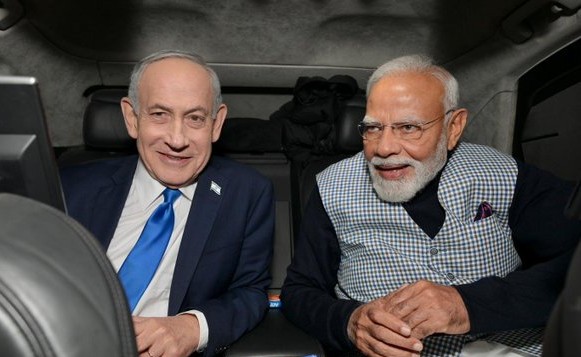
Prime Minister Narendra Modi with Israel's PM Benjamin Netanyahu in Tel Aviv (Image Israel PM on X)
From failing to condemn the killing of 163 Iranian schoolchildren to voting with the US at the UNSC, India’s once-proud non-alignment tradition is cracking — and ordinary Indians are already paying the price at the gas cylinder
By TRH Political Desk
New Delhi, March 13, 2026 — As the US-Israel war on Iran enters its twelfth day, a pointed and uncomfortable question is echoing through India’s Parliament, its street corners, and its social media feeds: why has the world’s largest democracy refused to condemn the missile strike that killed 163 schoolchildren in Iran?
Mexico’s president condemned it. Italy’s Prime Minister Georgia Meloni condemned it. Spain’s prime minister condemned it. India has not.
Foreign affairs commentator Manish Anand, in his monologue for The Raisina Hills, framed the silence as a symptom of something deeper. “India’s foreign policy tradition was never about being neutral — it was about being on the side of rule of law, on the side of justice. What justice happened to those children in Iran? Why can India not condemn that incident?” he asked pointedly.
The criticism extends beyond a single statement. Anand highlighted Prime Minister Narendra Modi’s address to the Israeli Knesset just days before the war began — a speech that, by his account, was entirely one-sided in Israel’s favour, with no acknowledgement of Iranian interests, no call for UN-mediated resolution, and no invocation of international law against attacking a sovereign nation. ‘A perception has now formed inside Iran that the Modi government is simply pro-Israel, and that India has severed its traditional ties with Tehran,” Anand said.
Those ties run deep. Thousands of Indian students study medicine in Iran. Nearly 10 million Indian diaspora workers live across the Gulf region. India imports roughly 90 per cent of its crude oil, with a substantial share historically sourced from Middle Eastern producers. A Thailand-flagged oil tanker bound for India’s Kandla port was struck and destroyed by Iran — a signal, analysts say, of how India’s perceived alignment is translating into real strategic cost.
The domestic fallout is already visible. Gas cylinder shortages have begun shutting down street food vendors and small traders in Delhi-NCR and across southern states — ordinary citizens absorbing the first shockwaves of a war their government publicly declined to oppose.
Parliament has erupted. The opposition, led by Rahul Gandhi, has used the budget session’s second phase to subject Modi’s foreign policy to what Anand described as a full postmortem. Former National Security Adviser Shivshankar Menon has said publicly that India’s inherited diplomatic tradition has been damaged by the current government’s approach.
India’s vote in favour of a US-sponsored UN Security Council resolution — widely seen as one-sided against Iran — has compounded the unease. “Even the aggressor in this war was America and Israel, not Iran. And yet India stood with the aggressor at the United Nations,” Anand noted. “That raises serious questions.”
For a country that once led the Non-Aligned Movement, positioned itself as the voice of the Global South, and built seven decades of foreign policy on the principle of strategic autonomy, the current moment represents a reckoning. As inflation tightens its grip on Indian household budgets and the Gulf diaspora grows increasingly vulnerable, the cost of alignment — or even the perception of it — is no longer abstract.
(Views expressed are those of Manish Anand.)
Trump’s Iran War Bind: The Biggest Illusion of Middle East Conflict
Follow The Raisina Hills on WhatsApp, Instagram, YouTube, Facebook, and LinkedIn




About The Author