Russia Emerges as the Quiet Winner of the Iran–US–Israel War
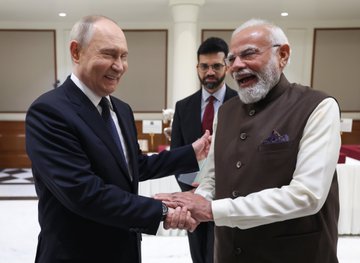
Prime Minister Narendra Modi with Russian President Vladimir Putin in New Delhi on Thursday. (Image Modi on X)
While Tehran absorbs strikes and Western attention fractures, Moscow exploits higher oil prices, surging Indian demand for Russian crude, and the slow collapse of its rivals’ influence — all without firing a shot
By NIRENDRA DEV
New Delhi, March 12, 2026 — Twelve days into the American and Israeli military campaign against Iran, one country appears to be reaping the rewards without bearing any of the costs: Russia.
European Council President António Costa has stated bluntly that Moscow is the “only winner” of the conflict so far — and the evidence is mounting.
For the Kremlin, the war in West Asia presents a rare convergence of strategic opportunities. Western attention is fragmenting. Energy markets are in turmoil. And Russia’s sanctioned oil is suddenly in higher demand than ever.
India’s Russian oil imports surged nearly 50 per cent in March 2026, rising to approximately 1.5 million barrels per day from 1.04 million barrels per day in February — a direct consequence of disrupted Gulf supplies. India, the world’s third-largest crude importer, consumes around 5.8 million barrels per day, with nearly 88 per cent sourced from abroad. With shipments from traditional Gulf suppliers — Saudi Arabia, Iraq and the UAE — now delayed, New Delhi is actively diversifying toward alternative sources to stabilise domestic markets.
Bangladesh offers a parallel case. Over the 14 months between January 2025 and March 2026, Bangladesh imported around 20.69 lakh tonnes of crude oil, with Saudi Arabia, the UAE and Iraq together supplying roughly 63 per cent of that total. But disruptions have exposed the fragility of that dependence, prompting Dhaka to seek a US sanctions waiver to purchase Russian oil directly.
Bob Hamilton, a former US Defence Department official, describes the situation for Moscow as a double-edged equation. “It has positive aspects and negative ones,” he said — a sword, as he put it, with two edges. On one side, higher energy prices and a distracted West benefit Russian coffers and relieve pressure on Ukraine. On the other, the war lays bare the limits of Russia’s eroding influence in the very region it sought to anchor.
“Iran was the second pillar of Russia’s strategy in the Middle East alongside Syria, and now Moscow has lost both,” Hamilton noted pointedly.
Russia is navigating this tension with studied ambiguity. On March 10, US envoy Steve Witkoff confirmed in a CNBC interview that Russia had told the Trump administration it was not sharing intelligence on US military assets with Iran. That calculated distance serves Moscow well — appearing neutral enough to protect Gulf relationships while doing just enough to keep Iran from collapse, all without risking a direct confrontation with Washington.
The broader energy fallout is accelerating. Crude oil supply disruptions can be partially managed through diversification, analysts say, but liquefied petroleum gas may prove harder to replace if Gulf instability persists. Countries from Pakistan to parts of South Asia have already begun introducing austerity measures — Pakistan has moved to a four-day workweek for public employees and announced school closures from March 16.
The effects of this war, in other words, are being felt far beyond any battlefield. And as the conflict stretches on, Moscow’s posture of watching, waiting and profiting grows ever more deliberate.
Iran Drone Strike Kills 6 US Soldiers in Kuwait, Injures Dozens
Follow The Raisina Hills on WhatsApp, Instagram, YouTube, Facebook, and LinkedIn




About The Author