Iran Broadcasts Nuclear Blast Survival Guide as US Strikes Raise Fears of Wider War
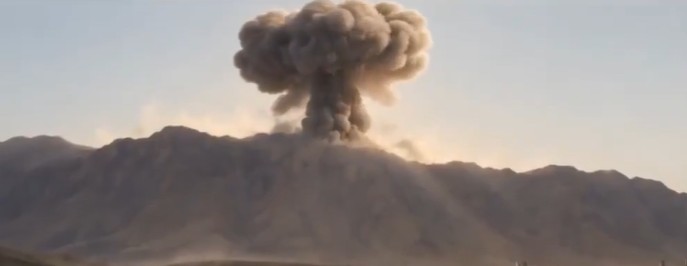
A hypothetical model illustrates how fallout from a ground-level nuclear detonation near Pickaxe Mountain could spread under certain wind conditions. (Image video grab)
By TRH World Desk
Iranian state media’s nuclear-emergency instructions have resurfaced amid renewed US-Iran military escalation. A hypothetical fallout map warns of possible regional contamination, but experts’ scenarios must not be confused with evidence of an imminent nuclear attack.
New Delhi, November 3, 2026 — Iran’s public messaging has taken a sobering turn as its state television and news agencies circulate instructions on surviving a nuclear explosion. The guidance, which urges citizens to seek shelter, avoid radioactive contamination and remain indoors, has drawn renewed attention amid the latest military confrontation with the United States.
The timing is striking. US forces carried out limited strikes on Iran’s Qasem Island near the Strait of Hormuz on Monday, following what US officials described as an Iranian attack on an American aircraft. The strikes were characterised as defensive and limited in scope, rather than the resumption of a major military campaign.
Yet the broader context is increasingly dangerous. US President Donald Trump has continued to discuss possible military action against Iran, including the fortified nuclear-related site known as Pickaxe Mountain. The renewed confrontation has fueled speculation about the potential consequences of a strike on Iran’s deeply buried nuclear infrastructure.
The guidance circulated by Iranian state media advises citizens to avoid looking directly at the intense flash of a nuclear explosion and to take cover immediately.
People caught outdoors are instructed to lie down behind a barrier, protect their heads and faces, and enter the nearest sturdy building once the blast wave passes. The instructions specifically warn against remaining outside to watch or photograph the explosion and against using cars as shelters.
Inside buildings, citizens are advised to move to basements or interior areas away from windows and exterior walls. Doors and windows should be closed, while air conditioners and ventilation systems drawing air from outside should be switched off.
The guidance also addresses radioactive contamination. Those exposed outdoors are told to remove outer clothing carefully, seal it in a bag and wash exposed skin with water and soap. Bottled water and packaged food are recommended, along with remaining sheltered for at least 24 hours and following official instructions before leaving.
The video reportedly appeared through Iran’s emergency services and news agencies during a period of heightened military anxiety. Its circulation does not, by itself, establish that Tehran expects a nuclear attack to occur.
A graphic shared by US-based professor Robert A. Pape examines a hypothetical ground-level nuclear detonation at or near Iran’s Pickaxe Mountain facility.
The model illustrates how radioactive fallout could travel across parts of the Gulf, Afghanistan, Pakistan and potentially northwestern India, depending on the weapon’s yield, release conditions and prevailing weather.
The graphic depicts a possible west-to-east wind direction and suggests that radioactive material could cross national borders. It identifies Afghanistan and Pakistan as areas where contamination could be plausible under the illustrated scenario, while describing impacts in India as possible at lower concentrations.
But the graphic itself explicitly labels the scenario hypothetical. It is not a forecast of an actual nuclear explosion, nor does it establish that fallout would follow the displayed path.
The extent and distribution of radioactive fallout would depend on several variables, including the weapon’s characteristics, whether the explosion occurred at ground level, atmospheric conditions, precipitation and the location of the detonation. Actual fallout patterns could differ substantially from the illustrative map.
The latest US strikes on Qasem Island underline how quickly the confrontation could widen. Washington describes its actions as defensive, while Tehran has warned of further retaliation. Meanwhile, the possibility of renewed attacks on Iran’s nuclear infrastructure has become a subject of public debate.
A nuclear strike would represent a qualitatively different escalation from conventional military operations. The humanitarian, environmental and geopolitical consequences could extend far beyond Iran’s borders.
Trump’s ‘No War, No Deal’ Iran Strategy Faces a Dangerous Deadlock
Follow The Raisina Hills on WhatsApp, Instagram, YouTube, Facebook, and LinkedIn




About The Author