Ek Kachori, Do Samosa: How a Women’s Safety Slogan Became India’s Latest Political Punchline
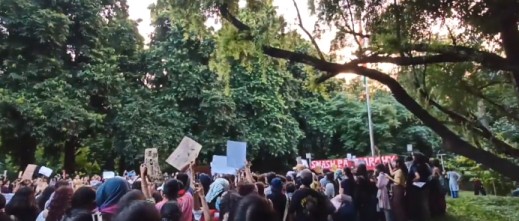
A street-food rhyme has moved from women's safety protests into India's political conversation. (Video grab)
By AMIT KUMAR
A street-food rhyme has travelled from Delhi’s student protests to political messaging, raising questions about women’s safety, Gen Z activism and the Indian politician’s instinct to turn every viral trend into an opportunity.
New Delhi, October 2, 2026 — India has a new political and social catchphrase, and this time it comes with a side order of kachori and samosa.
“Ek kachori, do samosa, in mardon ka kya bharosa” has emerged as one of the most talked-about slogans from recent women’s safety protests in Delhi. The rhyme is catchy, the humour unmistakable and the message considerably more serious than its reference to popular Indian snacks might suggest.
The slogan has attracted widespread attention online, alongside other chants questioning women’s freedom, safety and the social restrictions imposed on them. Its emergence reflects a style of protest in which humour and wordplay carry an unmistakable message of anger.
The protests by Delhi University students followed the alleged gang-rape of a 17-year-old girl near Aastha Kunj Park in Kalkaji. Students from colleges including Miranda House, Kamala Nehru College, Lady Shri Ram College and Gargi College were among those reported to have participated in demonstrations over women’s safety.
The slogan’s appeal lies in its simplicity. It sounds like a familiar street-side rhyme, is easy to remember and can be repeated without a microphone, a political banner or a social media strategy. Yet beneath the playful rhythm lies a question about trust and personal security that cannot be answered by a clever punchline.
The internet, naturally, has done what it does best: turned a protest slogan into a contest of wit. Variations have appeared in social media comments, videos and memes, while other chants have used similar rhymes to challenge restrictions on women’s freedom.
There is, however, a distinction between making a slogan go viral and addressing the concerns that produced it. A catchy line can draw attention to an issue, but its popularity alone tells us little about whether public spaces have become safer or whether complaints are being addressed effectively.
When politicians discover the samosa
The slogan’s journey did not stop at the protest site. It soon entered the political arena.
Samajwadi Party chief Akhilesh Yadav adapted the phrase to target the BJP, replacing the original reference to men’s trustworthiness with a political jibe: “Ek kachori, ek samose, BJP pe nahi hai bharosa.” His remarks linked the viral Gen Z slogan to his criticism of the ruling party.
Assam Chief Minister Himanta Biswa Sarma also joined the trend, using a variation of the phrase in a social media post: “Ek kachori, do samosa… aap sabka mere upar bharosa!” The wording turned a slogan questioning trust into a light-hearted appeal for public confidence.
And just like that, a rhyme born in the context of women’s safety became available for political reuse. One politician turned it against a rival party; another adapted it to project his own public connect.
This is hardly an unfamiliar feature of Indian politics. Leaders routinely borrow popular expressions, film dialogue, memes and youth slang to communicate with audiences beyond traditional political speeches. A phrase that travels organically through social media can be particularly attractive because it arrives with public recognition already attached.
But the context matters. The original slogan was not a campaign jingle. It emerged from protests over women’s safety. Political adaptations may extend its reach, but they can also shift attention from the concerns that gave it meaning.
The serious business behind the humour
There is a familiar contradiction in public conversations about women’s safety. Women are frequently advised to exercise caution, avoid certain places or return home early. When they take to the streets to question the conditions behind those precautions, the form of their protest can become a subject of debate in its own right.
The kachori-samosa rhyme challenges that conversation through humour. Its language is deliberately informal, even cheeky, but that does not make the underlying concern trivial.
At the same time, a slogan about men should not be mistaken for a factual claim about every individual man. The broader issue is the insecurity and distrust being expressed by the protesters, and the need to examine the circumstances that produce them.
The practical questions remain straightforward: Are public spaces adequately monitored and lit? Can women report harassment and violence without facing further barriers? Are investigations prompt, and are offenders held accountable through due process? These are questions that demand institutional responses rather than competing versions of a viral rhyme.
For political parties, the temptation to borrow a popular slogan is understandable. But the public will ultimately judge their engagement with the issue by more than their ability to produce a clever variation.
India’s political conversation has acquired a new snack-themed catchphrase. The kachori and samosa may be the ingredients of its viral appeal, but women’s safety is the subject that brought it to the streets.
The internet may keep the rhyme alive for days or weeks. Whether the concerns behind it receive sustained attention is a different question altogether.
CJP’s Gyanesh Kumar Ultimatum: Will ‘Jantar Mantar 2.0’ Begin?
Follow The Raisina Hills on WhatsApp, Instagram, YouTube, Facebook, and LinkedIn




About The Author