CJP Escalates Election Commission Fight: From Jantar Mantar to a Nationwide SIR Campaign
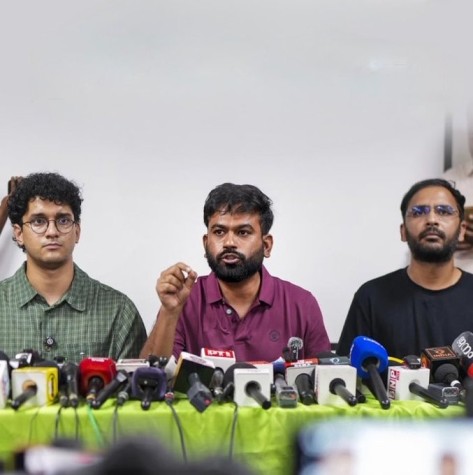
CJP leaders at a press conference in New Delhi on September 24, 2026, announcing demands concerning CEC Gyanesh Kumar and the SIR electoral-roll revision. (Image CJP on X)
By AMIT KUMAR
48-hour ultimatum to CEC Gyanesh Kumar marks a sharp expansion of CJP’s campaign from a single government minister to India’s electoral institutions
New Delhi, September 24, 2026 — The Cockroach Janta Party (CJP) has sharply escalated its campaign, this time targeting Chief Election Commissioner Gyanesh Kumar and the Election Commission’s handling of the Special Intensive Revision (SIR) of electoral rolls.
At a press conference in New Delhi on Thursday, CJP founder Abhijeet Dipke gave Kumar 48 hours to resign, while warning of a nationwide agitation if the demand was not met. The organisation also demanded criminal proceedings against the CEC, a halt to upcoming elections, an immediate freeze on SIR, restoration of the January 2025 electoral rolls and an independent inquiry into the revision exercise.
The third demand goes beyond the immediate SIR controversy. CJP wants the 2023 law governing the appointment of Election Commissioners repealed and replaced with a new selection mechanism involving civil society and what it describes as an independent process.
The escalation follows reports of disagreements within the Election Commission over decisions concerning electoral-roll management. Reports as published by The Indian Express cited by the CJP said Election Commissioners Sukhbir Singh Sandhu and Vivek Joshi had raised objections on multiple occasions concerning voter registration, deletion and restoration, changes to Form 6 and access to the electoral-roll database.
From voter rolls to institutional accountability
CJP’s argument is that the controversy cannot be treated simply as an administrative dispute over electoral rolls.
Chief spokesperson Saurav Das has argued that the experience of West Bengal demonstrates the consequences of voter deletions. He cited the restoration of a large proportion of voters following appeals and alleged that the electoral process had already moved ahead before those names were restored.
Those claims require careful distinction between voter deletion, successful appeals, restoration and the eventual electoral outcome. Restoration of names after an appeal does not, by itself, establish that an election result was caused by the earlier deletion of those voters.
CJP has nevertheless made this argument central to its campaign, asking a broader question: what happens to democratic participation if eligible voters are temporarily or permanently removed from electoral rolls?
Gen Z and the new-voter question
The campaign also seeks to connect SIR with the political participation of younger voters.
Das has alleged that new voters, particularly Gen Z citizens entering the electoral system for the first time, could face additional hurdles in enrolment. CJP has referred to questions associated with Form 6 and the SIR process.
The Election Commission’s position, as reported in the controversy, is that certain information sought from new applicants is optional. The dispute therefore involves not merely political rhetoric but questions about how electoral forms, databases and statutory authority are being implemented.
The welfare argument
CJP co-convenor Ashutosh Ranka has widened the argument further, claiming that exclusion from electoral rolls could eventually affect access to welfare schemes.
This is an important claim but needs scheme-by-scheme verification. Voter registration is not universally synonymous with eligibility for government welfare benefits. Where electoral-roll status is used in a particular scheme or administrative database, the consequences would depend on that scheme’s rules.
The argument nevertheless gives CJP’s campaign a wider social dimension: it is attempting to turn electoral-roll revision from an issue concerning voting alone into a question of citizenship, documentation and access to public services.
CJP’s latest claims on political constituencies
CJP has also circulated claims on X concerning alleged deletions from the constituencies of Mamata Banerjee, M.K. Stalin and Arvind Kejriwal, linking the number of deleted voters to the eventual margins of defeat.
These figures and the implied causal connection require independent verification before they can be presented as evidence that SIR determined those election results. A numerical coincidence between deleted voters and a candidate’s margin is not, by itself, proof of electoral manipulation.
That distinction is particularly important because CJP’s latest campaign has moved from raising questions about electoral administration to alleging deliberate manipulation of elections. The latter requires substantially stronger evidence.
Will the campaign gain traction?
The immediate significance of the CJP’s move is the scale of its demands.
Its earlier Jantar Mantar campaign focused heavily on the resignation of then Education Minister Dharmendra Pradhan. The new campaign targets the institution responsible for conducting elections, calls for changes to the appointment law, seeks judicial intervention and threatens nationwide mobilisation. Contemporary reports confirm that CJP is presenting the campaign as “Jantar Mantar 2.0” if its 48-hour deadline is not met.
Whether it develops into a sustained national movement will depend on factors that are still unfolding: the response of the Election Commission, the Supreme Court’s handling of SIR-related disputes, whether opposition parties formally associate themselves with the campaign, the organisation’s ability to mobilise beyond Delhi, and whether specific allegations can be substantiated with documentary evidence.
The campaign has therefore entered a substantially different phase. CJP is no longer simply protesting a government decision. It is questioning the architecture through which voters are enrolled, electoral rolls are revised and Election Commissioners are appointed.
That makes the next phase less about the rhetoric of a 48-hour ultimatum and more about evidence, institutional responses and the ability to sustain public mobilisation around electoral reform.
Follow The Raisina Hills on WhatsApp, Instagram, YouTube, Facebook, and LinkedIn




About The Author