Odisha BJP Government at Two Years: Crime, Growth, Investment and Welfare Under Scrutiny
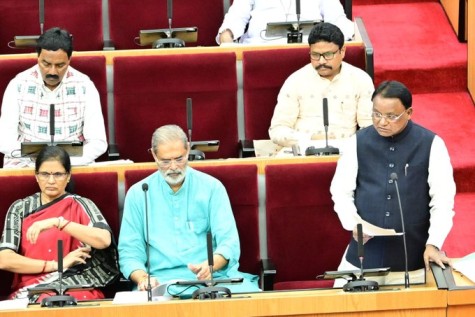
Odisha Chief Minister Mohan Charan Majhi during an official engagement. (Image Odisha CMO on X)
By PRADEEP KUMAR PANDA
Mohan Charan Majhi government completes two years with opposition raising questions over law and order, investment, welfare delivery and infrastructure, while official data point to both gains and continuing challenges
Bhubaneswar, September 24, 2026 — The BJP-led government headed by Chief Minister Mohan Charan Majhi completed two years in office in June 2026, providing enough data across law and order, economic growth, investment, welfare and public administration for a preliminary assessment of its performance.
The assessment remains contested. The Biju Janata Dal has released a 24-point critique of the government, while the BJP has defended its record. Available government data, Economic Survey figures, CAG audits, Assembly replies and crime statistics present a mixed picture.
Crime has emerged as one of the principal political issues during the Majhi government’s tenure. Odisha recorded 2,29,881 cognisable offences in 2025, compared with 2,14,113 in 2024, a rise of 7.3%, according to the state government’s crime white paper. However, individual categories moved in different directions: rape cases declined from 3,054 in 2024 to 2,994 in 2025, while murder cases increased from 1,258 to 1,304.
Assembly data showed 33,021 crimes against women in 2025, including 2,994 rape cases, 7,378 abductions, 4,361 dowry-torture cases and 5,419 cases of non-dowry torture. The government has pointed to declines in several categories during comparable periods and said specialised units are monitoring sensitive cases.
The BJD, however, has cited 48,798 crimes against women over an 18-month period and argued that the figures indicate continuing concerns over women’s safety.
Growth remains positive, but investment is a concern
Odisha’s economy continues to expand. The 2025–26 Economic Survey estimates real GSDP growth at 7.9%, following 7.2% growth in 2024–25 and 9.6% in 2023–24. The state’s economy is projected to approach ₹10 lakh crore at current prices in 2025–26.
The political debate is therefore less about whether Odisha is growing and more about the pace and quality of that growth.
Investment remains an important concern. DPIIT data show Odisha’s FDI equity inflow was relatively small compared with India’s major investment destinations. For the April-June 2024 quarter, Odisha recorded ₹28.44 crore, or 0.02% of the national total. DPIIT’s subsequent state-wise data also show comparatively modest inflows for Odisha.
The BJD has questioned the conversion of large investment intentions announced at events such as Utkarsh Odisha into operational projects and jobs, while also citing concerns over the state’s startup and export rankings. These remain areas where announced investment and actual project implementation need to be distinguished.
Agriculture and food security
Agriculture remains another area of scrutiny. The Economic Survey indicates moderation in agricultural growth compared with the previous high-growth period. Paddy procurement has continued at substantial levels, alongside input assistance to farmers.
At the same time, concerns have been raised over procurement registration, mandi-level issues and rice lifting by the Food Corporation of India. Inflation has also periodically remained above the national average, adding pressure on household budgets.
Education and examination administration
Examination management has generated repeated controversy, with reports of question-paper leaks, postponements and administrative disruptions affecting students.
A September 2026 question-paper leak involving Utkal University’s +3 second-semester examination has added to these concerns. Questions have also been raised over errors in newly issued school textbooks and the implementation of education-related schemes.
These incidents have put examination security, textbook quality and administrative coordination under scrutiny.
Welfare delivery and CAG findings
CAG audits provide a more institutional measure of some welfare-delivery gaps. Its 2026 report on PVTG development found that 1.60 lakh of Odisha’s 2.94 lakh PVTG population — about 54% — had been left outside PVTG-specific programmes, largely because newly identified villages had not been covered by the relevant Micro Project Agencies.
The same CAG report examined implementation of MGNREGS and identified shortcomings in employment provision and programme management. These findings are based on audited periods and should not automatically be treated as a measure of every current scheme outcome.
Pension payments, construction-worker welfare and utilisation of government funds have also become subjects of political debate, with the opposition alleging delays and administrative irregularities.
Infrastructure and administration
Roads, flyovers, bypasses and urban infrastructure remain visible indicators of government delivery. Delays in some projects have attracted criticism, including questions raised by legislators over timelines and construction quality.
Revenue administration has faced issues involving land-record mutation, pending cases and compensation. Disaster-management expenditure and alleged irregularities have also attracted scrutiny through audit and political debate.
Environmental and social concerns, including illegal mining, sand extraction, elephant deaths and migrant-worker distress, remain additional governance challenges.
The record after two years
The Majhi government’s two-year record therefore presents competing narratives. Economic growth remains relatively strong, while investment conversion, employment, law and order, welfare delivery and implementation capacity continue to attract scrutiny.
The opposition’s charge is that the government’s political promises have not consistently translated into outcomes on the ground. The government’s counter-position is that several crime indicators have improved, Odisha’s economy continues to grow and institutional mechanisms for policing, investment and welfare delivery have been strengthened.
With the government entering its third year, the more significant test will be whether announced investments translate into operating projects and jobs, whether welfare delivery gaps identified by audits are addressed, and whether improvements in selected crime indicators become sustained trends.
(This is an opinion piece. Views expressed are the author’s own.)
Odisha’s ₹42 Lakh Crore Investment Story: Where Is the Ground Reality?
Follow The Raisina Hills on WhatsApp, Instagram, YouTube, Facebook, and LinkedIn




About The Author