Odisha’s ₹42 Lakh Crore Investment Story: Where Is the Ground Reality?
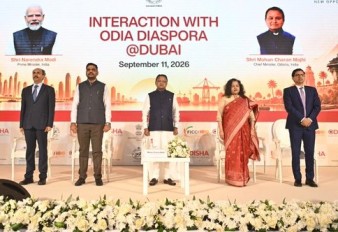
Odisha’s investment pitch is increasingly being measured against project execution, capital deployment and employment outcomes. (Image Manjhi on X)
By Pradeep Kumar Panda
Investment roadshows have produced a mountain of proposals, but project execution, FDI inflows, industrial growth and jobs raise questions over Odisha’s conversion record
Bhubaneswar, September 23, 2026 — From New Delhi in October 2024 to Dubai in September 2026, the BJP government in Odisha has staged a relentless series of investment roadshows, conclaves and diplomatic engagements. Press releases have piled up claims of investment commitments totalling ₹42 lakh crore—a figure arrived at by simple addition of successive announcements.
The latest Dubai outing alone carried a headline of ₹22 lakh crore. The first major outreach in the national capital had already set an ambitious tone. Between these bookends lies a dense calendar of events whose cumulative arithmetic raises an elementary question: which number is correct, and what portion of any of them has actually touched the ground?
The flagship Utkarsh Odisha – Make in Odisha Conclave held in Bhubaneswar on 28–29 January 2025 produced the single largest headline: ₹29.62 lakh crore, split between ₹16.73 lakh crore in proposals and ₹12.89 lakh crore in memoranda of understanding. Enterprise Odisha followed in Rourkela in January 2026.
Sectoral and regional gatherings continued—the CII Eastern Regional Council’s GO-EAST launch in June 2026 and the CII IWN Shakti Samman in July.
In October 2024 the Chief Minister met diplomats from roughly 34 countries in New Delhi and then conducted a two-day investors’ meet in Mumbai, engaging industrialists including Kumar Mangalam Birla, Sajjan Jindal, Anil Agarwal and Anant Ambani.
Further Delhi summits, Hyderabad and Kolkata investor meets in late 2025 and early 2026, a three-day Gujarat outreach in May 2026, and the ongoing Odisha Food Pro 2026 roadshow in the capital have kept the announcement pipeline open.
Claims attached to these events have ranged from ₹65,000–67,000 crore in Hyderabad to multi-lakh-crore petrochemical-linked figures in Delhi and large participation numbers in Gujarat and Singapore.
The sole major foreign foray was a November 2024 Singapore roadshow that drew several hundred delegates and meetings with companies interested in green energy, petrochemicals, logistics and related sectors.
A Japanese prefectural delegation visited in July 2026. The overall exercise has been presented as evidence of a state on the move. The economic ledger tells a different story.
Foreign direct investment inflow to Odisha remains negligible. DPIIT data for FY 2024-25 put the state’s FDI at roughly ₹39 crore—0.009 per cent of India’s total.
Large announced projects have exited or shifted: the JSW EV and battery project valued at ₹40,000 crore moved to Maharashtra; ArcelorMittal Nippon Steel’s proposed ₹1 lakh crore investment left Kendrapara for Andhra Pradesh; vaccine, S Ram N Ram semiconductor, Welspun textile and Waresolar proposals have likewise relocated.
These departures are not abstract accounting entries. Each represents forgone capital formation, delayed employment and lost multiplier effects in a state that continues to struggle with industrial diversification.
Industrial growth has declined from 8.7 per cent in 2023-24 to around 6.1 per cent in 2024-25. GSDP growth has slowed from 9.6 per cent in 2023-24 to subsequent estimates of 7.2 per cent in 2024-25 and 7.9 per cent in 2025-26.
The slowdown coincides with the peak of the investment roadshow calendar. Unemployment has risen. Distress migration has increased: a written answer in the Odisha Assembly recorded registered migrant labour numbers climbing from 72,000 in 2023-24 to 92,000 in 2024-25, with indications of further rise in subsequent years.
Informal distress migration is larger still. Official records note 448 migrant labour deaths in the last two years. These figures measure the human cost of an economy that is not generating enough stable local jobs.
On grounding status the gap between claim and reality is stark. Official statements have cited ₹3.1 lakh crore across 150 projects. Many of these originate from the previous BJD government’s pipeline—JSW Utkal, Acme, Page Industries, Seismic and others.
Against a cumulative commitment narrative of ₹42 lakh crore, the grounded amount yields an abysmal conversion rate. The arithmetic is unforgiving: even if every rupee of the ₹3.1 lakh crore materialises, it represents a fraction of the headline total that has been repeatedly added and re-announced across successive events.
Employment projections attached to these announcements fare no better under scrutiny. Labour-intensive industry typically generates 30 to 60 jobs per crore of investment; semi-capital-intensive industry 15 to 20; capital-intensive mining and heavy industry only 1 to 3. Claims from the Dubai visit that ₹2.46 lakh crore would create nearly 9 lakh jobs sit far outside these empirical ranges.
Even under the optimistic assumption of 100 per cent grounding, realistic employment numbers would be substantially smaller than the figures circulated in press releases. The mismatch is not a rounding error; it is a structural feature of the narrative.
The economic loss is multi-layered. First is the opportunity cost of administrative bandwidth. Senior officials, the Chief Minister’s office and industrial promotion agencies have spent two years organising and attending conclaves, roadshows and diplomatic receptions.
Odisha’s Economic Survey: Structural Challenges Sour Optimism
Each event consumes public resources—venue costs, travel, hospitality, documentation and follow-up machinery—while the conversion rate remains low. Second is the signalling effect on genuine investors. When successive large announcements fail to materialise or migrate to other states, credibility erodes. Capital is mobile; it responds to demonstrated delivery rather than repeated intent.
Third is the fiscal and social cost of continued under-performance. Slower industrial and GSDP growth means slower expansion of the tax base, constrained public investment in infrastructure and human capital, and sustained pressure on rural livelihoods that push workers into distress migration.
The pattern of project relocation is particularly damaging. When a ₹40,000 crore EV and battery complex or a ₹1 lakh crore steel investment chooses another state, Odisha loses not only the direct capital but the ancillary ecosystem—suppliers, logistics providers, skilled and semi-skilled employment, and downstream demand for local services.
The cumulative effect of several such exits compounds. Meanwhile, the state’s actual FDI remains vanishingly small, indicating that the roadshows have not translated into measurable external capital inflows.
From an economic-loss perspective the central failure is one of prioritisation and accountability. Investment promotion is a legitimate function of state government. What is not legitimate is the substitution of announcement volume for delivery metrics.
A transparent public ledger of every MoU, investment intent and proposal signed between October 2024 and September 2026, updated quarterly with grounding status, employment generated and capital actually deployed, would allow citizens and markets to distinguish substance from spectacle.
In its absence, the ₹42 lakh crore figure functions as a rolling headline rather than an accountable target.
The human consequences are already visible in the migration data and the death toll among migrant workers. When industrial growth decelerates and local job creation lags, households respond by sending members to distant labour markets under precarious conditions.
Each registered increase in migrant labour and each recorded death is a downstream cost of an economic strategy that has emphasised visibility over conversion.
Two years of intensive outreach have produced an impressive calendar of events and an arithmetic total of commitments that strains credibility when set against actual FDI, project retention and growth numbers.
The economic loss is not merely the gap between ₹42 lakh crore announced and ₹3.1 lakh crore grounded. It is the forgone growth, the eroded investor confidence, the administrative resources diverted to perpetual roadshows, and the continued outflow of workers from a state that has yet to convert its investment narrative into measurable expansion of productive capacity.
Until grounding rates, employment outcomes and retained capital become the primary metrics rather than cumulative press-release arithmetic, the circus will continue and the ground will remain largely empty.
(This is an opinion piece. Views expressed are the author’s own.)
₹12,000 Crore Question: Why Odisha Is at the Centre of India’s Mining Revenue Battle
Follow The Raisina Hills on WhatsApp, Instagram, YouTube, Facebook, and LinkedIn




About The Author