One Nation, One Election: Is Parliament Scrutinising the Reform Seriously?

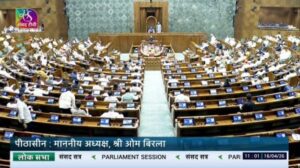
The Lok Sabha on Thursday witnessed din during tabling of bills. (Image X.com)
By TRH Op-Ed Desk
Political analyst Manish Anand questions the choice of invitees and the practical feasibility of simultaneous elections, arguing that constitutional reform demands wider consultation and serious scrutiny.
New Delhi, October 15, 2026 — The Supreme Court’s refusal to hold an informal interaction with the parliamentary committee examining the proposed One Nation, One Election legislation has renewed debate over the constitutional implications of the reform and the process being followed to examine it.
In a monologue for The Raisina Hills, political analyst Manish Anand questioned the committee’s approach, arguing that a proposal with far-reaching consequences for India’s parliamentary and federal systems requires rigorous scrutiny, credible consultation and a serious assessment of its practical challenges.
The Joint Parliamentary Committee, chaired by BJP MP P. P. Chaudhary, is examining the Constitution (129th Amendment) Bill, 2024, and related legislation. The Lok Sabha extended the committee’s tenure until the final week of the Winter Session in 2026.
Anand argued that the proposal reflects the BJP and RSS emphasis on uniformity in public life. He questioned whether synchronising Lok Sabha and state Assembly elections would adequately account for India’s political diversity, regional interests and the possibility of governments losing their legislative majorities before completing their terms.
The committee’s proposed interaction with Chief Justice of India Surya Kant and other Supreme Court judges was cancelled after the Court indicated that such a discussion would not be appropriate because the proposed constitutional amendments could eventually face judicial review.
Anand said the development highlighted the constitutional sensitivity of the legislation. He argued that the proposal should not be treated as a routine electoral reform and that parliamentary scrutiny must address the possibility of legal challenges.
The government and supporters of simultaneous elections have argued that holding national and state polls together could reduce election-related expenditure, limit repeated disruption caused by the Model Code of Conduct and ease the burden on administrative and security personnel. The committee has conducted consultations with political parties, legislators, legal experts, academics and other stakeholders.
Anand also criticised the reported selection of invitees for discussions on October 10, questioning whether the choice of media figures and economic commentators would ensure a balanced examination of the proposal.
Among those he discussed were television anchors Anjana Om Kashyap and Sudhir Chaudhary, corporate commentator Suhel Seth, journalist Shekhar Gupta, and senior journalist Rajdeep Sardesai. He also questioned the inclusion of S. Gurumurthy in the category of economists, citing his ideological association with the RSS-linked Swadeshi movement.
For Anand, the larger concern is whether the consultation process will adequately represent competing constitutional, political, economic and administrative perspectives before Parliament considers the legislation.
Can India realistically hold simultaneous elections?
The practical challenges form another major part of Anand’s criticism. Elections in different states take place in phases because of security requirements, administrative capacity and local conditions. Conducting Lok Sabha and Assembly elections within a common electoral cycle would require extensive coordination of personnel, security forces, polling equipment and logistics.
He also questioned what would happen if a government lost its majority before the end of a synchronised term. Any framework for simultaneous elections would need to address such situations without undermining the electorate’s mandate or the constitutional position of state governments.
The proposal is therefore about more than saving the cost of repeated elections. It raises questions about federalism, the tenure of legislatures, political accountability and the Election Commission’s operational capacity.
Anand compared the government’s determination to pursue the reform with earlier major economic decisions, including demonetisation and the introduction of GST. He argued that a policy’s scale or ambition should not exempt it from detailed scrutiny.
His central contention is that One Nation, One Election must be judged on constitutional soundness, administrative feasibility and democratic accountability, not simply on the appeal of a uniform electoral calendar.
The parliamentary committee’s task is to examine those questions before Parliament decides whether the proposed changes merit adoption.
Follow The Raisina Hills on WhatsApp, Instagram, YouTube, Facebook, and LinkedIn




About The Author