Why ‘Dimaagi Naxal’ Was a Political Misstep for Modi Government
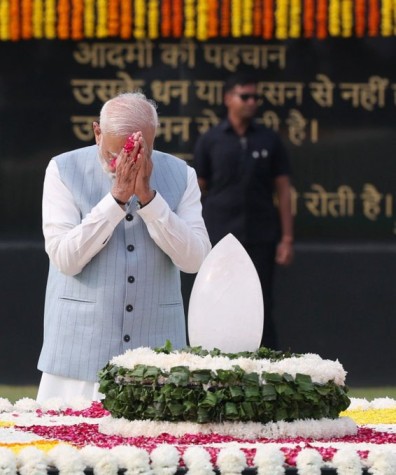
Prime Minister Narendra Modi pays floral tributes to late Atal Bihari Vajpayee (Image Modi on X)
By RAVI SHANKER KAPOOR
The government’s attempt to explain the term after the Prime Minister’s Independence Day speech failed to dispel confusion, while critics argue that the rhetoric risks alienating young protesters.
New Delhi, August 19, 2026 — Use of the term “dimaagi Naxal” (mentally Naxal) by Prime Minister Narendra Modi in his Independence Day address was extremely unfortunate. For it tended to conflate Naxalites or Maoists with Cockroach Janta Party (CJP) protestors.
Many things were wrong about the term. First, it was not defined; he slammed dimaagi Naxals, saying, “The armed Naxalites have been defeated, but the Naxal mindset remains. These forces are looking for opportunities. They are searching for paths of violence and anarchy, and are employing various tactics to drag society onto the wrong path,” he said.
For once, it looked like another derogatory coinage by him, like the ‘Khan Market gang’ and ‘Tukde-tukde gang.’ So, on Sunday evening, Congress leader and former home minister P. Chidambaram reacted by claiming that he was “proud to be a dimaagi Naxal.”
It took a day for the government to describe dimaagi Naxals. Parliamentary Affairs Minister Kiren Rijiju wrote on X, “PM @narendramodi ji didn’t say opposition leaders as Dimagi Naxals. Only following are Dimagi Naxals: 1. Who support Maoists and reject Indian Constitution. 2. Who stand with separatists & support Article 370. 4. Who want to cut chicken neck to separate North-East from India (sic).”
But then anyone holding any of the three positions is, by definition, a traitor; and traitors always search “for paths of violence and anarchy” and employ “various tactics to drag society onto the wrong path.” That’s tautological, so why did the Prime Minister use this cryptic term, causing so much confusion?
Almost everyone understood the term to denote the detractors of the government. Had Modi or any other member of the government clarified the term right in the beginning, there would have been no confusion; surely Chidambaram, who took a hardline against Naxalites or Maoists, would never have called himself a Naxal.
Worse, by wrongly conflating Naxals with Cockroach Janta Party (CJP) activists or Opposition leaders, the term bestowed respectability on Naxalites, who are violent terrorists because the man they derive inspiration from, Mao Zedong, was the greatest butcher of history, responsible for the killing of anywhere between 40 million and 70 million people.
From the government’s perspective too, the controversy surrounding the term took attention away from one of its biggest achievements: the end of the Maoist menace. As the name suggests, the movement began in the late 1960s in Naxalbari, West Bengal. In the early years of this century, it spread quickly in many parts of India. In 2009, 180 districts in 10 states were infested with Naxal terrorists.
The Prime Minister correctly said, “In places where Naxalites once fired their guns, where the soil was once stained with blood, today, in those very Naxal-affected regions, the Tricolour of development, trust and endeavour is flying high because these areas are becoming Naxal-free.” But, owing to its predilection to trash opponents, the government missed the opportunity to draw the attention of people to its great feat. Such are the wages of brazenly deceitful rhetoric.
If there was any attempt or intention of portraying the protests of youngsters as anarchic or linking them with Naxalites, it has badly backfired. One reason is that all young protestors have been peaceful, despite the gravity of their cause and the grave provocations like the assault by Delhi Police on July 20.
Modi and the brain trusts of the government and the Sangh Parivar must realize that vilifying Gen Z and now also Gen Alpha will not yield any political dividends; in fact, chances are that this will further alienate people from the ruling dispensation. The only option available to the government is to do what it is supposed to do: govern properly. Grand announcements, polarizing political narratives, high-profile events, and pompous speeches are no substitute for good governance.
(This is an opinion piece. Views expressed are the author’s own.)
BJP’s Nabin Team: Amit Shah Still Holds the Wheel as Old Faces Return
Follow The Raisina Hills on WhatsApp, Instagram, YouTube, Facebook, and LinkedIn




About The Author