BJP’s Muslim Outreach Gets New Faces: Why Tariq Mansoor Matters
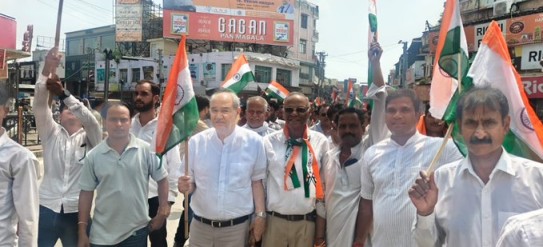
BJP vice president Tariq Mansoor takes part in a Tiranga Yatra (Image Mansoor on X)
By NIRENDRA DEV
The elevation of Tariq Mansoor and Basit Ali signals a renewed BJP effort to reach sections of Muslim voters, particularly as caste and sect-based identities reshape the community’s electoral politics.
New Delhi, August 19, 2026 —The BJP’s latest organisational appointments have brought two relatively new Muslim faces into greater prominence: academician Tariq Mansoor, appointed national vice president, and Kunwar Basit Ali, who has been elevated as the national chief of the party’s Minority Morcha.
One thing appears certain: the era in which Mukhtar Abbas Naqvi and Syed Shahnawaz Hussain were the BJP’s most recognisable Muslim faces is practically over.
The question now is whether Mansoor and Ali can offer the BJP something more than symbolic representation.
For the party, the answer could be particularly important in Uttar Pradesh.
Muslims account for roughly 20 per cent of the state’s population and are electorally significant across several regions. The BJP has repeatedly attempted in recent years to reach sections of the community, particularly Pasmanda Muslims — socially and economically marginalised groups within the Muslim community.
The elevation of Mansoor and Ali gives that outreach a more visible organisational face.
But the strategy goes beyond Uttar Pradesh.
Across India, the representation of Muslims in legislatures has declined sharply over the past decade and, more broadly, over the last two decades. One interpretation is that this decline has coincided with the growing acceptance and political mainstreaming of Hindutva.
The political consequences of the communally charged atmosphere following the demolition of the Babri Masjid in 1992 were visible soon afterwards. In the 1993 Madhya Pradesh Assembly election, not a single Muslim MLA was elected — an unprecedented development at the time.
Uttar Pradesh presents another striking picture.
By 2022, there had been 628 Muslim MLAs elected to the Uttar Pradesh Assembly over the period covered by available electoral data, against a total of 7,389 legislators. That meant Muslims accounted for just over 8 per cent of legislators, while Muslims constituted around 15.5 per cent of the state’s population.
Gujarat, another stronghold of Hindutva politics, has also seen limited Muslim representation. Only 39 Muslim MLAs had been elected out of 2,296 legislators through 2017, or about 1.69 per cent, despite Muslims accounting for around 8.6 per cent of the state’s population.
Against this backdrop, the BJP’s latest appointments assume a significance that goes beyond organisational reshuffling.
Why Tariq Mansoor matters
Mansoor’s elevation is particularly significant because of his profile.
A former vice chancellor of Aligarh Muslim University, he brings an academic background and a degree of social standing that sets him apart from the BJP’s traditional Muslim leadership in Uttar Pradesh.
He is also relatively new to the party, having joined the BJP in 2023.
That makes him an interesting political choice.
Mansoor is not merely another Muslim leader brought into the BJP’s organisational structure. His background gives the party an opportunity to present a different kind of Muslim outreach — one built around academia, education and social influence rather than conventional electoral politics.
Basit Ali, meanwhile, brings experience from the BJP’s minority organisation in Uttar Pradesh. His elevation to head the national Minority Morcha gives the party another organisational vehicle for reaching out to Muslim voters.
Together, Mansoor and Ali could become the public faces of a renewed BJP effort to expand its appeal among sections of the Muslim community.
BJP’s Nabin Team: Amit Shah Still Holds the Wheel as Old Faces Return
Can BJP break the Muslim voting pattern?
The larger question is electoral.
For years, the BJP has struggled to make significant inroads among Muslim voters. In several major elections, the community has largely consolidated behind the party’s principal opponents.
In the 2020 Bihar Assembly election, around 77 per cent of Muslim voters backed the Mahagathbandhan, according to survey-based studies.
In the 2021 West Bengal Assembly election, around 75 per cent of Muslim voters supported the Trinamool Congress.
Uttar Pradesh offered a similar picture in 2022. Studies suggested that around 79 per cent of Muslim voters backed the Samajwadi Party, even as the BJP retained power after a closely fought election.
The pattern became even more consequential in the 2024 Lok Sabha election.
The consolidation of Muslim votes behind the Samajwadi Party contributed to the BJP’s difficulties in Uttar Pradesh, with the SP’s Muslim candidates performing particularly well.
The numbers tell an interesting story.
The SP fielded only four Muslim candidates in the state — Zia Ur Rehman from Sambhal, Afzal Ansari from Ghazipur, Iqra Hasan from Kairana and Mohibullah Nadvi from Rampur.
All four won.
The BSP, in contrast, fielded 10 Muslim candidates. None won, and the party’s relatively limited vote share in several constituencies ultimately contributed to a fragmented opposition vote.
The lesson for the BJP is potentially significant: Muslim electoral behaviour may not always be as predictable or homogeneous as conventional political narratives suggest.
Is the Muslim vote still a coherent bloc?
Although Muslim voters have increasingly shown a tendency to consolidate behind a common political choice in recent elections, political and social mobilisation within the community also highlights divisions based on caste, sect and regional identity.
Muslim caste hierarchies and sectarian identities have increasingly become part of political conversations.
That raises a larger question: Is the idea of a single, coherent Muslim voting bloc becoming outdated?
If the answer is yes, the political implications for the BJP are obvious.
The party does not necessarily need to win over the entire Muslim electorate. Even limited shifts among particular social groups, castes, sects or regions could alter electoral arithmetic in closely contested constituencies.
This is where the Pasmanda outreach becomes particularly relevant.
The BJP’s strategy appears to be aimed less at a wholesale transformation of Muslim political preferences and more at identifying sections of the community that may be receptive to its message.
A new experiment for the BJP
Mansoor and Basit Ali therefore represent more than two new appointments.
They are part of an experiment.
Can the BJP create a Muslim political constituency without abandoning its core Hindutva politics? Can it attract even a small section of Muslim voters while retaining its existing coalition? And can leaders such as Mansoor, with an academic and institutional profile, make the party’s outreach more credible among sections of the community that have traditionally remained outside the BJP’s electoral coalition?
These questions will become particularly important as the party prepares for future electoral battles.
For now, nayi season; nayi chehre is more than a slogan.
The BJP has changed its Muslim faces. The bigger test is whether these new faces can change the party’s Muslim electoral arithmetic.
Why Phangnon Konyak and Mriganka Deo Barman Matter in Nitin Nabin’s New BJP Team
Follow The Raisina Hills on WhatsApp, Instagram, YouTube, Facebook, and LinkedIn




About The Author