Delhi Builder Floor Disputes: When Neighbours Take Over Common Areas
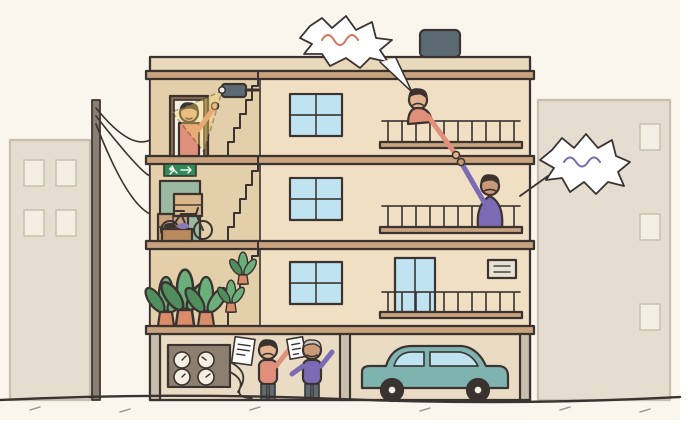
From common areas and blocked emergency exits to plants, shared bills and CCTV, Delhi builder-floor disputes are straining relations between neighbours. (Image: AI Sktech)
By BHAWNA MALIK
Disputes over staircases, emergency exits, shared electricity bills and CCTV access expose the challenges of collective living in Delhi’s builder-floor homes.
New Delhi, October 11, 2026 — A builder floor promises independence, privacy and the comfort of living in a smaller residential community. But what happens when four families share one building and one household begins to behave as if the common areas belong exclusively to it? From blocking emergency access and occupying the space beneath staircases to hanging plants in shared areas and refusing to respect collective rules, everyday disputes can turn neighbours into adversaries.
In Delhi, where builder floors are a popular housing choice, the distinction between private ownership and common property is often blurred. Residents may own separate floors, but staircases, entrances, passages, landings and other designated common areas are meant to serve everyone entitled to use them. The challenge begins when individual convenience takes precedence over collective safety and the rights of other occupants.
Common areas are not private extensions
In a four-floor building, every resident depends on shared spaces for movement, access and safety. The entrance and staircase are not merely architectural features; they are essential routes connecting homes to the outside world. The space beneath a staircase, too, cannot automatically be treated as an individual storage area if it forms part of the building’s common area.
Yet disputes frequently arise when a family places personal belongings, shoes, cabinets, cartons or other items in these spaces. What begins as a small act of convenience can gradually become a permanent encroachment, leaving other residents with less usable space and creating potential obstructions.
Sweety Anand, a resident of a posh area shares that “one family started keeping their old washing machines, tyres under stairs and other times it was a broken cycle. This being a common area other resident too should be allowed to keep their discarded things”
The problem becomes more serious when plants, pots, hooks or decorative installations are placed in common passages or near entrances. While greenery can enhance a home, it should never come at the cost of access, safety or another resident’s right to use a shared area.
It’s a Supreme Court ruling that hanging plants on balcony is illegal as it can cause injury to other residents. “The pots have fallen down twice luckily no one was hurt. But is one family above law?” Anand questions.
Anand was silenced by the threat that we know people in power, RWA ‘s and no one can stop us.
When emergency access is compromised
Perhaps the most serious concern is the obstruction or closure of an emergency entrance or exit used by other residents. In an emergency, every second matters. A passage that is blocked, a gate that cannot be opened freely or an exit controlled by one household can create a dangerous situation for the entire building.
Malik another resident shares that “during no electricity the electric doors do not open then emergency exit is for all residents. One family has placed huge plants inside and out of the emergency exit gate putting all at risk”
Fire safety is not a matter of personal preference. Applicable building and fire-safety requirements must be followed, and common access routes must not be obstructed. Residents should not have to negotiate with a neighbour to secure safe passage out of their own building.
Any restriction on access must therefore be examined carefully in light of the building’s approved layout, ownership documents and applicable safety rules. If an exit is being obstructed or an emergency route is compromised, residents should document the issue and approach the appropriate municipal or fire-safety authority where necessary.
Common bills, unequal responsibility
Another source of friction is the sharing of common expenses. When four households contribute towards common electricity, water, maintenance, cleaning or other agreed bills, the arrangement reflects a shared responsibility for the building.
It becomes unfair when one family expects the benefits of collective arrangements while disregarding the corresponding responsibilities and rights of other residents. Paying common bills does not give any household the right to occupy shared space exclusively. Equally, a disagreement over expenses does not justify restricting another owner’s access to the building.
Bela Arora (name changed) a single woman living alone shares that one family in the building has regular late-night parties in their basement and the lights of the parking area are on till wee hours of the morning “This falls under common electricity bill shared by four families living in the building. Why should I pay extra for his parties”
A written understanding on maintenance contributions, use of common areas, storage, cleanliness and access can prevent misunderstandings. Where ownership documents or a residents’ agreement specify how expenses must be divided, those provisions should guide the arrangement.
Women Living Alone Are Building a New Life — and a New Publishing Market
A safety risk for the most vulnerable
The stakes are higher in a building where senior citizens, heart patients, cancer patients and children live. Unobstructed entrances and safe passage are everyday necessities, especially for elderly residents, those undergoing treatment and children. Objects, hanging plants or other obstructions in common areas can cause trips and falls, while even a minor blockage may endanger someone with limited mobility or facing a medical emergency. Common spaces must therefore remain shared safety zones, and no family’s convenience should compromise another resident’s ability to enter, exit or receive emergency assistance safely.
Malik further tells that the pavement outside the building is a common area, placing heavy metal planters on both sides can cause injury to the elders or other residents
‘How one family sets rules for others to follow” Malik questions.
‘Ironically one family targets each resident, intimidating them with false accusations and unverified facts. Why a dog has entered the building, why the food delivery boy has dropped gravy, it must be cleaned and all this is shared in the common WhatsApp group of the residents. Then what happens to their moral responsibility towards other residents.” Asks Anuj Gulati a senior citizen facing this daily trauma.
The consequences of such disputes extend beyond clutter or unpaid contributions. Repeated confrontations, unreasonable restrictions, intimidation and attempts to dominate common spaces can make residents feel uncomfortable in their own homes.
A home should offer security, not a daily struggle for basic rights. When neighbours begin policing one another’s movements or using shared spaces as instruments of control, the entire residential environment suffers.
“Our building has CCTV Cameras for security and the common bill of the connection is shared by the four families living in the building. One family placed tall plants obstructing the cameras, are we paying for the security of the plants?” Asks Sujata another resident.
Residents should maintain dated photographs, copies of relevant messages, expense records and a written account of incidents. Calm written communication, mediation through a neutral third party and advice from a property lawyer can help establish a practical resolution. Depending on the nature of the obstruction or harassment, the relevant municipal authority, fire department or police may also need to be approached.
Builder-floor living requires more than separate ownership papers; it requires a shared understanding of boundaries. Common areas must remain accessible, collective expenses must be handled transparently, and no household should assume unilateral control over spaces meant for all.
The real test of urban living is not how beautifully a home is furnished, but how respectfully its occupants coexist. Four families may own four separate floors, but they remain connected by one building and shared responsibilities.
A common staircase is not anyone’s private kingdom. A shared entrance is not a bargaining tool. And peaceful coexistence cannot survive where one family’s convenience repeatedly overrides everyone else’s rights.
Mental Health Is More Than Depression: The Hidden Struggles of Patients and Caregivers
Follow The Raisina Hills on WhatsApp, Instagram, YouTube, Facebook, and LinkedIn




About The Author