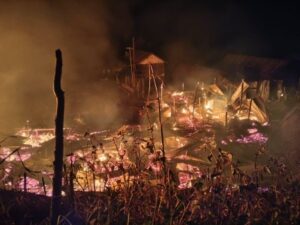
Bushehr Hit 4 Times: Radiation Fallout Risk Looms Over Gulf
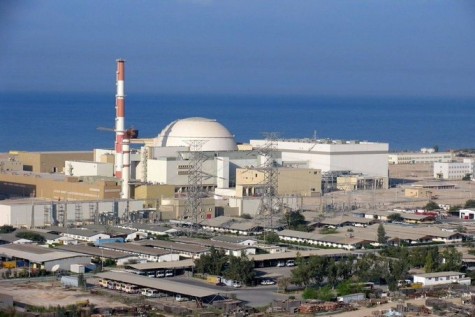
Bushehr nuclear plant in Iran (Image Aragchi on X)
IAEA confirms fourth strike, Rosatom warns of rising nuclear accident risk, while Iran’s FM tells Gulf capitals: the fallout comes to you, not us
By TRH World Desk
New Delhi, April 4, 2026 — The Bushehr nuclear power plant on Iran’s Persian Gulf coast has been struck four times by U.S.-Israeli forces, Russia’s state nuclear company Rosatom has confirmed a rising risk of nuclear accident and evacuated 198 Russian employees from the site. Iran’s Foreign Minister has delivered a chilling geographic warning to Gulf Arab states hosting the very forces conducting the strikes: radioactive fallout from a Bushehr breach would reach their capitals, not Tehran.
The IAEA confirmed the fourth strike in a statement, reporting that a projectile hit close to the plant’s premises, killing one physical protection staff member, damaging a support building through shockwaves and fragments. No increase in radiation levels was detected. The containment held — for now.
IAEA Director General Rafael Grossi expressed deep concern, stating that nuclear plant sites or nearby areas must never be attacked, warning that auxiliary site buildings may contain vital safety equipment. Grossi reiterated his call for maximum military restraint, stressing adherence to the seven pillars for ensuring nuclear safety and security during conflict.
Russia Condemns, Evacuates, Warns
Rosatom’s confirmation of the evacuations was reported by Iranian researcher Arya Yadeghaar on X, who cited the head of Russia’s state nuclear company stating: “The bombing of the Bushehr power plant occurred in a special protected area, and the likelihood of a nuclear accident is increasing.”
Russia Today reported that a top Russian official confirmed the strike had breached the plant’s protection circuit, warning of skyrocketing catastrophic nuclear incident risk as mass evacuations to the border began.
Russian Foreign Ministry spokesperson Maria Zakharova issued a harsh condemnation of the U.S.-Israeli strike, calling for an immediate end to all attacks on nuclear facilities.
The Warning Gulf States Cannot Ignore
Iran’s Foreign Minister Seyed Abbas Araghchi posted five sentences on X on April 4 that, as author and analyst Shanaka Anslem Perera observed, should have stopped every government in the Gulf.
“Remember the Western outrage about hostilities near Zaporizhzhia Nuclear Power Plant in Ukraine?” Araghchi wrote. “Israel-U.S. have bombed our Bushehr plant four times now. Radioactive fallout will end life in GCC capitals, not Tehran,” he warned.
Araghchi’s message, Perera noted, was not aimed at Washington. It was aimed at Abu Dhabi, Riyadh, Doha, Manama, and Kuwait City — the capitals of the states hosting the military infrastructure conducting the strikes.
Iran War ‘Greatest Disaster in American History’: Brig. Anderson
The Geography of Catastrophe
The physics behind Araghchi’s warning are not rhetoric. They are geography.
Perera laid out the case in forensic detail. Bushehr sits on the Persian Gulf coast at 28 degrees north. Tehran is 750 kilometres inland, shielded by the Zagros Mountains. Prevailing winter winds blow from northwest to southeast — directly across the Gulf toward the UAE, Qatar, Bahrain, and Saudi Arabia’s Eastern Province. The Gulf’s anticlockwise surface currents carry waterborne radionuclides westward and northwestward toward Kuwait and Bahrain within approximately 15 days, according to peer-reviewed hydrodynamic simulations. Atmospheric dispersion models running 3,652 HYSPLIT simulations for a Bushehr release scenario found that deposition exceeding relocation thresholds reached Gulf coastal areas with low but non-zero probability.
“The plume does not go north,” Perera wrote. “It goes west. The reactor sits on Iran’s coast but the fallout belongs to the Gulf.”
60 Million People, Seven Days of Water
The consequences of a Bushehr breach would be felt most acutely not through blast or fire but through the Gulf’s desalination infrastructure — the sole source of drinking water for tens of millions of people.
Qatar relies on desalination for 99 percent of its water supply. Kuwait and Bahrain for 90 percent. Saudi Arabia for 70 percent. The UAE for 42 percent. All draw intake directly from the Persian Gulf. If that water carries Caesium-137 or Iodine-131, desalination plants shut down or their output becomes contaminated.
Gulf states maintain roughly one week of strategic water reserves.
“A Bushehr breach would not produce a Chernobyl explosion,” Perera wrote. “It would produce something the models describe as worse for the region: a slow, invisible contamination of the water supply that 60 million people depend on, arriving by current over two weeks, with seven days of reserves to outlast it.”
The Bases and the Blast Zone
The strategic contradiction embedded in the current military posture is stark. Al Udeid Air Base in Qatar launches the sorties striking Bushehr. Al Dhafra in the UAE stages overflow forces. Bahrain’s Fifth Fleet headquarters coordinates the naval component. Saudi Arabia’s Prince Sultan Air Base — where an E-3 AWACS was destroyed on the ground by Iranian fire on March 27 — sits in the Eastern Province that fallout models identify as a primary deposition zone.
“The allies are hosting the bombers,” Perera wrote. “The bombers are hitting the reactor. The reactor sits on the coast of the water the allies drink. And the enemy is the one warning them.”
The IAEA says no radiation has been released. The containment has held through four strikes. But as Perera observed: containment is engineering, not physics. Engineering can fail. And Araghchi’s geographic statement — that the fallout goes to them, not Tehran — is a fact no amount of diplomacy can alter.
US Jet Downed Over Iran Signals Dangerous Escalation: Analyst
Follow The Raisina Hills on WhatsApp, Instagram, YouTube, Facebook, and LinkedIn




About The Author