Prashant Kishor’s Bypoll Win Signals Bihar’s Next Political Earthquake, Says Analyst
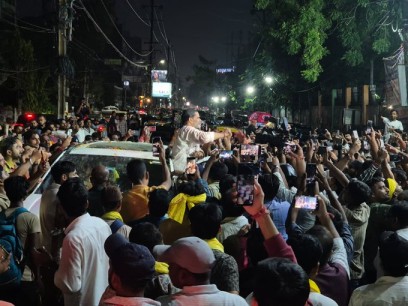
Jan Suraj founder Prashant Kishor in a road show after his victory from Bankipur Assembly seat. (Image Jan Suraj on X)
By TRH Political Desk
Bihar bypoll result 2026: Jan Suraaj chief’s victory in a three-decade BJP stronghold marks what analyst Manish Anand calls an “inflection point” in state politics
New Delhi, August 4, 2026 — Bihar’s voters have, once again, delivered a message that political arrogance won’t be tolerated — this time by handing Jan Suraaj founder Prashant Kishor victory in his very first election.
According to political analyst Manish Anand, host of The Raisina Hills, Bihar’s electorate has a long history of puncturing overconfidence, pointing back to the 2015 assembly election when the state rejected the BJP despite a powerful Modi-led wave nationally. Anand argues the bypoll result repeats that pattern: Kishor won by a margin of just over 19,000 votes in a seat the BJP had effectively owned for close to three decades.
The significance, Anand says, lies in exactly which seat changed hands. The constituency had been won five consecutive times by the sitting BJP state president, whose own father had held it even during the 1990s peak of Lalu Prasad Yadav’s RJD-led politics in Bihar. For Jan Suraaj to break that streak on its electoral debut is, in Anand’s words, nothing short of a tremor in Bihar’s political landscape.
Anand also flags what he sees as a strategic miscalculation by the BJP: fielding relatively unknown candidates in two separate bypolls, seemingly hoping an anonymous local face could humble Kishor and permanently damage his political prospects. That gamble, he argues, backfired — and instead handed Jan Suraaj a symbolic win against the party’s own organizational machinery.
The result lands barely seven months after the BJP-led NDA secured a commanding majority in Bihar’s state elections. Anand suggests the ruling alliance may have grown complacent in that time, treating last year’s mandate as a permanent entitlement rather than a renewable one.
Anand also links the bypoll outcome to visible public frustration on other fronts: student protests in Patna and Ranchi over exam cancellations and paper leaks, police action against demonstrators in both Delhi and Patna, an unresolved police encounter case still under judicial scrutiny, and what he describes as an unfulfilled campaign promise to bring new industry to every district.
A Vacuum at the Top
Central to Anand’s analysis is the state of Bihar’s two legacy power centers. He describes Lalu Prasad Yadav as largely politically inactive now, citing age, health issues and reported divisions within his family. Nitish Kumar, he says, is similarly drifting toward political retirement, with his son inducted as a minister but carrying limited independent political weight.
That leadership vacuum, Anand argues, is exactly the opening Jan Suraaj was built to exploit — comparing Kishor’s rise to two other recent regional disruptions: actor-turned-politician Vijay’s TVK breakthrough in Tamil Nadu, and Jairam Mahto’s JLKM gaining outsized attention in neighbouring Jharkhand despite holding just one seat.
For Anand, the real story isn’t that Jan Suraaj won one assembly seat — it’s what the win represents. He calls it an inflection point in Bihar’s politics, one where voters are actively signalling they’re open to alternatives beyond the RJD-JDU-BJP axis that has dominated the state for decades. Whether Kishor can convert this into a durable statewide base, Anand says, will be the defining question for Bihar’s politics in the months ahead.
A Fortress Falls: What Prashant Kishor’s Bankipur Victory Says About Bihar Politics
Follow The Raisina Hills on WhatsApp, Instagram, YouTube, Facebook, and LinkedIn




About The Author