Rahul Gandhi Recasts CJP Protest as a Battle for India’s Soul, Puts Amit Shah in the Dock
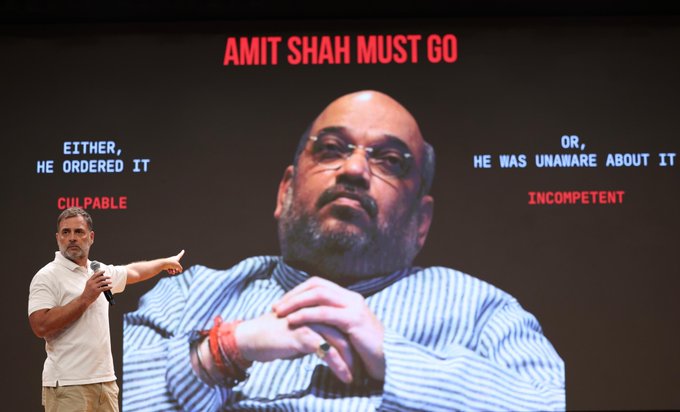
Leader of Opposition Rahul Gandhi demands sacking of Home Minister Amit Shah over CJP police crackdown. (Image INC India)
By AMIT KUMAR
Congress leader uses Parliament to portray the student movement as a revolt against the RSS’s ideological control of education before accusing the Home Minister of authorising the crackdown.
New Delhi, July 29, 2026 — Rahul Gandhi’s Lok Sabha speech on the Public Examination (Prevention of Unfair Means) Amendment Bill was not merely about examination reforms. It was an attempt to transform the CJP movement from a protest over paper leaks into an ideological challenge to the Narendra Modi government.
The speech unfolded in three distinct layers.
First, Rahul Gandhi celebrated the student movement as a democratic awakening. He argued that the protests reflected hope rather than anger and urged every political party—including the BJP—to respect what he described as the aspirations of India’s youth.
Second, he introduced an unusual philosophical framework built around a conversation with an 18-year-old student. He contrasted three categories of people: “students”, who remain humble and constantly seek truth; those who believe they know everything; and “andhbhakts”, whom he described as followers of unquestioning authority. Although repeated interruptions forced him to withdraw some terminology, the underlying message remained unchanged. The metaphor became the organising principle of his entire speech.
From there, Rahul Gandhi shifted to politics.
He argued that the real crisis in India’s education system was not simply paper leaks or privatisation. His central claim was that the RSS, rather than the Education Minister, exercises ideological control over universities and educational institutions. According to him, the resignation of Dharmendra Pradhan was therefore symbolic rather than substantive because, in his telling, the “real decision-makers” lie outside the ministry.
This represented the speech’s principal political message. Rahul Gandhi attempted to redefine the conflict as one between students seeking knowledge and an ideological establishment seeking conformity.
Only in the final phase of his speech did he turn his fire directly on Home Minister Amit Shah.
He alleged that Shah had authorised the use of force against CJP protesters and claimed that the Home Minister had avoided attending the debate because he was unwilling to defend the government’s actions. The accusation immediately triggered uproar in the House, repeated interventions by Treasury bench MPs and intervention from the Chair.
Rahul Gandhi repeated the charge at his press conference outside Parliament, demanding Amit Shah’s removal and calling for a Supreme Court-monitored investigation into the alleged police crackdown.
Politically, the Congress appears to be recalibrating its strategy after Dharmendra Pradhan’s resignation. Instead of continuing to target the Education Ministry, Rahul Gandhi is moving the political battle to the Home Ministry and the RSS. That allows the opposition to argue that the controversy is no longer about examinations alone but about the state’s response to dissent and the ideological direction of India’s education system.
Whether this strategy succeeds will depend on whether the CJP movement continues to command public attention. But Wednesday’s speech makes one thing clear: Rahul Gandhi wants the next phase of the opposition’s campaign to be fought over civil liberties, institutional autonomy and the political role of the RSS—not merely over leaked examination papers.
The BJP’s Real Opposition Isn’t Congress—It’s Gen Z on Social Media
Follow The Raisina Hills on WhatsApp, Instagram, YouTube, Facebook, and LinkedIn




About The Author