Dharmendra Pradhan Resignation Sparks Bigger Debate on Gen Z, Hindutva and India’s Political Future
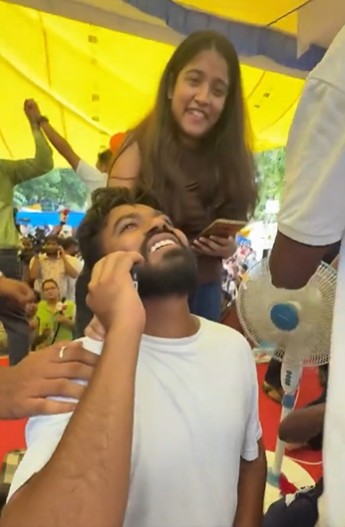
CJP founder Abhijeet Dipke celebrates announcement of Dharmendra Pradhan resignation at Jantar Mantar. (Image video grab CJP on X)
By RAVI SHANKER KAPOOR
The resignation of Dharmendra Pradhan as Education Minister has become more than a political event, prompting questions about youth activism, changing social norms and the future of Indian politics.
New Delhi, July 28, 2026 —Dharmendra Pradhan’s resignation as Education Minister has revealed three major truths about India. The first is that, thankfully, Hindutva has not succeeded in extinguishing everything that is noble, vibrant and idealistic in Indian society. Second, Generation Z is not as apolitical, distracted or socially detached as it is often portrayed. Finally, young women have broken free from the traditional sushil-sambhrant (shy, coy and “well-behaved”) stereotype.
Over the past 12 years, India has witnessed the steady rise of religiosity, superstition, intolerance and irrationality. According to this argument, Hindutva has been the ideological vehicle behind that transformation. Critics contend that the ideology is less about immutable beliefs and more about the pursuit and retention of political power. Principles, values and positions may shift, they argue, but the quest for power remains constant.
The BJP has repeatedly declared corruption unacceptable. Yet, critics point out that politicians once accused by the party of financial irregularities have later become allies, with some even joining the BJP and rising to the position of chief minister. Supporters often describe such decisions as the compulsions of political pragmatism.
Questions have also been raised over ideological consistency. BJP and RSS leaders have frequently opposed the public promotion of non-vegetarian food, while vigilante groups have targeted street vendors selling meat. However, during election campaigns in West Bengal, BJP leaders were seen publicly consuming non-vegetarian food to reassure voters that their dietary habits would not be affected by a BJP government.
Critics also cite policy decisions such as restrictions on eggs in midday meals in some BJP-ruled states, despite the widely accepted nutritional value of eggs. In Uttar Pradesh, Lucknow’s King George’s Medical University removed non-vegetarian food from hostel and canteen menus after Governor Anandiben Patel’s visit to the campus.
Such examples, critics argue, reflect a style of governance in which personal preferences of those in authority can quickly become public policy, often without broad consultation or institutional debate.
They further argue that constitutional conventions, institutional autonomy, political morality and fairness have increasingly been subordinated to ideological priorities. In such an environment, many young people see political opportunism being rewarded while public discourse becomes increasingly centred on religious symbolism and spectacle.
Against this backdrop, the nationwide protests over examination irregularities assumed greater significance. Thousands of young people mobilised against what they viewed as an unfair examination system overseen by Dharmendra Pradhan as Education Minister.
Supporters of the protests argue that the movement reflected an enduring commitment among India’s youth to fairness and accountability. Despite widespread perceptions that young people are more interested in social media than public affairs, the protests demonstrated a willingness to challenge authority over issues directly affecting their future.
Unlike earlier generations, today’s youth lack a unifying national movement or towering reformist leadership. Yet many still chose to protest against what they considered institutional injustice, suggesting that idealism remains alive despite an increasingly polarised political climate.
The protests also challenged another widely held assumption—that Generation Z is politically disengaged. Frequently portrayed as consumed by reels, influencers and digital culture, many young Indians instead displayed organisational ability and sustained civic engagement.
Another striking feature of the protests was the participation of young women, many from conservative family backgrounds, who rejected conventional expectations of being quiet and deferential. Their use of strong and sometimes abusive language against Prime Minister Narendra Modi surprised many observers.
For critics of the protests, such language undermined the moral force of the movement and handed political ammunition to the government’s supporters. For others, it reflected a generation unwilling to conform to traditional expectations of how women should express anger or dissent.
Regardless of political affiliation, the developments surrounding Dharmendra Pradhan’s resignation highlight three broader realities: idealism among India’s youth has not disappeared; Generation Z is more politically engaged than commonly believed; and changing gender norms are reshaping the country’s political discourse.
Whether the government or the Opposition responds to these shifts may influence the direction of Indian politics in the years ahead.
(This is an opinion piece. Views expressed are the author’s own. The article brought in collaboration with The Hindu Chronicle.)
From NEP Vision to NEET Crisis: The Rise and Fall of Dharmendra Pradhan
Follow The Raisina Hills on WhatsApp, Instagram, YouTube, Facebook, and LinkedIn




About The Author