From Diabetes to Cancer: Why Punjab Needs a Healthcare Reset
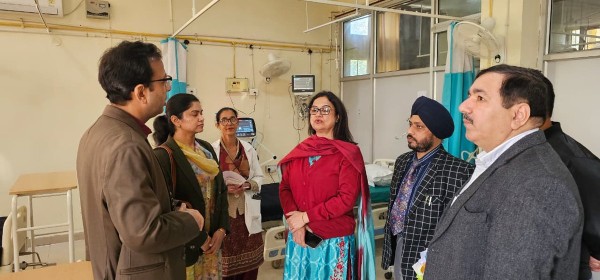
Director Health and Family Welfare Punjab Dr. Hitinder Kaur inspects health facility. (Image DHS Punjab)
 By Dr. JUGRAJ SINGH
Punjab faces a growing burden of lifestyle diseases, high out-of-pocket healthcare costs, uneven distribution of doctors and hospital beds, rural healthcare gaps and a continuing medical brain drain.
Punjab has a healthcare crisis which encompasses burden of disease, affordability and economic factors, disparity in healthcare provision and services and an unwillingness to improve healthcare in Punjab by most Punjabi NRI doctors and medical professionals. Punjab has a high burden of disease due to lifestyle diseases such as obesity, hypertension and diabetes as well as other illnesses such as cancer, respiratory diseases and mental illnesses.
The National Family Health Survey 2023-24 (NFHS-6) conducted by the Union Ministry of Health and Family Welfare has found that 48.5 per cent of men and 41.9 per cent of women aged 15-49 in Chandigarh are overweight or obese. Chandigarh’s adult male overweight/obese population is nearly double the national male average of 27.3 per cent. One in six Chandigarh adults has high or very high blood sugar levels and over 15 per cent of adult women are hypertensive.
The economic cost of lifestyle diseases is very high. Data from the NFHS-6 has found that although health insurance coverage has improved to 42.8 per cent of households, most policies do not adequately cover long-term chronic disease management. Approximately 60% of healthcare expenditures in Punjab are out-of-pocket, and this makes healthcare services inaccessible to many people, especially in rural areas. This financial burden on individuals leads to delayed or foregone medical care, exacerbating health disparities (Berman et al., 2010).
Punjab has one of the highest rates of diabetes in India, specifically in people over the age of 40 (Tripathy et al., 2017). Environmental factors, such as crop burning and industrial and vehicular pollution, are causing increased hospitalizations and deaths from conditions such as asthma and chronic obstructive pulmonary disease (COPD) (Chowdhury et al., 2019). Studies show that exposure to pesticides in agriculture has resulted in high incidences of cancers, particularly among rural populations who are directly exposed to these chemicals (Thakur et al., 2008). Mental health crisis with anxiety, depression, and substance abuse becoming very common amongst the youth. Mental health infrastructure is inadequate, particularly in rural regions, where access to trained mental health professionals is limited (Sagar et al., 2020).
Maternal and child health have serious challenges in Punjab, with high rates of malnutrition and gestational diabetes reported. Approximately 28% of children under five years of age are stunted, indicating insufficient nutrition in early childhood (NFHS-5, 2021). The prevalence of gestational diabetes among pregnant women in Punjab is very high, with figures reaching 18% (Anjana et al., 2017).
Although Punjab has a doctor to population ratio of 1.05 to 1,000 people, which is slightly better than the World Health Organization benchmark of 1 doctor per 1,000 people, disparity in patient care and hospital bed availability remain and maintaining and improving the doctor to patient ratio is difficult.
Data from the 2022 Economic Survey revealed disparity in healthcare services provision despite improvement in access to healthcare and and healthcare infrastructure. Population served per medical institution increased from 7,916 in 2020 to 8,144 in 2021, and population served per bed increased from 1,595 in 2020 to 1,636 in 2021. Population served per doctor has improved: on average, one doctor served 957 patients in 2021 against 988 patients per doctor in 2020. The nurse-to-patient ratio has slightly worsened from one nurse serving 347 patients in 2020 to 354 in 2021.
One health facility currently serves a 2.68 km radius, on average. But the problem is that some health facilities serve a much larger population than other health facilities. A health facility in Nawanshahr serves 5,189 people, but a similar health facility in Mohali serves more than double the patients at 11,684. In Faridkot, 848 patients are served per bed, whereas in Ludhiana there are nearly four times more patients with the bed to patient ratio being 1 bed per 3,143 patients! As per international standards, the hospital bed to population ratio should be 3:1,000 (1 bed for 333 patients).
The disparity in healthcare services and availability of doctors and nurses in different districts – One doctor in Faridkot serves less than 500 patients, whereas one doctor in Tarn Taran serves over 9,700 patients! Similiarly, one nurse serves 626 patients in Patiala, while one nurse in Pathankot serves over 5,000 patients.
Most people of Punjab have little faith in Primary health centres, Community health centres, District hospitals and state medical colleges. Analysis by The Tribune newspaper has found three main reasons for this:
A) lack of adequate staff and manpower;
(B) lack of infrastructure facilities, including routine, high-end investigation facilities, essential drugs and consumables and
(C) lack of course, desired work and service culture.
It takes 5.5 years to complete an MBBS, two to three years to complete a postgraduate (PG) residency for MD and MS, and three years to complete a super specialization program such as DM or MCH. Therefore, it will take a student 5.5 years to obtain a license to practice medicine and a total of between 7.5 years to 11.5 years to become either a medical postgraduate or a super specialist, respectively.
One solution to increase doctors has been to increase the number of MBBS seats and PG seats in existing medical colleges or by establishing new medical colleges. The problem which continues to reduce the number of doctors available in Punjab and India is brain drain by the west. According to the Journal of Pioneering Medical Sciences, roughly one-third of fresh medical graduates consider leaving India annually, with top destinations being the US, UK, Canada, and Australia.
60,000 to 75,000 Indian-trained physicians practice in Western countries: According to data from Medscape, over 59,000 Indian-origin physicians practice in the US. One in every five (22%) immigrant doctors in the US is from India, comprising nearly 5% of the total active US physician workforce. In the UK, more than 10.9% of doctors have Indian qualifications. Canada has between 3,900 and 10,000 doctors who were trained in India. Australia attracts 36.7% of migrating Indian doctors.
Punjabis suffer from a colonized mentality and that mentality affects healthcare in Punjab: the elite and bureaucracy are out of touch with the problems and suffering of ordinary people
Punjab’s healthcare crisis can be addressed by improving the distribution of healthcare facilities, doctors and nurses, and beds to districts based upon their population size and needs. A healthcare system which focuses on prevention, affordability, and improving disease burden is needed. Values such as compassion, empathy and selflessness should be inculcated in all Punjabis, especially NRI doctors and medical professionals, so that they have a desire to spend time in Punjab and help improve the healthcare system.
(This is an opinion piece. Views expressed are the author’s own. Dr Jugraj Singh, MD, MHA, is currently working with U.S. Government remotely in Healthcare Administration.)
Follow The Raisina Hills on WhatsApp, Instagram, YouTube, Facebook, and LinkedIn




About The Author