Whose “Zionist majority”? Netanyahu’s phrase, and the arithmetic behind it
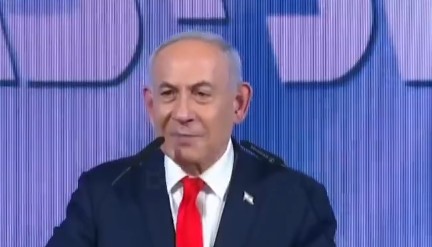
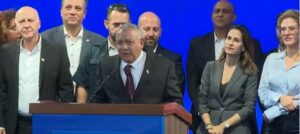
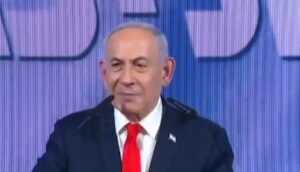
Netanyahu says a “Zionist majority” backs the right. Eisenkot says the same of his side. (Image: Video grab)
By TRH World Desk
Israeli President Isaac Herzog will name the candidate with the best chance of forming a government, not necessarily the leader of the largest party. The official count, which could differ from the exit polls, will decide whether anyone has a path.
New Delhi, October 28, 2026 — In his early-morning speech, Benjamin Netanyahu skipped the word “victory” and reached for a different one: majority. Netanyahu portrayed the exit polls as a win because Likud outperformed its projections and because the opposition lacks what he calls a “Zionist majority.” The phrase is carrying more weight than the numbers can bear.
Netanyahu spoke after 3 am. The speech was short by his standards, that he did not directly claim victory and that he said, “The Jewish and Zionist majority must unite.” He said the right-wing bloc has a decisive majority among the Zionist and Jewish public. He also warned against a government dependent on Arab parties.
Strip out the Arab parties and the Jewish-led blocs split about evenly. On Channel 12’s revised exit poll, Netanyahu’s bloc has 52 seats and Eisenkot’s 49, which is about 51.5 per cent of the 101 Jewish-party seats. Kan 11 showed the two blocs tied at 51 each. That is a slim edge at best, not a “clear, decisive” one, and it rests on exit polls that have been revised several times. The ultra-Orthodox parties in Netanyahu’s bloc describe themselves as non-Zionist.
Eisenkot hailed the polls as a “victory for Israel’s responsible Zionist majority,” which he said had voted no confidence in Netanyahu and the October 7 government. In effect, each camp is telling the same story: the real Zionist majority is on our side.
Why the framing matters
– Legitimacy: A majority of 61 seats governs, however it is composed. Calling one coalition “Zionist” and another illegitimate tries to rule certain partners out before talks begin.
– The Arab parties: They are projected to win a record 18 or 19 seats, and they oppose Netanyahu, so they sit at the centre of the arithmetic. Eisenkot’s side cannot reach 61 without them unless leaders break campaign promises.
– Likud’s gains: Analyst Ran Porat said Netanyahu “cannibalised his own bloc,” winning strength at the expense of partners he needs.
President Isaac Herzog will name the candidate with the best chance of forming a government, not necessarily the leader of the largest party. The official count, which could differ from the exit polls, will decide whether anyone has a path.
Israel’s election night: a late Likud surge narrows the gap, but nobody has 61
Follow The Raisina Hills on WhatsApp, Instagram, YouTube, Facebook, and LinkedIn




About The Author