Nagaland’s prohibition story returns amid 19 deaths linked to spurious liquor
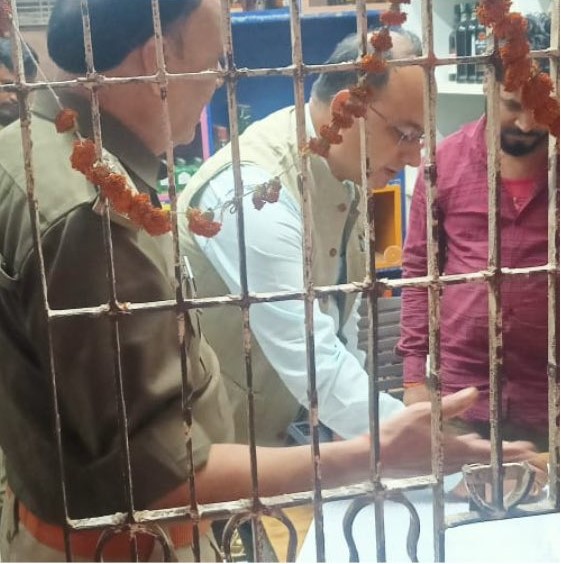
UP Excise Department inspects liquor shop in Jaunpur Image credit X.com @upexcise
By NIRENDRA DEV
Nineteen deaths allegedly linked to spurious liquor in Nagaland have brought fresh attention to the state’s three-decade-old prohibition experiment.
Kohima, September 27, 2026 — At least 19 people have died in Nagaland over the past two days after allegedly consuming spurious liquor. Mokokchung district reported eight deaths, while Tuensang district reported 11 other casualties following the consumption of suspected illicit liquor.
The Nagaland Police have constituted a Special Investigation Team (SIT) to investigate the deaths and trace the supply chain of the suspected adulterated liquor.
The tragedy brings back memories of Nagaland’s long and complicated experiment with prohibition — a story that I had reported from Nagaland more than three decades ago.
In August 1990, when Mumbai was still widely known as Bombay, Mid-Day carried my first feature story outside Nagaland. The headline was not mine, but I had virtually fallen in love with it: “Nagaland goes dry amid cacophony.”
At that time, I was simply Nirendra of Nagaland — not even “ND”, as I later came to be known at PTI after moving to New Delhi in 1998.
Those were different days. Journalism was not about celebrity. My father would sometimes lament that his eldest son was simply wasting time. Time, however, has its own way of turning around.
Years later, I landed in Mumbai. The city had changed, Mid-Day had changed, and the brown-and-black tabloid had become a coloured publication.
Now, amid reports of 19 deaths allegedly linked to spurious liquor in Nagaland, that old headline returns to memory.
“Nagaland goes dry amid cacophony.”
The Nagaland Liquor Total Prohibition Act was enacted in 1989 and prohibition came into force in 1990. The move followed sustained pressure from church organisations and civil society groups, including the Nagaland Baptist Church Council (NBCC) and the Naga Mothers’ Association.
But the decades that followed produced a complicated picture.
Several Naga politicians, including some who had supported the legislation, later argued that prohibition had failed to achieve its intended objectives. One former minister told me in 2016 that the law had helped bootleggers operating from neighbouring Assam while depriving Nagaland of substantial revenue.
The experience of other northeastern states also became part of the debate.
Mizoram introduced prohibition and eventually repealed it in 2014 after 18 years. Aizawl-based commentator Vanlalruata famously described Mizoram as “the wettest dry state in the country” while discussing the consequences of prohibition.
Manipur introduced prohibition in 1991, although its implementation and scope evolved over the years. Questions were subsequently raised about bootlegging, revenue losses and the availability of illicit liquor.
The prohibition debate has also surfaced repeatedly elsewhere in India.
Bihar introduced prohibition under Chief Minister Nitish Kumar in 2016. Haryana imposed prohibition in 1996 but withdrew it in 1998. Rajasthan experimented with prohibition during 1977-79. Tamil Nadu has had several periods of prohibition, including the lifting of a long-standing ban in 1971 and another brief period beginning in 1974.
The former Bombay State also experimented with prohibition. The state imposed it from 1948 to 1950 and again from 1958 to 1960. After Maharashtra and Gujarat were created in 1960, prohibition remained a defining feature of Gujarat, while Maharashtra retained it in selected districts.
In Nagaland, the roots of the prohibition movement go back to 1988, when Hokishe Sema was Chief Minister. A major rally organised by the NBCC youth wing became an important moment in the campaign. In March 1989, another large rally was held in the state capital, where an effigy of a wine bottle was burnt.
The demand was eventually translated into legislation.
More than three decades later, the deaths allegedly caused by spurious liquor raise the same underlying question in a different form: what happens when a legal prohibition coexists with an illicit market?
The immediate responsibility now lies with the investigators to establish how the suspected adulterated liquor reached consumers, who supplied it and whether failures in enforcement contributed to the deaths.
For me, however, the news also carries a deeply personal echo.
A story written in Mumbai in 1990 about a dry Nagaland has unexpectedly returned to the headlines decades later.
Somewhere in life, every story has another story waiting to be told.
Dil ki baat, or mann ki? Perhaps both.
Follow The Raisina Hills on WhatsApp, Instagram, YouTube, Facebook, and LinkedIn




About The Author