Modi at SRCC: What His 2013 Speech Reveals About the Changing Face of Indian Journalism
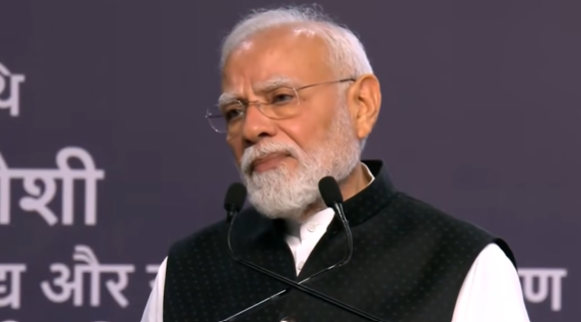
Prime Minister Narendra Modi at SRCC College spoke of Naraz Fufa. (Image video grab BJP on X)
By NIRENDRA DEV
Prime Minister Narendra Modi’s return to SRCC has revived memories of his landmark 2013 speech—and prompted a wider debate over newsroom culture, political loyalties and journalistic independence.
New Delhi, September 9, 2026 — Prime Minister Narendra Modi’s visit to Shri Ram College of Commerce (SRCC) in Delhi and his reference to his 2013 address at the same venue brought back memories of a very different political and media landscape.
Politics and political speeches are made, covered and sometimes “uncovered”. But there is another question worth asking: What happened to the journalism of that era, and when did the working atmosphere in some newsrooms become toxic?
Modi delivered an impressive speech at SRCC and recalled the impact of his 2013 address.
“Especially people are remembering my 2013 address (at the same venue). People have listened to it again, read it again. It is possible that the new generation has also revisited it. That speech, I can say, became a wave, a movement. And even today, 13–14 years later, the impact of that gathering, that address, remains,” the Prime Minister said.
As a writer of this piece, I want to revisit that period and debate what I believe was the beginning of a process of decline in sections of Indian journalism.
Modi had arrived in Delhi after winning his third consecutive election in Gujarat in December 2012. At the time, he was still the chief minister of Gujarat, and a major political debate was underway over whether the BJP should project him as its prime ministerial candidate for the 2014 Lok Sabha elections.
Within the BJP, L.K. Advani and some senior leaders, including the late Sushma Swaraj, were opposed to such a move. Nitish Kumar was also an influential NDA leader and, despite efforts by Arun Jaitley to persuade him to support Modi, the Bihar chief minister had made his reservations clear.
Against that backdrop, Modi’s SRCC speech had an extraordinary political impact.
The 2013 Media Debate
The next day, The Hindu did not give Modi’s speech the prominence that some expected. Its story focussed on a lathi charge and clashes involving Left-leaning students who had gathered near the college campus and raised slogans against Modi.
The editorial decision triggered considerable discussion at the time.
The then-editor, Siddharth Varadarajan, defended the decision on social media, arguing that the publication should not simply follow what he described as the media herd. The newspaper’s position was that several other stories on the front page were more newsworthy than a speech by a chief minister at a Delhi college.
The argument was essentially this: a chief minister visiting Delhi and addressing college students was not, by itself, sufficient reason to make the speech a front-page lead.
That is a legitimate editorial argument.
But journalism is also about recognising political significance before history confirms it.
The question, therefore, is not merely whether Modi’s speech deserved Page 1 treatment. It is whether sections of the media had already begun viewing Modi through a political lens that influenced editorial judgement.
Another publication, the Mumbai-based Mid-Day, also chose not to put Modi’s speech on its front page.
Its then-editor, Sachin Kalbag, explained the decision in comments to Firstpost, arguing that putting Modi on Page 1 would have required assumptions that he would become the NDA’s prime ministerial candidate and subsequently become prime minister.
His argument was that chief ministers make speeches regularly and that the newspaper did not ordinarily give such speeches front-page treatment.
Again, this was an editorial choice.
But history subsequently gave that 2013 speech a significance that few could ignore.
India’s 7.8% GDP Growth Sparks a Bigger Question: Where Are the Jobs?
My Own Experience
I was working with The Statesman at the time.
After Modi’s speech, I went to the newspaper’s city office on Barakhamba Road and filed a report. I do not remember every detail of the context now, but I recall mentioning Dr. Murli Manohar Joshi in the copy. Further down the page, I had referred to him simply as “Joshi”.
When the copy reached Resident Editor Usha Mahadevan, she objected strongly.
She called me and asked, in substance, which Joshi I was referring to and told me that I should have made the reference clearer.
I was surprised because she had generally been one of the fine senior colleagues I had worked with.
At the time, however, I felt that the newsroom environment was changing. I believed that some colleagues’ political preferences were beginning to influence the atmosphere and, in some cases, editorial discussions.
One colleague in particular was perceived by several of us as being strongly aligned with senior Congress leaders. His political preferences were often visible in his work, or at least that was how some of us interpreted them.
I remember occasions when political affiliations appeared to influence newsroom debates.
I also remember stories that, in my view, were treated differently depending on the political figure involved.
When Ram Vilas Paswan criticised Ahmed Patel in 2009 over the alliance setback involving the Lok Janshakti Party and the Congress, a story I filed on the issue was not published.
Similarly, stories involving criticism of Rahul Gandhi were, on occasions, subjected to editorial scrutiny that I believed was excessive.
These are my recollections of that period. They are important not because every editorial decision necessarily reflected political bias, but because they demonstrate how journalists themselves began to perceive the changing newsroom environment.
A Prediction That Came True
One colleague, now working in Himachal Pradesh, once asked me why I looked so angry.
Perhaps my face gave away my frustration.
I remember saying that Modi’s SRCC speech had been politically significant and that it appeared to have unsettled sections of what I regarded at the time as an excessively ideological media ecosystem.
I also made a prediction: If Modi became prime minister, I would eventually have to leave the newspaper.
It turned out to be prophetic.
In the final week of November 2015, I was almost compelled to put in my papers.
By then, what I had experienced as a growing sense of toxicity had reached another level.
Saturday meetings sometimes resembled political war rooms. Editorial disagreements were increasingly coloured by political perceptions. And some of us found it difficult to accept lectures on journalistic ethics from colleagues whose own political preferences appeared, at least to us, to be reflected repeatedly in their work.
Gradually, several journalists left.
Was This the Beginning of the Problem?
Whenever the debate over Indian journalism arises today, the conversation often begins with the Narendra Modi government.
Critics argue that the Modi era has damaged media freedom and created pressure on journalists.
There are legitimate questions to be asked about media ownership, government pressure, corporate influence and the independence of journalism.
But there is another side of the story.
Political polarisation in Indian journalism did not begin in 2014.
Sections of the media had their own ideological preferences long before Modi became prime minister.
There were journalists who openly admired Congress leaders. There were others who were deeply sympathetic to regional political leaders. There were also journalists who viewed Modi with hostility from the beginning.
None of this means that every journalist belonging to a particular political persuasion was biased.
Nor does it justify the excesses of the present-day television ecosystem, where partisan journalism can sometimes become indistinguishable from political campaigning.
But intellectual honesty requires us to acknowledge that the problem predates the Modi government.
‘Start Preparing for 2024 Polls’: What Modi Told a Manipur Student in 2014
The Politics of the Newsroom
There were also political figures who enjoyed considerable goodwill among sections of Delhi’s journalistic community.
Mamata Banerjee was one such figure among some anti-Modi journalists. Many saw her as a possible prime ministerial alternative.
Political fortunes, however, change quickly.
The electoral setbacks suffered by political leaders can also expose the limitations of a media ecosystem that becomes too emotionally invested in particular political outcomes.
This is where journalism needs distance.
A journalist’s job is not to ensure that a preferred politician wins.
It is not to ensure that a disliked politician loses.
It is to report, question, investigate and analyse.
The same principle applies to television anchors and commentators.
I am certainly not defending the excesses of pro-Modi television journalism. There has been plenty of partisan journalism on the other side as well.
The point is simply that political partisanship did not suddenly enter Indian journalism after 2014.
Journalism Needs a Mirror
Congress leader Jairam Ramesh also had a considerable following among sections of Delhi’s journalistic community because of his accessibility and engagement with reporters.
I covered him for a long period when he was rural development minister, although I never became part of his circle.
There were also controversies surrounding some of his remarks and statements, and some journalists objected strongly to them.
I remember one exchange in which, following a disagreement over a comment concerning temples and toilets, he asked me whether I was a Brahmin or belonged to an upper caste.
For me, the larger issue was not the personal exchange.
It was the uncomfortable intersection of politics, identity and journalism.
Journalists should be able to question politicians without being categorised according to their presumed social or political identities.
Likewise, politicians should be able to face criticism without assuming that every critical journalist belongs to an opposing ideological camp.
The Question We Should Be Asking
The media landscape has changed dramatically since 2013.
Social media has fragmented audiences. Television has become increasingly polarised. Digital platforms have weakened the traditional gatekeeping power of newspapers. Political communication has become faster, more direct and more aggressive.
Yet the fundamental responsibility of journalism remains unchanged.
Independence is not the same as opposition to the government.
Professionalism is not the same as loyalty to the government.
And journalistic objectivity does not require journalists to abandon their personal beliefs; it requires them not to allow those beliefs to determine what becomes news and how it is presented.
Modi’s return to SRCC therefore offers an opportunity to look beyond the speech itself.
The real question is not whether one newspaper covered the 2013 address adequately or whether another ignored it.
The real question is whether Indian journalism gradually lost the ability to separate political preference from professional judgement.
And if it did, when did that happen—and who allowed newsroom culture to become toxic?
Oscar Wilde is often credited with the line: “Journalism is unreadable, and literature is not read.”
Perhaps the more relevant challenge today is different.
Journalism must remain readable, credible and independent—even when the journalist dislikes the politician being covered.
That is the real test.
(This is a personal opinion of the writer. Views expressed are his own.)
PM Modi at SRCC: From 2013 ‘Half-Full Glass’ to India’s Growth Story
Follow The Raisina Hills on WhatsApp, Instagram, YouTube, Facebook, and LinkedIn




About The Author