Modi’s Indonesia Visit: India Expands Indo-Pacific Playbook
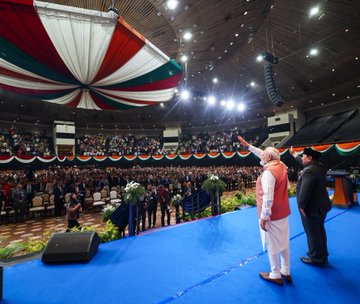
PM Narendra Modi with Indonesian President Prabowo Subianto, at a community programme in Jakarta. (Image Modi on X)
By TRH World Desk
Modi’s Indonesia Visit Signals India’s Indo-Pacific Reset with Defence, Trade and Strategic Depth
New Delhi, July 7, 2026 — Prime Minister Narendra Modi’s state visit to Indonesia is more than another diplomatic engagement with an ASEAN partner. The joint statement released after his talks with Indonesian President Prabowo Subianto suggests New Delhi is pursuing a broader Indo-Pacific strategy that blends security, supply chains, technology and economic integration rather than relying solely on military partnerships.
The timing is significant. As geopolitical competition intensifies across the Indo-Pacific, India is seeking stronger partnerships with countries that occupy critical maritime locations. Indonesia, which straddles vital sea lanes connecting the Indian and Pacific Oceans, has become central to that vision.
Unlike earlier bilateral declarations that largely emphasized goodwill, the latest roadmap is unusually operational. It expands defence cooperation to include joint production, technology transfer, shipbuilding, maintenance facilities and collaboration on advanced defence systems. The explicit reference to cooperation on the BrahMos missile system reflects the growing strategic trust between the two countries and India’s ambition to emerge as a credible defence exporter.
Equally important is the maritime dimension. India and Indonesia agreed to deepen cooperation on maritime domain awareness, coastal surveillance, search and rescue, hydrography and the Information Fusion Centre-Indian Ocean Region. These initiatives strengthen India’s role in safeguarding sea lanes that carry much of the world’s trade while reinforcing a rules-based Indo-Pacific without directly naming China.
The economic agenda is equally revealing. The two countries are moving beyond conventional trade by focusing on critical minerals, rare earths, steel supply chains and local currency settlement. These initiatives align with India’s efforts to reduce dependence on concentrated global supply chains while supporting its manufacturing ambitions under Viksit Bharat 2047.
Another noteworthy development is Indonesia’s interest in partnering with India on the development of Sabang Port near the Andaman Sea. If implemented effectively, the project could strengthen connectivity between India’s Andaman and Nicobar Islands and Indonesia’s Sumatra region, creating strategic and commercial advantages across the eastern Indian Ocean.
The partnership also extends into emerging technologies. Cooperation on digital payments, telecommunications, artificial intelligence, cyber security, space, green hydrogen and disaster resilience reflects a relationship that is no longer confined to traditional diplomacy.
Perhaps the most consequential aspect of the visit is its geopolitical messaging. India and Indonesia reaffirmed support for ASEAN centrality, freedom of navigation under UNCLOS and reform of global institutions while backing each other’s roles in BRICS and other multilateral forums. Rather than forming exclusive blocs, New Delhi appears to be strengthening a network of strategic partnerships that collectively enhance its influence across the Indo-Pacific.
For India, the visit demonstrates that foreign policy is increasingly being driven by strategic geography, resilient supply chains and defence industrial cooperation. Indonesia is no longer merely a friendly neighbour across the Bay of Bengal—it is emerging as one of India’s most important Indo-Pacific partners.
Follow The Raisina Hills on WhatsApp, Instagram, YouTube, Facebook, and LinkedIn




About The Author