Trump Accounts Go Live: Inside the First $1,000 Deposits and What Comes Next
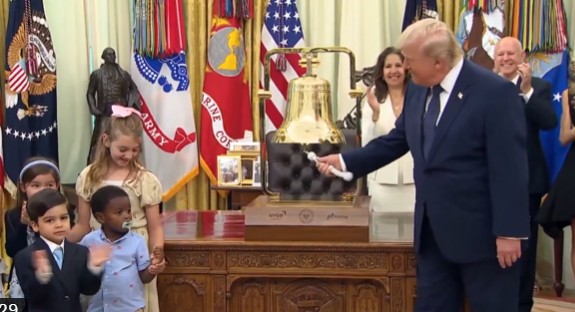
Trump rings the bells to launch the "Trump Account" (Image video grab)
By TRH World Desk
Trump says the government has deposited $1,000 into more than 500,000 “Trump Accounts” for newborns — with 1.4 million more eligible. Here’s how the program actually works, and what it’s really worth by 18.
New Delhi, July 7, 2026 — US President Donald Trump said Monday that the federal government had deposited the first $1,000 into more than 500,000 “Trump Accounts,” the newly launched program designed to give newborn Americans a stake in the stock market and help them build wealth from an early age. As CBS News reported, Trump made the announcement while ringing the opening bell from the White House Oval Office alongside executives of the New York Stock Exchange and Nasdaq, a joint appearance he framed as a rare instance of cooperation.
The president leaned into the symbolism of the moment. U.S. News quoted him telling the assembled crowd, “Those accounts will begin to grow along with our booming economy… We’re giving this money to children so they can have a good life.”
Fortune reported he struck a similar note at the event itself, framing the accounts as “absolutely incredible for children” and noting that the $1,000 seed deposits covering the initial batch of more than 500,000 accounts had gone out on July 4.
How the Program Actually Works
Trump Accounts were created under the tax and spending law Trump signed last year, commonly referred to as the “One Big Beautiful Bill.” According to NPR, Congress created the accounts as part of that law, and as of July 4, parents could open one either by filling out a tax form or by signing up directly on trumpaccounts.gov. The $1,000 federal seed deposit is available specifically to children born with a Social Security number during Trump’s second term — spanning 2025 through 2028.
Beyond the government’s initial contribution, the accounts are designed to accept more money over time. NPR reported that friends, family, employers, nonprofits, and state welfare agencies can all contribute to a child’s account as well, and that for now, most contributions are capped at $5,000 a year. Money in the accounts must be invested in broad-based U.S. stock index funds, and funds generally cannot be touched until the child turns 18.
The scale of enrollment appears to run well beyond the 500,000 figure Trump cited for completed deposits. Fortune’s reporting, drawing on a Treasury Department briefing ahead of the bell-ringing, noted that Treasury officials disclosed more than 6 million children have signed up for Trump Accounts since enrollment opened, with 1.4 million of them eligible for the $1,000 federal seed deposit — roughly $1.4 billion in government money already earmarked for the program.
That suggests Monday’s 500,000 figure represents an early wave of processed deposits rather than the full universe of eligible children, with more expected to follow as enrollment continues.
What Supporters and Sceptics Are Saying
The administration has pitched the program as a financial-literacy and long-term-wealth tool as much as a direct cash benefit. The Washington Post described the initiative as pairing a one-time $1,000 federal deposit for eligible babies with the opportunity for families and employers to contribute more over time.
Financial planners quoted by NPR offered a more measured read on the actual dollar impact. Indiana-based financial planner Michael Reynolds ran the numbers for the outlet and found that an 8% annual rate of return over 18 years would grow the initial $1,000 deposit to just shy of $4,000 by the time a child reaches adulthood — a meaningful head start, but not the kind of transformative sum that debates over “generational wealth” sometimes imply.
NPR also noted the tax treatment isn’t as favourable as some alternatives: unlike 529 college savings plans, which allow qualified withdrawals tax-free, growth inside a Trump Account is taxed as ordinary income upon withdrawal.
Timing is the Key in Trumpism
The timing of the rollout is notable. The Detroit News, citing Reuters, connected the announcement to the broader economic backdrop, noting that the rising cost of living has become a major issue for voters heading into the November midterm elections.
That gives the Trump Accounts launch a political dimension beyond its policy mechanics — it’s both a savings vehicle and a messaging opportunity for an administration eager to point to a tangible, dollar-figure benefit for American families ahead of the midterms.
Private-sector buy-in has also become part of the story.
Fortune’s coverage of the launch event noted commitments from corporate and philanthropic donors, including a pledge from Michael and Susan Dell to help fund additional deposits for lower-income children who don’t qualify for the federal seed money, alongside participation from companies including Visa, Dell, Comcast, and chipmaker Micron.
Follow The Raisina Hills on WhatsApp, Instagram, YouTube, Facebook, and LinkedIn




About The Author