From ‘Aam Aadmi’ to Lutyens: Kejriwal’s Politics of Convenience
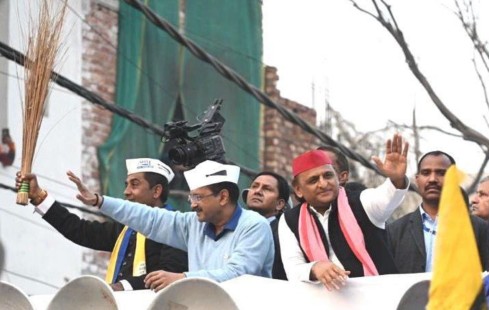
AAP leader Arvind Kejriwal with former UP CM Akhilesh Yadav Image credit X.com
Arvind Kejriwal’s bungalow shift exposes the widening gap between anti-VIP rhetoric and political reality
By AMIT KUMAR
New Delhi, April 25, 2026 — There was a time when Arvind Kejriwal symbolised disruption — a political outsider who promised to dismantle the entrenched culture of privilege in Indian politics. He spoke of modest living, rejected the trappings of power, and took direct aim at what he described as the excesses of the political class.
Today, that narrative sits uneasily with reality.
Kejriwal’s move into a Type-VII bungalow in Lutyens’ Delhi is not just a change of address; it is a powerful symbol of political transformation — or, critics would argue, political convenience. The man who once said a small apartment would suffice now occupies one of the most prestigious government residences in the capital, enabled by legal entitlement and institutional norms.
To be clear, there is nothing illegal about the allotment. The Delhi High Court ensured due process was followed. By the rulebook, Kejriwal is well within his rights.
But politics is rarely judged by legality alone.
The discomfort arises from memory — of speeches that mocked VIP culture, of pointed criticism directed at Sheila Dikshit’s residence, and of a carefully crafted “aam aadmi” image that drew moral strength from simplicity. That image had already taken a hit during the “Sheesh Mahal” controversy, when his Civil Lines residence became synonymous with alleged extravagance.
This latest move deepens that perception: that the anti-establishment crusader has, over time, adapted seamlessly into the very system he once opposed.
Supporters argue this is maturity, not hypocrisy — that governance demands security, infrastructure, and institutional support. They see it as a natural evolution from activism to administration.
Yet, such arguments miss a crucial point. Kejriwal’s political capital was built not merely on governance, but on moral contrast. He did not just promise better administration; he promised to be different.
That difference is now harder to locate.
In Indian politics, this is hardly an isolated story. Idealism often fades as leaders confront the machinery of power. But for those who rise on the promise of breaking the system, the cost of blending into it is far steeper.
Kejriwal’s bungalow, therefore, is more than a residence. It is a metaphor — for the distance travelled from protest to power, and for the uncomfortable truth that in politics, convenience often outlives conviction.
(This is an opinion piece. Views expressed are the author’s own.)
Follow The Raisina Hills on WhatsApp, Instagram, YouTube, Facebook, and LinkedIn




About The Author