Odisha’s Coalition Politics: From Instability to BJP’s Breakthrough
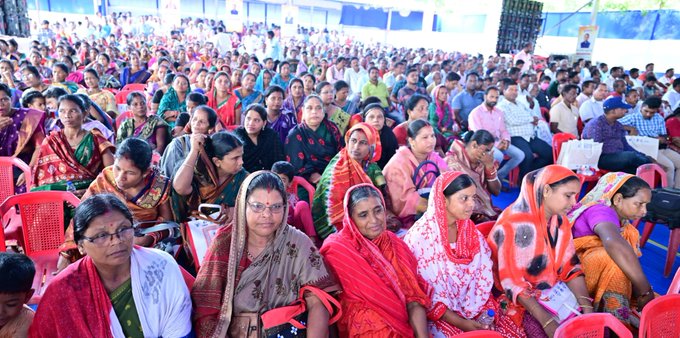
A PM Kisan Nidhi Samman scheme was held in Odisha on Saturday! (Image credit CMO Odisha, X)
From Congress dominance to BJD’s long rule and BJP’s rise, Odisha’s political journey reflects the limits of coalition experiments
By PRADEEP KUMAR PANDA
Bhubaneswar, April 25, 2026 — Odisha’s post-independence political landscape has been marked by frequent experiments with coalition governments and the emergence of regional parties, driven by anti-Congress sentiments, sub-regional imbalances (coastal vs. western/tribal areas), caste dynamics, and leadership splits.
Despite early promise, most coalitions proved unstable, collapsing due to ideological incompatibilities, personal rivalries, and power-sharing disputes. Regional parties like the Ganatantra Parishad (GP), Swatantra Party, Utkal Congress, Jana Congress, and later the Biju Janata Dal (BJD) articulated state-specific grievances but largely failed to sustain long-term dominance or deliver stable governance, except for the BJD’s 24-year rule (2000–2024).
The 2024 assembly elections, which ended BJD’s reign and brought the BJP to power with a clear majority, underscore the broader pattern: coalition politics has often led to instability rather than consolidation, while regional parties have struggled against the organizational strength and resource advantages of national parties.
Early Post-Independence Phase: Congress Dominance and Initial Coalitions (1952–1960s)
The first Odisha Legislative Assembly election in 1952 (140 seats) saw the Indian National Congress (INC) secure 67 seats but fall short of a majority. It formed a minority government under Nabakrushna Choudhury with support from independents. The Ganatantra Parishad (GP), a regional party backed by former princes and zamindars representing feudal and tribal interests, emerged as the main opposition with 31 seats.
Subsequent elections (1957) again produced no absolute majority for Congress (56 seats), with GP gaining strength (51 seats). Coalitions were inevitable but fragile. The 1961 election gave Congress a clear majority (82 seats) under Biju Patnaik, temporarily ending coalition experiments. However, factionalism within Congress led to further splits.
In 1967, a non-Congress coalition formed with the Swatantra Party (49 seats) and Orissa Jana Congress (26 seats) under Rajendra Narayan Singh Deo. This government highlighted regional aspirations against centralized Congress rule but collapsed amid internal differences. Similar short-lived alliances in the late 1960s and early 1970s, involving Utkal Congress (formed by Biju Patnaik after leaving INC in 1969, winning 33 seats in 1971), Swatantra, and Jana Congress, reflected anti-Congress unity but suffered from ideological mismatches—feudal/regional vs. socialist leanings—and personal ambitions.
Key Failure Factors: Lack of a unifying ideology, dependence on independents or defectors, and Congress’s ability to exploit divisions through central intervention or co-option.
The 1970s–1990s: Persistent Instability and Fragmented Regionalism
The 1970s witnessed continued hung assemblies and coalition experiments. The Utkal Congress-Jana Congress-Swatantra alliances challenged Congress but rarely lasted full terms. Political instability was rampant: chief ministers changed frequently, with groupism and in-fighting as principal causes. Congress regained strength in 1980 and 1985 with clear or near-majorities under Janaki Ballabh Patnaik, but anti-incumbency revived non-Congress forces.
The Janata Dal wave in 1990 brought Biju Patnaik back, but the party splintered nationally. Regional outfits like the GP (later evolving into elements of Swatantra) and others faded due to absorption into larger fronts or loss of distinct appeal. By the mid-1990s, no single regional party could dominate without alliances, leading to short-lived coalitions marked by incompatibility.
Except for a few elections (1961, 1977, 1980, 1985, 1995), absolute majorities were rare, making coalitions the norm—but rarely stable.
The BJD Era: Partial Success and Eventual Decline (1997–2024)
The formation of the Biju Janata Dal (BJD) in 1997 by Naveen Patnaik, leveraging his father Biju Patnaik’s legacy of Odia pride and development focus, marked a turning point. BJD allied with the BJP (NDA) from 1998–2009, winning assembly elections in 2000 and 2004 through this coalition. It provided relative stability and governance focused on disaster management, welfare, and infrastructure.
In 2009, BJD broke the alliance over seat-sharing disputes and issues like the Kandhamal riots, adopting an “equidistance” strategy from both national parties (BJP and Congress). This allowed BJD to rule alone for multiple terms (2009, 2014, 2019), winning clear majorities and becoming Odisha’s most successful regional party. It projected Odia sub-nationalism, efficient administration, and state-centric policies while supporting national governments issue-wise.
However, cracks appeared: over-reliance on bureaucracy (e.g., V.K. Pandian in later years), allegations of dynastic control, neglect of sub-regional imbalances, and failure to build deep organizational roots beyond Naveen’s personal appeal. The 2024 elections saw BJD’s dramatic collapse—it won zero Lok Sabha seats and only around 51 assembly seats, while the BJP secured a majority (81 seats) on its own.
The attempted BJD-BJP pre-poll alliance in 2024 failed over seat-sharing disagreements (BJD wanted dominance in assembly; BJP sought more Lok Sabha seats), highlighting recurring coalition pitfalls even for a mature regional player.
Biju Babu at 110: Architect of Odisha and Toast of Three Nations
Structural Reasons for Failure of Coalitions and Regional Parties
Ideological Incompatibilities and Personal Rivalries: Early coalitions (Swatantra + Jana Congress + Utkal Congress) mixed feudal/regional interests with socialist or anti-Congress elements, leading to quick breakdowns. Power-sharing disputes repeatedly derailed alliances.
Sub-Regional Fragmentation: Odisha’s geography—coastal (developed, Odia-centric) vs. western/tribal (backward, resource-rich)—fostered fragmented voting. Regional parties often appealed to specific pockets (e.g., GP to princely areas) but failed to build statewide cohesion.
Dependence on National Parties: Most successful “regional” phases involved alliances with national fronts (e.g., BJD-BJP). Purely independent regional efforts lacked resources, cadre depth, and central patronage.
Organizational Weaknesses: Many regional outfits were personality-driven (Biju Patnaik, Harekrushna Mahatab, Naveen Patnaik) rather than institutionally robust. Splits from Congress (Utkal Congress, Jana Congress) carried factional baggage.
National Parties’ Resilience: Congress dominated early due to freedom struggle legacy and central support. The BJP, with its organizational machinery, Hindutva appeal blended with regional pride, and central resources, gradually expanded, overtaking BJD by 2024. It effectively co-opted regional sentiments without ceding control.
Electoral Arithmetic and Anti-Incumbency: Hung assemblies forced coalitions, but voters often punished instability. Long regional rule (BJD) bred complacency, enabling national parties to capitalize on change.
Broader Indian Context: Unlike Tamil Nadu or West Bengal, where regional parties developed strong Dravidian or linguistic identities, Odisha’s regionalism remained moderate, allowing national parties to adapt and absorb local aspirations.
Broader Implications
The “failure” is relative: coalitions prevented outright one-party dominance in many periods and forced attention to regional issues. However, they contributed to political uncertainty, policy paralysis, and slower development in a state already facing poverty, natural disasters, and tribal marginalization. The BJD‘s long rule demonstrated that a disciplined regional party with charismatic leadership and pragmatic equidistance can succeed temporarily, but even it succumbed when national forces consolidated.
The 2024 BJP victory signals a potential shift toward two-party (or bipolar) competition between national parties, reducing space for pure regionalism. Emerging talks of new regional outfits (possibly involving ex-BJD/Congress leaders) suggest the cycle may continue, but historical patterns indicate high risk of fragmentation.
Since independence, coalition politics in Odisha has largely been a story of instability rather than enduring federal experimentation. Regional parties rose on legitimate grievances—underdevelopment, cultural pride, and opposition to centralized rule—but repeatedly faltered due to internal divisions, weak structures, and the superior adaptability of national parties.
The BJD represented the high-water mark of regional success, yet its 2024 defeat reinforces that in India’s evolving federal polity, sustained regional dominance requires more than charisma or equidistance—it demands deep-rooted organization and governance delivery that can withstand national winds. For Odisha, the challenge remains balancing state-specific aspirations with the realities of national political integration. Future stability may lie less in fragile coalitions and more in competitive bipolarity or reformed regional strategies.
Further research could examine quantitative vote-share trends, caste/tribal voting patterns, or comparative studies with other eastern states to deepen understanding of why Odisha’s regional experiments have been more transient than in southern or western India.
Biju Patnaik: Odisha Icon Reserved Women’s Power 27 Years Early
Follow The Raisina Hills on WhatsApp, Instagram, YouTube, Facebook, and LinkedIn




About The Author